November 24, 2026 · Guides
Repeat Loans and Renewals in Microfinance: Writing the Policy
A repeat loan is easy to sell and easy to get wrong. Offering a larger loan automatically because a borrower paid last time can push her into over-indebtedness.
A good repeat loan policy treats each renewal as a fresh credit decision, with step-up limits and pause rules.
In this guide
- What the policy should say
- A worked illustration
- When to pause renewals
- Rewarding good behaviour
- Related reading
- Where this comes from
- Metrics to watch
- Risks of automatic renewal
- A simple renewal process
- FAQs
What the policy should say
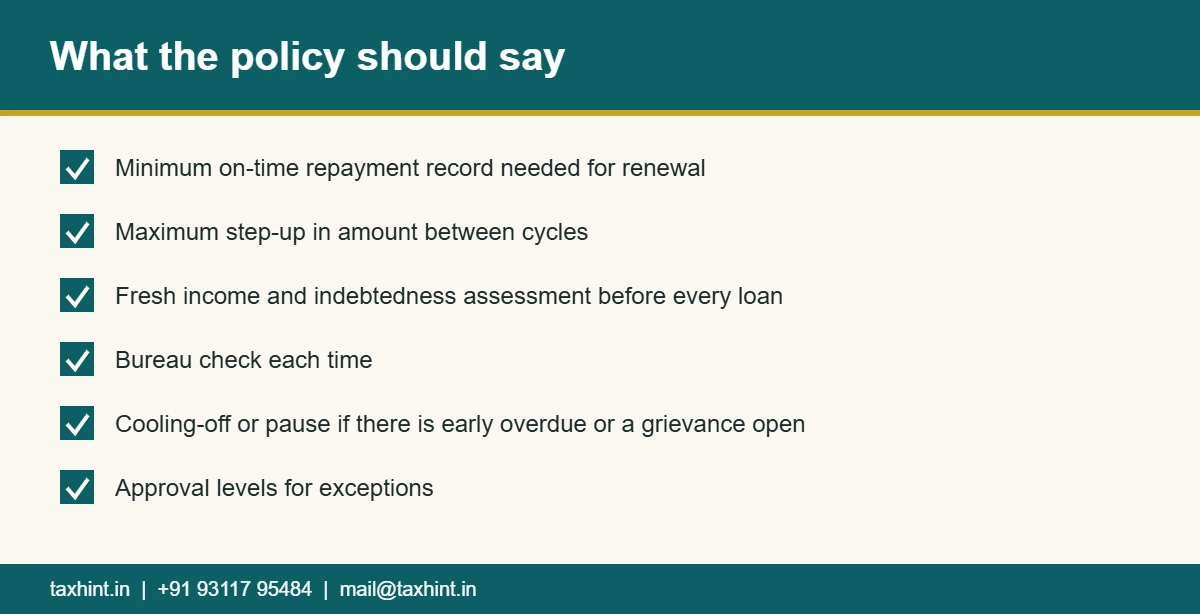
- Minimum on-time repayment record needed for renewal.
- Maximum step-up in amount between cycles.
- Fresh income and indebtedness assessment before every loan.
- Bureau check each time.
- Cooling-off or pause if there is early overdue or a grievance open.
- Approval levels for exceptions.
A worked illustration
This is illustrative, not a client case. A borrower repaid a ₹20,000 loan on time. Policy allows a step-up of up to 25 percent. A fresh appraisal shows her household income fell because her husband lost work, and the bureau shows a new loan from another lender. The officer offers ₹20,000 again, not ₹25,000, and records why. A second borrower with stable income and no new loans is offered ₹25,000, which is within the cap on total repayments set by RBI’s microfinance framework.
When to pause renewals
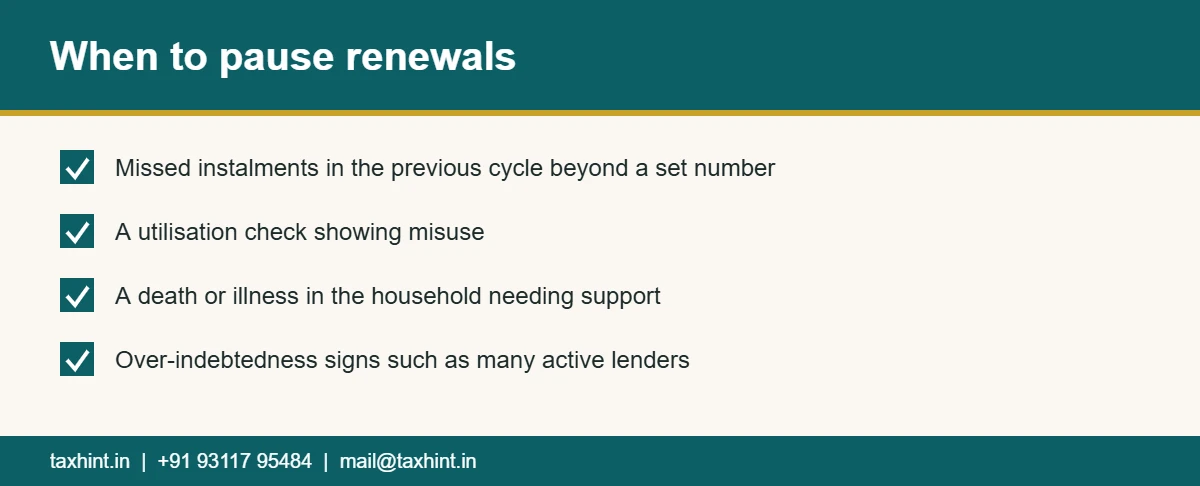
- Missed instalments in the previous cycle beyond a set number.
- A utilisation check showing misuse.
- A death or illness in the household needing support.
- Over-indebtedness signs such as many active lenders.
Rewarding good behaviour
Offer simple benefits for strong repayment: faster approval, priority for new products or small fee reductions. Avoid rewards that depend only on loan size.
Related reading
Read borrower selection and utilisation checks.
Where this comes from
Source: RBI (NBFC – Credit Facilities) Directions, 2025, microfinance chapter. RBI updates these Directions from time to time, so confirm the current text before acting.
Metrics to watch
- Share of repeat loans by cycle number.
- PAR of repeat loans compared with first-cycle loans.
- Average step-up and how many borrowers reach the cap.
- Drop-out rate between cycles and the reasons.
- Complaints from repeat borrowers.
Risks of automatic renewal
Automatic renewal can hide over-indebtedness. A borrower whose income fell, or who borrowed from three other lenders, may still look like a model client because she paid on time. That is why a fresh assessment and a bureau check are not optional. A repeat loan that ends in distress hurts the borrower first and the lender later.
A simple renewal process
- System lists borrowers who are within sixty days of closing.
- Officer visits and updates income, household changes and needs.
- Bureau report is pulled.
- System proposes a limit using policy rules.
- Approver confirms or reduces the amount.
- Disbursement follows the standard loan cycle; see loan cycle.
FAQs
Should every repeat loan be bigger?
No. The amount should follow capacity, not habit.
Do we need a new GRT for repeat loans?
Usually not, but refresh group understanding and check membership changes.
Can the system block risky renewals?
Yes. Rules for step-up limits, bureau flags and overdue can be set in the loan software.
Who approves exceptions?
A senior credit officer or committee, with a written reason.
What if a borrower asks for a smaller loan?
Honour it. Choosing a smaller amount is often a sign of good judgement, and the policy should allow it without penalty.
Do we need to give a new key fact statement?
Yes, for each new loan the borrower should receive the disclosures for that loan.
Running loans on spreadsheets? Book a free demo of our microfinance software, starting ₹15,000, or WhatsApp +91 93117 95484.