November 27, 2026 · Guides
Winding Up a Multi-State Co-operative Society

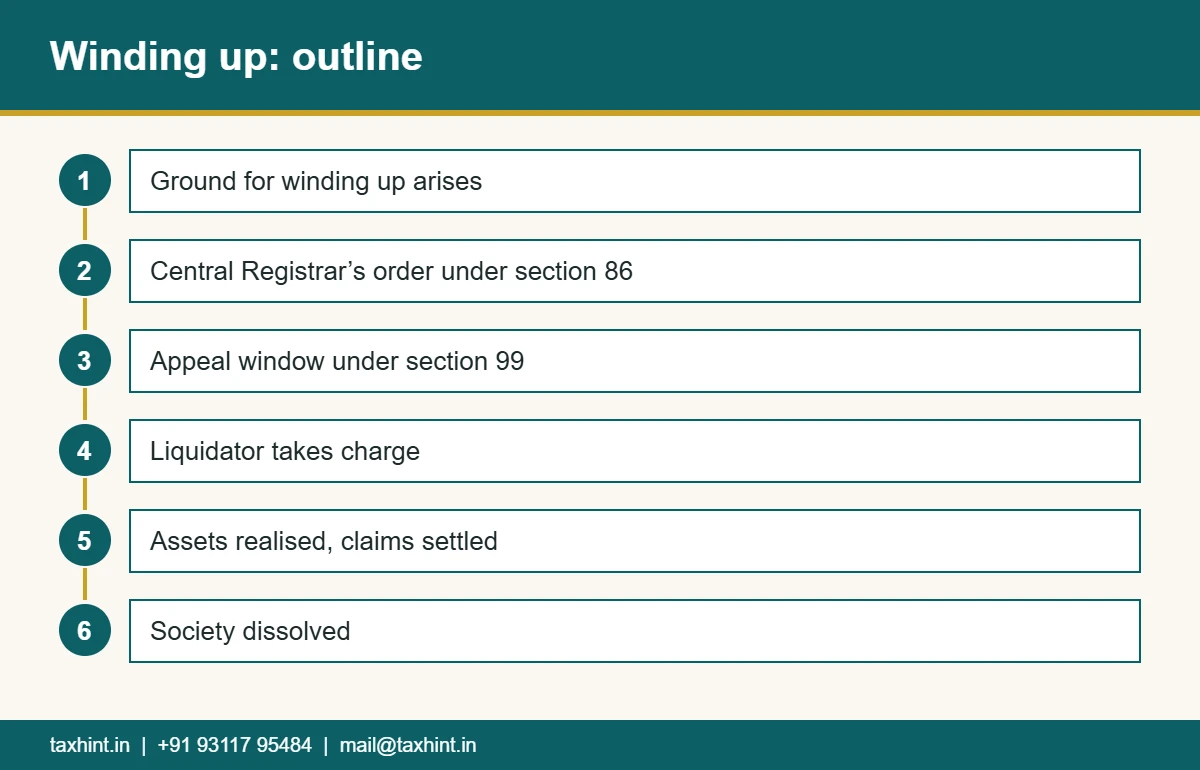
Winding up ends a multi-state society’s life. It can follow a members’ decision, a collapse in membership or serious failure. Under the MSCS Act the Central Registrar makes the order and a liquidator takes over.
Here is how it works in outline.
In this guide
- The winding up order
- What the liquidator does
- What members and depositors should do
- Avoiding it in the first place
- How we help
- A worked example
- Warning signs for members
- How long a liquidation lasts
- FAQs
The winding up order
Section 86 of the MSCS Act lets the Central Registrar direct the winding up of a multi-state society. An order under section 86 can be appealed under section 99. The Central Registrar’s office keeps a public list of multi-state societies under liquidation.
What the liquidator does
Once the order is made, a liquidator is appointed to take charge of the society’s assets and records, collect dues, sell assets where needed, settle claims in the order the law sets and close the books.
What members and depositors should do
File claims with the liquidator within the time announced, with passbooks, receipts and share certificates. Keep copies. Members who owe the society are expected to repay; the liquidator can recover dues.

Avoiding it in the first place
Most liquidations follow years of weak governance: loans to insiders, poor audit, deposits from non-members. The 2023 amendments added board loan limits and concurrent audit for large credit societies for this reason. See MSCS deposit rules.
How we help
We advise boards on compliance and members on claims. See MSCS compliance and MSCS audit and annual return.
A worked example
A multi-state credit society loses most of its members after a local fraud. Its board fails to hold meetings and the audit shows heavy losses. The Central Registrar issues a winding up order under section 86. The board has a window to appeal under section 99 but does not.
A liquidator takes charge, freezes the accounts, lists assets and publishes a claim deadline. Members file claims with passbooks. Borrowers are asked to repay. The liquidator sells assets, pays claims in the order the law sets and finally closes the society. Members who filed on time with proof are in the best position.
Warning signs for members
- Meetings and audits delayed year after year
- Loans to board members and relatives growing
- Deposits sought from non-members
- Returns not filed with the Central Registrar
Members who see these signs should raise them in the general meeting early.
How long a liquidation lasts
Liquidations often run for years, because assets have to be found, valued and sold, and claims checked one by one. Members should keep their papers safe for the whole period, update their address with the liquidator and respond to notices on time. Delay on the member’s side is one of the most common reasons claims get stuck.
Frequently asked questions
Who orders the winding up of an MSCS?
The Central Registrar, under section 86 of the MSCS Act.
Can the order be challenged?
Yes. An appeal lies under section 99.
Who runs the society after the order?
A liquidator appointed for the purpose.
What should depositors do?
File claims with the liquidator within the announced time, with proof.
Is there a public list of MSCS under liquidation?
Yes, on the Central Registrar’s website.
Need help? Need advice on an MSCS in trouble? Get Free Consultation or call +91 93117 95484.