November 27, 2026 · Guides
NBFC Principal Business Test (50-50 Rule) Explained
Many companies lend money or invest on the side. Not all of them need to register with RBI. The test that decides is the principal business test, popularly called the 50-50 test.
Here is how it works and why it matters even after registration.
In this guide
- The 50-50 test
- Who is not an NBFC
- Two quick examples
- Why it matters after registration
- Common mistakes
- How we help
- Group companies and the test
- How to run the test yourself
- FAQs
The 50-50 test
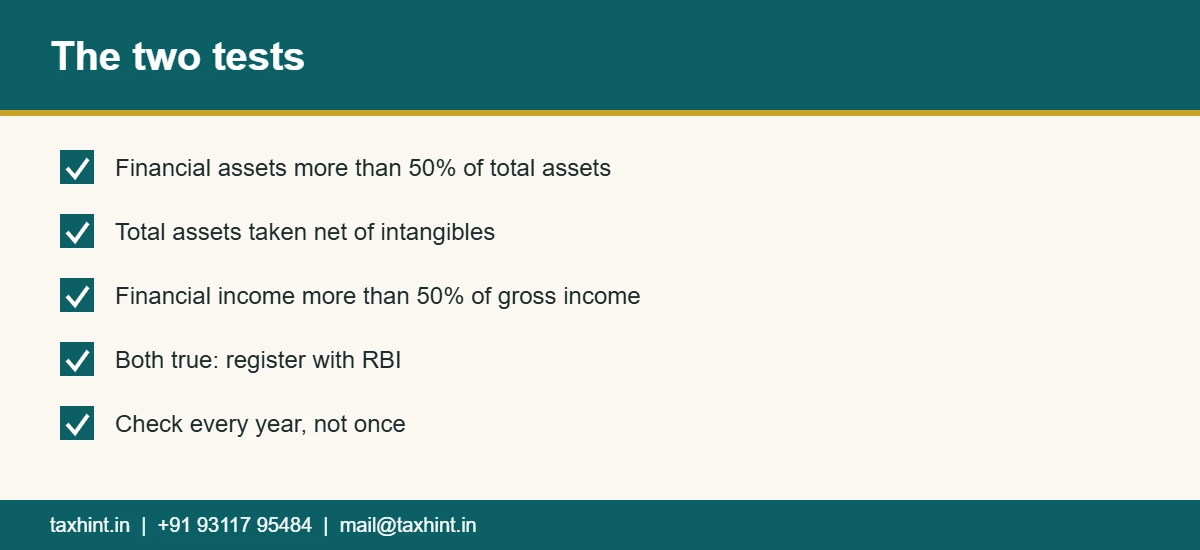
RBI treats financial activity as a company’s principal business when its financial assets are more than 50 per cent of its total assets (net of intangible assets) and its income from financial assets is more than 50 per cent of its gross income. A company that meets both needs to register with RBI as an NBFC.
RBI set out this test in a press release dated 8 April 1999, since the RBI Act does not define principal business.
Who is not an NBFC
RBI’s FAQ says a company whose principal business is agriculture, industrial activity, buying and selling goods, providing services, or buying, selling or building immovable property is not an NBFC, even if it does some financial business in a small way.
Two quick examples
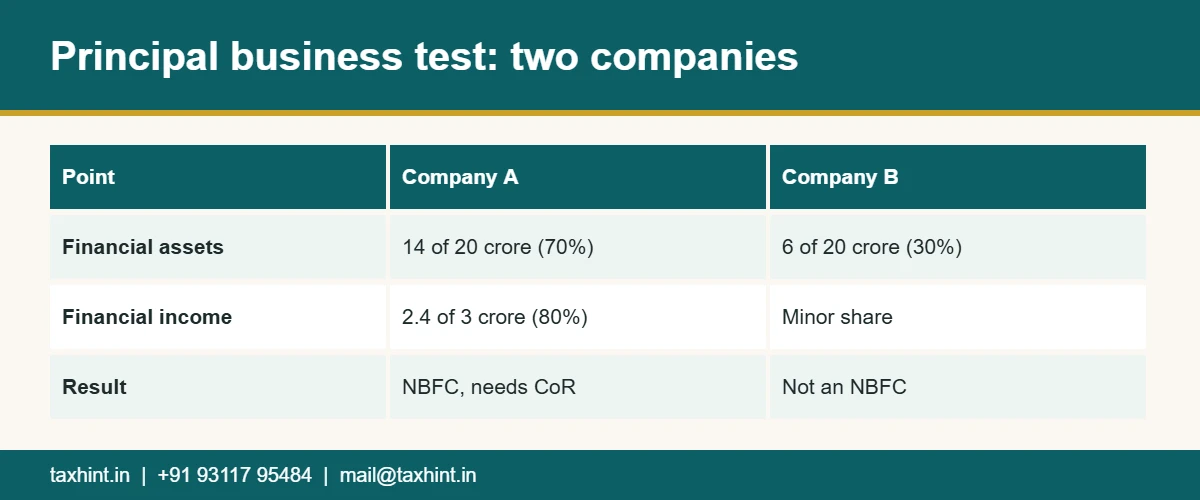
Company A has total assets of 20 crore, of which 14 crore are loans and investments, and earns 2.4 crore of its 3 crore income from interest. Both tests are above 50 per cent, so it needs an RBI registration.
Company B is a trader with 20 crore of assets, of which 6 crore are loans to dealers, and most income comes from sales. It fails both tests and is not an NBFC, though it must still follow company law on loans.
Why it matters after registration
The test also runs the other way. A registered NBFC that drifts into other business may stop meeting it, and the statutory auditor reports on this in the yearly certificate. See the DNBS10 auditor certificate.
Common mistakes
Lending to group firms without checking. Heavy inter-company loans can push a trading company over the line.
Forgetting intangibles. Total assets are taken net of intangible assets.
Checking only once. The mix changes every year.
How we help
We run the test on your balance sheet and advise on registration. See NBFC registration, types of NBFC and the NOF calculator.
Group companies and the test
Many family groups keep one company that holds shares in and lends to the other group firms. If those loans and investments are most of its assets and income, it may meet the 50-50 test and need RBI registration, or fall under the rules for core investment companies. The answer depends on the numbers and the exemptions in RBI’s directions, so check before the books close. See core investment company.
How to run the test yourself
- Take the audited balance sheet
- Remove intangible assets from total assets
- Add up loans, investments and other financial assets
- Add up interest, dividend and other financial income
- Compare both with 50 per cent
If either figure is close to 50 per cent, plan for next year too.
Frequently asked questions
What is the 50-50 test?
Financial assets above 50 per cent of total assets (net of intangibles) and financial income above 50 per cent of gross income.
Does meeting only one test require registration?
RBI’s test needs both to be met.
Is a trading company that lends a little an NBFC?
No, if its principal business is trading and it does not meet the test.
Where did the test come from?
RBI’s press release dated 8 April 1999.
Does the auditor check this every year?
Yes, as part of the yearly auditor certificate for registered NBFCs.
Need help? Not sure if your company needs RBI registration? Get Free Consultation or call +91 93117 95484.