November 24, 2026 · Guides
NBFC-MFI NOF: A Quarterly Routine to Track Net Owned Fund
For an NBFC-MFI, NOF (net owned fund) is not an annual certificate exercise. It is the capital base that supports your RBI registration, your lending limits and your lenders’ confidence, and it moves every month with profits, losses and write-offs.
Many lenders check NBFC-MFI NOF only when the auditor asks. By then a shortfall has already happened. This guide gives a simple quarterly routine, shows how the number is built, and explains what to do if headroom disappears.
In this guide
- How NOF is built
- A simple illustration
- A quarterly tracking routine
- Why headroom matters more than compliance
- If NOF falls below the requirement
- What to read next
- Where this comes from
- FAQs
How NOF is built
The RBI Directions define “owned funds” as the sum of paid-up equity capital, eligible preference shares, free reserves, share premium, capital reserves from the sale of assets, and similar items, reduced by accumulated losses and deferred revenue expenditure and intangible assets. “Net owned fund” is owned funds reduced further by certain investments, such as investments in shares of subsidiaries, group companies and other NBFCs, and loans to group companies above the ten percent limit the Directions mention.
In plain words: start with what the owners have put in and kept, subtract what has been lost or is not real cash value, and subtract specified group investments. What remains is the cushion RBI counts.
A simple illustration
This example is illustrative, not a real company. Suppose an NBFC-MFI has paid-up equity of ₹10 crore, free reserves of ₹1.5 crore, accumulated losses of ₹2 crore and intangible assets of ₹0.3 crore. Owned funds would be ₹10 + ₹1.5 − ₹2 − ₹0.3 = ₹9.2 crore before any investment deductions. If the company also holds ₹0.5 crore in shares of another NBFC, NOF falls to about ₹8.7 crore. The key lesson: a loss quarter reduces NOF rupee for rupee.
A quarterly tracking routine
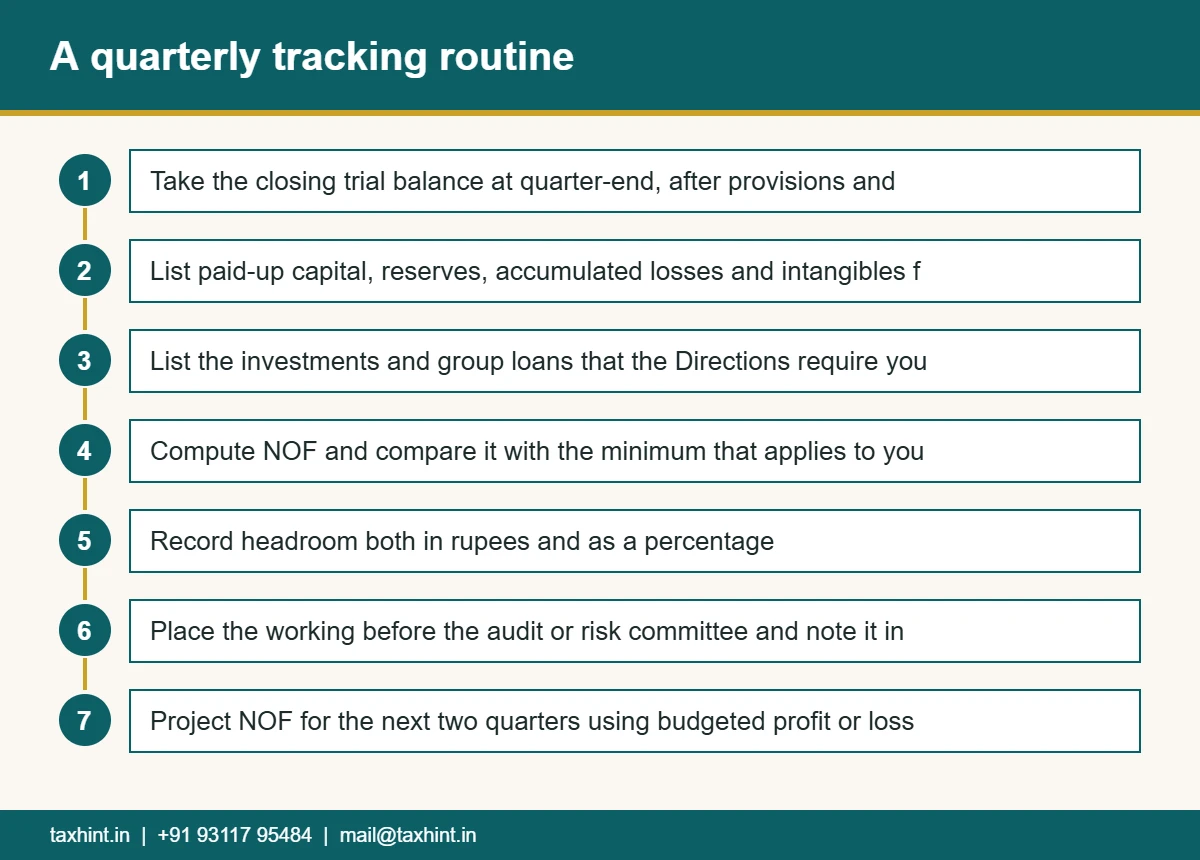
- Take the closing trial balance at quarter-end, after provisions and write-offs.
- List paid-up capital, reserves, accumulated losses and intangibles from the ledger.
- List the investments and group loans that the Directions require you to deduct.
- Compute NOF and compare it with the minimum that applies to you.
- Record headroom both in rupees and as a percentage.
- Place the working before the audit or risk committee and note it in the minutes.
- Project NOF for the next two quarters using budgeted profit or loss.
Why headroom matters more than compliance
Being just above the minimum is not safe. A single large write-off or a delayed grant can push you below. Boards should set an internal buffer, for example a stated percentage above the minimum, and plan any equity infusion before the buffer is touched. Lenders and rating agencies also look at capital in relation to assets, so thin NOF can raise funding costs.
If NOF falls below the requirement
Treat it as an urgent board matter. Inform your RBI regional office as the Directions require, prepare a time-bound plan to restore capital through fresh equity or retained profit, and slow new disbursement until it is fixed. Hiding a shortfall until the auditor reports it damages trust more than the shortfall itself.
What to read next
NOF works together with the asset test. Read qualifying assets at 60 percent, use the NOF and qualifying asset calculator, and see minimum capital for entry requirements. Our RBI inspection checklist shows what inspectors ask about capital.
Where this comes from
Source: RBI (NBFC – Microfinance Institution) Directions, 2025. RBI updates these Directions from time to time, so confirm the current text before acting.
FAQs
How often should an NBFC-MFI check NOF?
At least every quarter, and again before any large disbursement plan, dividend or investment decision.
Who certifies net owned fund?
The statutory auditor certifies it as part of the annual reporting to RBI, but the company should track it throughout the year.
Can grants or subordinated funds count?
It depends on the nature of the item and the Directions. Ask your auditor before counting any grant or quasi-equity instrument.
What happens if NOF drops below the minimum?
RBI can take supervisory action, including restrictions on business. Inform the regional office early and present a recovery plan.
Does NOF change when we grow the loan book?
Not directly, but growth consumes capital through provisions and, over time, requires fresh equity to keep headroom.
Planning a microfinance company or already running one? Our CAs and CSs handle registration, RBI work and yearly compliance. Get Free Consultation or WhatsApp +91 93117 95484.