November 23, 2026 · Guides
Minimum Capital for a Microfinance Company: Section 8 vs NBFC-MFI
The minimum capital for a microfinance company depends on the route. A Section 8 microfinance company has no minimum capital fixed by the Companies Act, but it needs real money to lend. An NBFC-MFI must hold net owned fund (NOF) of ₹10 crore, which is a hard RBI requirement.
Promoters usually ask for one number. There isn’t one. The minimum capital for a microfinance company is a legal floor on one side and a business question on the other, and mixing them up is how people either overspend or start with too little.
In this guide
- Minimum capital microfinance company: the two routes side by side
- Section 8: no legal minimum, but real needs
- NBFC-MFI: the ₹10 crore NOF
- What counts in NOF
- The glide path for existing NBFC-MFIs
- How to choose
- FAQs
Minimum capital microfinance company: the two routes side by side
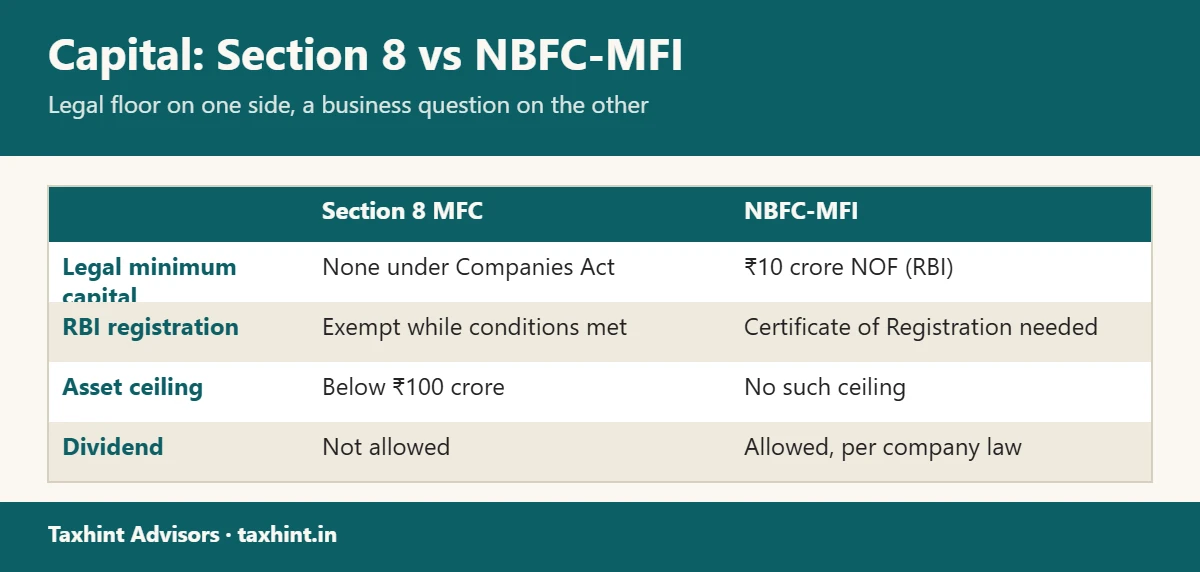
| Point | Section 8 microfinance company | NBFC-MFI |
|---|---|---|
| Legal minimum capital | None under the Companies Act | ₹10 crore NOF (RBI) |
| RBI registration | Exempt while conditions are met | Certificate of Registration needed |
| Asset ceiling | Below ₹100 crore | No such ceiling |
| Dividend | Not allowed | Allowed, as per company law |
| Typical starting point | Small, grows with grants and borrowings | Needs serious equity from day one |
The Section 8 route suits promoters who want a not-for-profit entity and a gradual start. The NBFC-MFI route suits investors who want to scale and can bring ₹10 crore of owned funds. Our comparison, Section 8 vs NBFC-MFI, goes deeper on that choice.
Section 8: no legal minimum, but real needs
Since the Companies (Amendment) Act, 2015, no company has to show a minimum paid-up capital, and a Section 8 company can even be formed with no share capital at all, as one limited by guarantee. So on paper you could register with a very small number. We have never advised a client to do that.
A microfinance company has to lend, and lending needs money. Take a trust in Palwal that wants to run a livelihood programme for 300 women, with an average first loan of ₹20,000. That is ₹60 lakh of loan book before you count the office, the staff, software, audit and the first year’s compliance. Whatever the Act says, that number is the real minimum.
Money for a Section 8 microfinance company comes from promoters’ contributions, grants, and borrowings from banks and institutions. It cannot come from public deposits, a point we explain in can a Section 8 microfinance company take deposits. Authorised capital, where you choose to have share capital, also affects government charges: the SPICe+ fee is linked to authorised capital, and state stamp duty applies on the MoA and AoA, with the DSC as a separate cost.
Keep one more number in mind. The RBI exemption lasts only while assets stay below ₹100 crore, and the company gives only microfinance loans without taking public deposits. Above ₹100 crore, the exemption is withdrawn for not-for-profit microfinance companies and registration as an NBFC-MFI is expected. Start with our Section 8 microfinance company registration page if you plan to go this way.
NBFC-MFI: the ₹10 crore NOF
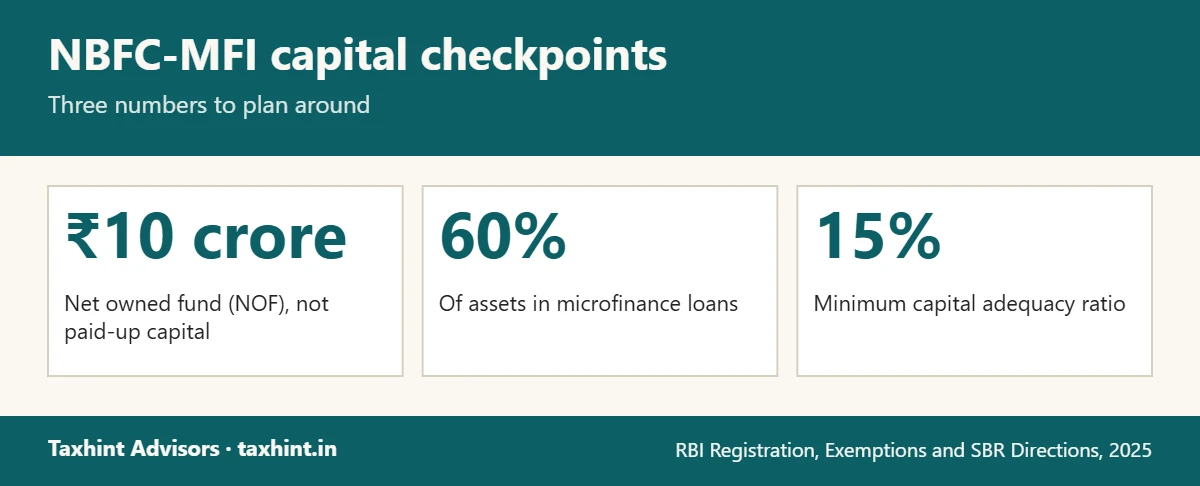
Para 39 of the RBI’s Registration, Exemptions and Scale Based Regulation Directions, 2025 sets ₹10 crore as the NOF needed to commence or carry on business as an NBFC-MFI. The same figure applies to an NBFC-ICC and an NBFC-Factor. The RBI also requires at least 60 per cent of assets (net of intangible assets) to be in microfinance loans, and the Microfinance Institution Directions set a capital adequacy ratio of at least 15 per cent.
The ₹10 crore is NOF, not paid-up capital. People mix these up, and it costs them. NOF is calculated by a formula, so you may need to bring more than ₹10 crore of share capital to land at ₹10 crore of NOF after deductions. Our microfinance company registration page covers the application on the RBI PRAVAAH portal.
What counts in NOF
Under section 45-IA of the RBI Act, NOF starts from paid-up equity capital and free reserves as shown in the latest balance sheet. Then deductions come off. The RBI’s capital adequacy Directions list the same building blocks in their definition of owned fund.
Counts
- Paid-up equity capital.
- Compulsorily convertible preference shares.
- Free reserves, including quarterly profits where the quarterly numbers have been audited or reviewed by the statutory auditors.
- Balance in the share premium account.
- Capital reserves arising from the sale of assets (not from revaluation).
Deducted
- Accumulated losses and the current year’s loss.
- Deferred revenue expenditure.
- Intangible assets, including capitalised software cost.
- Investments in shares of subsidiaries, group companies and other NBFCs, and loans and deposits to those companies above 10 per cent of the owned fund after the first deductions, as the Act’s explanation sets out.
The practical lesson: founder loans and borrowings are not NOF, however long they stay. Only equity-type money counts. Check your cap table early, then run your own numbers in our NBFC-MFI NOF and qualifying asset calculator. For a detailed read of the definition, see net owned fund (NOF) explained.
The glide path for existing NBFC-MFIs
If you already run an NBFC-MFI registered earlier, para 42 of the same Directions gives a glide path. The current requirement is ₹5 crore (₹2 crore in the North East Region), the interim target was ₹7 crore (₹5 crore in the North East) by 31 March 2025, and the final target is ₹10 crore by 31 March 2027. For a new applicant today, the ₹10 crore applies from the start, with no separate figure for the North East.
How to choose
We usually ask three questions before recommending a route.
- Can you bring ₹10 crore of owned funds, and keep it above that level after losses? If not, an NBFC-MFI is the wrong start.
- Is the aim to earn returns for shareholders? Section 8 cannot pay dividends.
- Will the loan book stay below ₹100 crore for the next few years? If it will, the Section 8 route is workable.
Many promoters begin with Section 8, prove the model, and move up later. A few go straight to NBFC-MFI. Both are valid, as long as the capital plan is real.
For the sources, see the RBI’s Registration, Exemptions and SBR Directions, 2025.
FAQs
What is the minimum capital for a microfinance company?
For an NBFC-MFI it is ₹10 crore of net owned fund. For a Section 8 microfinance company the Companies Act sets no minimum, though practical needs depend on your loan book.
Is ₹10 crore paid-up capital or NOF?
NOF. It is paid-up equity and free reserves after the RBI’s deductions, so paid-up capital may need to be higher.
Do loans from promoters count in NOF?
No. Only equity-type funds count, such as equity capital, compulsorily convertible preference shares and free reserves. Loans are borrowings.
Can a Section 8 company be registered with no share capital?
Yes. A Section 8 company may be limited by guarantee. Whether that suits your lending plan is a separate question we can help you decide.
What is the asset limit for a Section 8 microfinance company?
Assets must stay below ₹100 crore for the RBI exemption to apply, along with microfinance-only lending, a Section 8 licence and no public deposits.
Do existing NBFC-MFIs need ₹10 crore too?
Yes, on a glide path. The final target is ₹10 crore by 31 March 2027.
Not sure how much capital your plan really needs? Get Free Consultation or WhatsApp +91 93117 95484. Our CA and CS team has handled filings for 5,000+ businesses across 28 states since 2014.