November 23, 2026 · Guides
NBFC-MFI RBI Inspection Checklist: What to Have Ready
An NBFC-MFI RBI inspection is far easier when the evidence is already sitting in the right files. Inspectors test whether your book really is microfinance, whether borrowers were treated fairly, and whether your numbers hold up.
This checklist groups what to keep ready. It is based on the 2025 NBFC-MFI Directions and our experience preparing lenders; treat it as a starting list, not an exhaustive one.
Use this NBFC-MFI RBI inspection checklist as a monthly habit, not a last-minute scramble.
In this guide
- Qualifying assets and capital
- Borrower eligibility evidence
- Pricing and disclosure
- Fair practices, recovery and grievances
- Reporting and systems
- How inspectors usually sample loan files
- A monthly readiness routine
- Findings we see most often
- How we help
- FAQs
Qualifying assets and capital
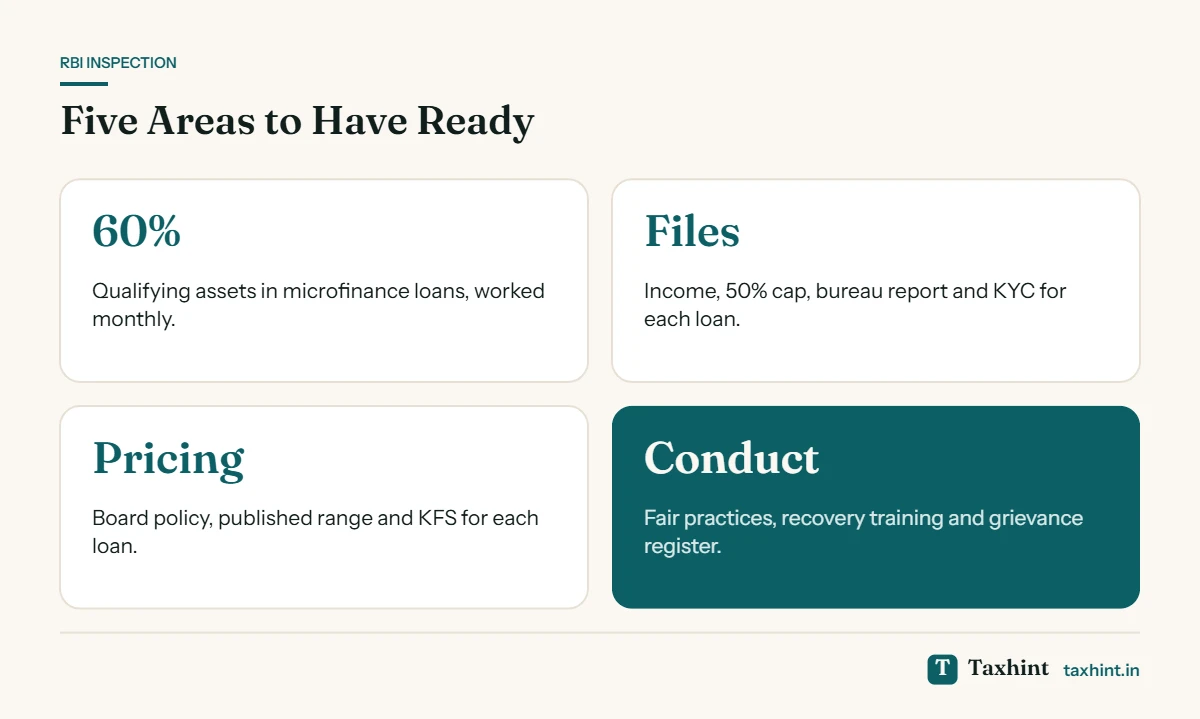
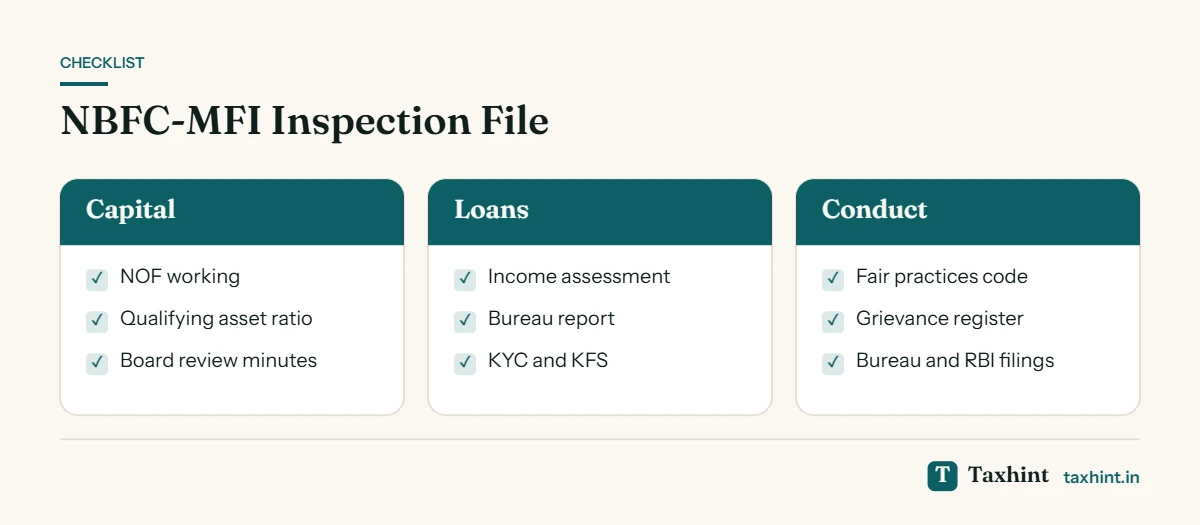
Under RBI’s NBFC-MFI Directions, 2025, an NBFC-MFI must keep at least 60% of its total assets, net of intangibles, in microfinance loans on an ongoing basis. Keep a monthly working of this ratio, signed off by finance, and the board minutes that reviewed it.
Keep the net owned fund working and the glide-path position too. Our NOF and qualifying asset calculator is a quick check.
Borrower eligibility evidence
Inspectors sample loan files. For each, they look for the household income assessment, the repayment-to-income working against the 50% cap, the credit bureau report pulled before sanction, and KYC. A file that shows only an application form and a receipt book will draw comment.
Pricing and disclosure
Keep the board-approved pricing policy, the published interest-rate range and ceiling, and copies of KFS for sampled loans. Charges collected must match the KFS. Our guide to the Key Fact Statement explains what it should show.
Fair practices, recovery and grievances
Have the fair practices code, the recovery policy, staff training records and the grievance register with resolution times. Inspectors often compare complaints with recovery staff conduct. Our post on fair practices and recovery covers the basics.
Reporting and systems
Keep credit bureau submission logs, RBI returns filed, board and committee minutes, and the audit trail of your loan system. A system that shows who changed what and when makes sampling quicker and less painful.
How inspectors usually sample loan files
Inspectors typically pick loans across branches, products and loan officers, often including recent disbursements, restructured loans and loans that went overdue quickly. For each, they check whether the file tells a consistent story: who the borrower is, how income was judged, what the bureau said, what the borrower was told and how they were treated when they paid late.
The easiest way to prepare for an NBFC-MFI RBI inspection is to pull ten random files yourself every month and fix what you find.
A monthly readiness routine
- Week 1: work out the qualifying asset ratio and NOF; minute the review.
- Week 2: sample ten loan files and check KYC, income, bureau and KFS.
- Week 3: review the grievance register and recovery complaints by officer.
- Week 4: confirm bureau submissions and RBI returns, and check the audit trail for unusual edits.
Findings we see most often
- Income recorded with no basis or the same figure for every borrower.
- Charges collected that are not on the KFS.
- Grievances logged but with no resolution dates.
- Board minutes that never mention the qualifying asset ratio.
- Manual edits in the loan system with no reason recorded.
How we help
We run mock inspections for NBFC-MFIs, fix files and policies before RBI arrives, and handle the follow-up reporting. Start with our NBFC-MFI registration page if you are still setting up.
FAQs
What does RBI check in an NBFC-MFI inspection?
Typically the qualifying asset ratio, borrower eligibility and income assessment, pricing and disclosure, fair practices and recovery, grievance handling, bureau reporting and capital. The exact scope is set by the inspecting team.
What is the qualifying asset requirement now?
At least 60% of total assets, net of intangibles, in microfinance loans, under RBI’s 2025 NBFC-MFI Directions.
Does a Section 8 microfinance company face RBI inspection?
A Section 8 company relying on the RBI exemption is not registered with RBI, but it must keep meeting the exemption conditions, and lenders and auditors will ask for similar evidence.
How can software help with inspection?
It keeps KYC, income assessment, KFS, schedules and an audit trail on each loan, so files can be pulled in minutes.
Planning a microfinance company or already running one? Our CAs and CSs handle registration, RBI work and yearly compliance. Get Free Consultation or WhatsApp +91 93117 95484.