November 23, 2026 · Guides
Key Fact Statement for Microfinance Loans: A Practical Guide
A Key Fact Statement for microfinance loans is the one-page summary a borrower reads before signing: the real annual cost, every charge and the repayment schedule. RBI made it standard for retail, MSME and microfinance loans from 1 October 2024.
Get it right and most pricing complaints never arise. Get it wrong and every extra rupee you collect becomes a dispute.
Below we explain what a key fact statement for microfinance loans must show, how to work out the APR, and the mistakes that lead to complaints.
In this guide
- What a KFS is
- APR: the number that matters
- What a microfinance KFS should show
- Rules that catch lenders out
- A worked example of APR
- Mistakes we see in microfinance KFS
- Generating the KFS automatically
- FAQs
What a KFS is
RBI’s KFS circular of 15 April 2024 defines the KFS as a statement of key facts of a loan agreement, in simple language, given in a standardised format. It applies to all retail and MSME term loans by regulated entities, and its rules replaced the separate factsheet provisions of the 2022 microfinance directions. All new loans sanctioned on or after 1 October 2024 must follow it.
A Section 8 microfinance company outside RBI registration is not formally bound, but our loan agreement format treats the KFS as part of the agreement, and we recommend every lender do the same.
APR: the number that matters
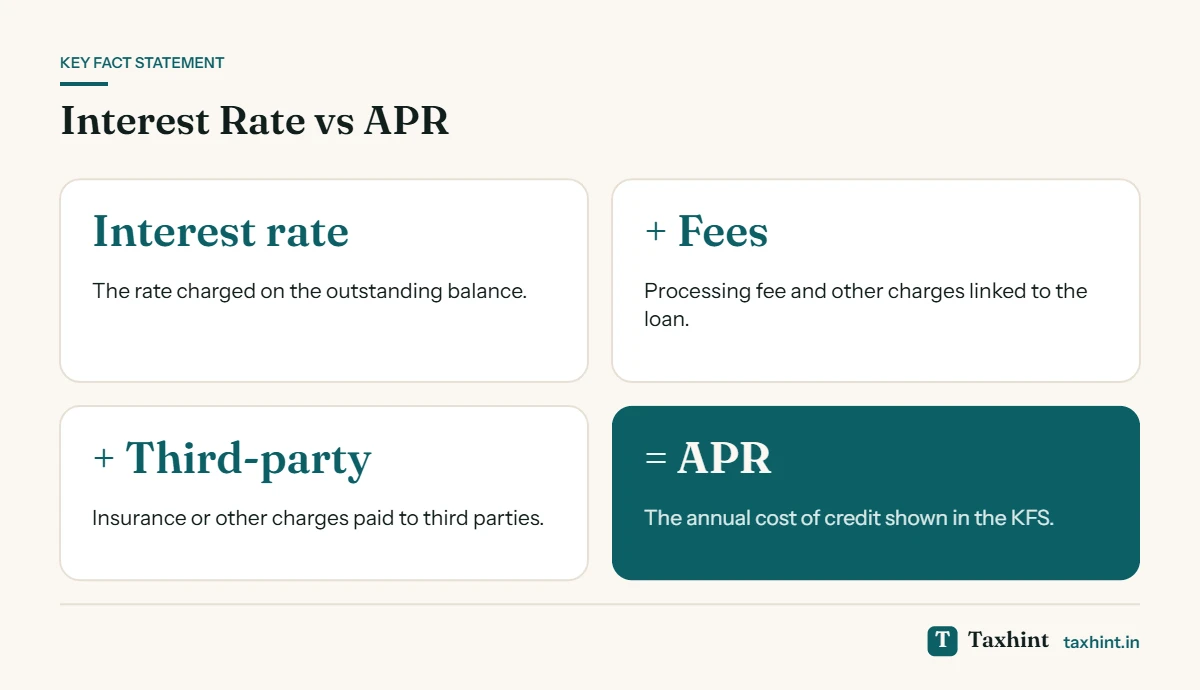
The circular defines the annual percentage rate (APR) as the annual cost of credit to the borrower, including the interest rate and all other charges linked to the loan. The KFS must carry a computation sheet showing how the APR was worked out, and the amortisation schedule over the life of the loan.
Take a ₹30,000 loan at 24% reducing with a ₹600 processing fee. The interest rate is 24%, but the APR is higher because the fee is part of the cost. Our microfinance EMI calculator shows the instalment and interest; add fees to see the full cost.
What a microfinance KFS should show
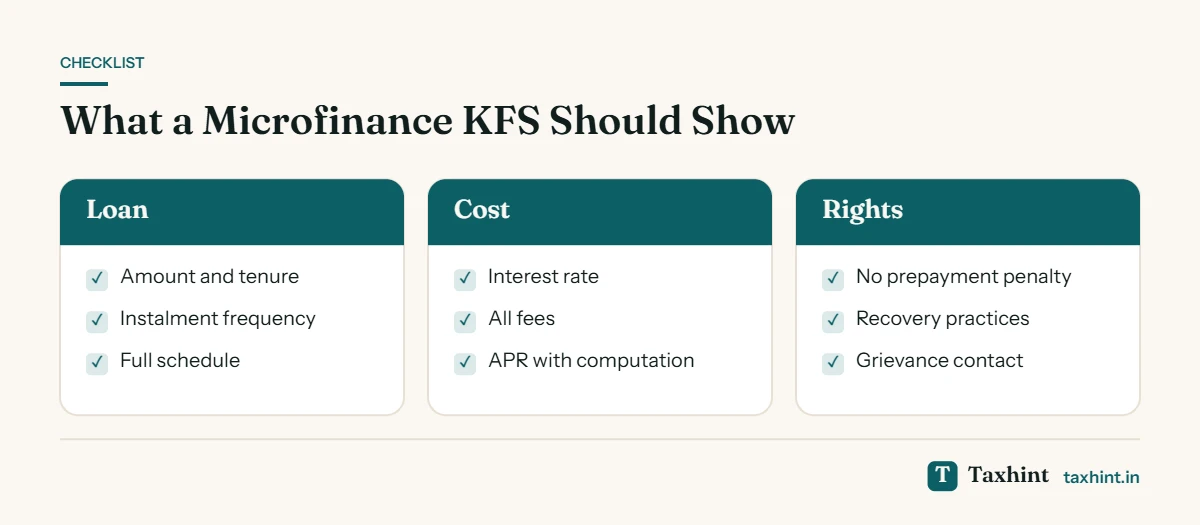
- Loan amount, tenure and instalment frequency
- Interest rate type and rate, and the APR
- Every fee and charge, including any paid to third parties such as insurance
- Number and amount of instalments, with the full schedule
- Penal charges, if any, and that there is no prepayment penalty
- Recovery and collection practices, and the grievance officer’s contact
- A cooling-off or look-up period where applicable
Rules that catch lenders out
Language. The KFS must be in a language the borrower understands. An English-only sheet handed to a borrower who reads Odia or Marathi does not meet the purpose.
No surprise charges. Charges not mentioned in the KFS cannot be levied during the loan without the borrower’s explicit consent.
Same numbers everywhere. The KFS, the agreement and the repayment schedule must match. Generating all three from one product setup avoids errors; our guide to microfinance interest rate rules covers how pricing is set.
A worked example of APR
Take a ₹30,000 loan over 12 months, repaid weekly, at 24% a year on reducing balance, with a ₹600 processing fee. The interest alone comes to roughly ₹3,900. The borrower actually receives ₹29,400 after the fee but repays ₹30,000 plus interest, so the effective annual cost, the APR, is higher than 24%. The key fact statement for microfinance loans must show that higher figure, with the computation sheet behind it.
If insurance is bundled, its premium goes into the APR too, because the circular counts charges paid to third parties as part of the cost of credit.
Mistakes we see in microfinance KFS
- Showing only the interest rate, not the APR.
- Leaving out insurance or documentation charges.
- A KFS in English for borrowers who read another language.
- A KFS that does not match the agreement or the schedule.
- Charging a fee later that was never on the KFS.
Generating the KFS automatically
Writing a KFS by hand for every loan invites errors. Our microfinance software generates the KFS, APR computation, agreement and schedule from the same product setup, in the borrower’s language.
FAQs
Is a Key Fact Statement mandatory for microfinance loans?
For regulated entities, yes. RBI’s April 2024 circular covers retail, MSME and microfinance loans sanctioned from 1 October 2024. Section 8 lenders outside RBI registration should follow it as good practice.
What is APR in a KFS?
The annual cost of credit including interest and all other charges, shown with a computation sheet.
Can a lender add a charge later that was not in the KFS?
Not without the borrower’s explicit consent.
In which language should the KFS be?
In a language the borrower understands.
Planning a microfinance company or already running one? Our CAs and CSs handle registration, RBI work and yearly compliance. Get Free Consultation or WhatsApp +91 93117 95484.