November 26, 2026 · Guides
Types of NBFC in India: Which Category Fits Your Business

“NBFC” is a family of licences, not one licence. RBI groups them in two ways: by what the company does (its activity) and by how big and risky it is (its layer under scale-based regulation). Knowing both tells you which rules apply and how much capital you need.
This guide lists the main types and who each suits. When you have picked one, our NBFC registration page covers the process, and how to start an NBFC explains the full order of steps.
In this guide
- Types of NBFC by activity
- Investment and Credit Company (NBFC-ICC)
- Microfinance Institution (NBFC-MFI)
- NBFC-Factor
- NBFC-P2P and Account Aggregator
- Large-ticket categories
- Types of NBFC by layer
- How to choose your category
- FAQs
Types of NBFC by activity
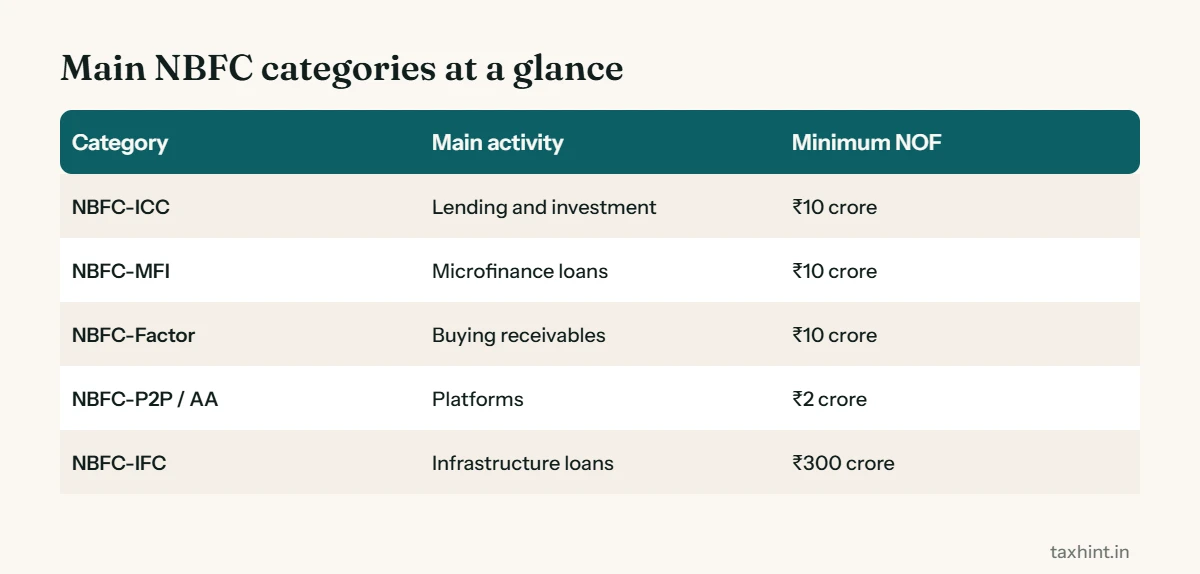
These are the categories most promoters choose between. Each has its own principal business test and, in some cases, its own minimum capital.
Investment and Credit Company (NBFC-ICC)
The general category for companies that lend or invest as their main business: personal loans, business loans, vehicle finance, loans against property, gold loans and more. Most new NBFCs start here. The regulatory minimum net owned fund is ₹10 crore. A company focused on gold loans is usually an ICC that follows RBI’s gold lending rules; see gold loan NBFC.
Microfinance Institution (NBFC-MFI)
An NBFC that puts most of its assets into collateral-free microfinance loans to low-income households. It follows RBI’s microfinance directions on household income, repayment limits and pricing. See NBFC-MFI registration, or the not-for-profit route through a Section 8 microfinance company.
NBFC-Factor
Buys trade receivables from businesses under the Factoring Regulation Act, 2011. At least half its assets and half its income must come from factoring. See NBFC-Factor registration.
NBFC-P2P and Account Aggregator
Two platform licences. A P2P lending platform connects lenders and borrowers without lending its own money; an Account Aggregator moves financial data between institutions with the customer’s consent. Both have a lower net owned fund requirement of ₹2 crore. See P2P lending NBFC and Account Aggregator licence.
Large-ticket categories
Infrastructure Finance Companies, Housing Finance Companies and Core Investment Companies sit in RBI’s Middle or Upper Layer from the start and need far more capital. See IFC, HFC and CIC.
Types of NBFC by layer
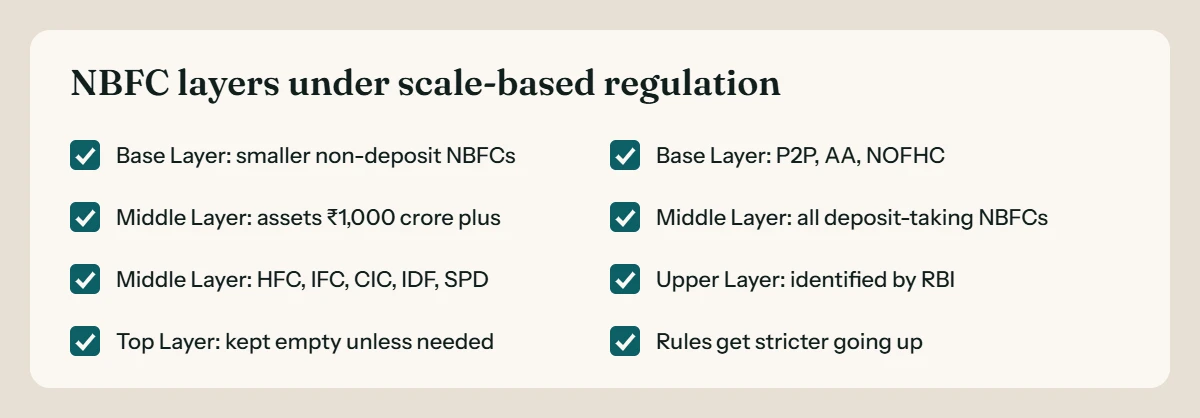
Under RBI’s scale-based regulation, every NBFC also sits in a layer that decides how strict its rules are. Read more in our guide on NBFC scale-based regulation.
How to choose your category
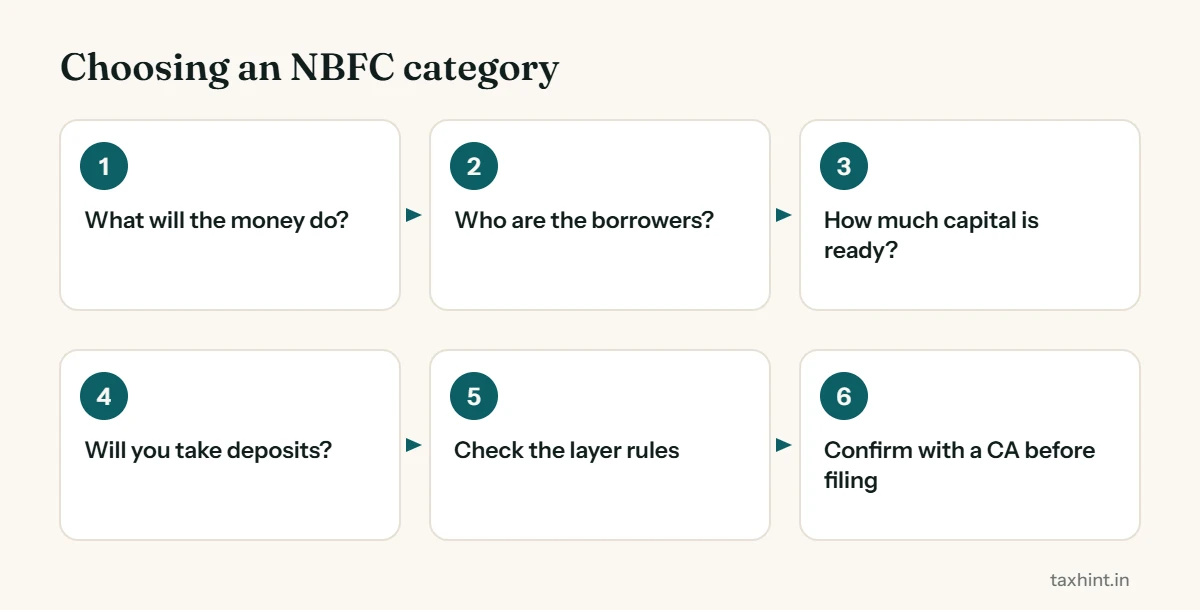
Ask what the money will do: lend to individuals and businesses (ICC), microloans to low-income groups (MFI), buy invoices (Factor), run a platform (P2P, AA) or fund large projects (IFC). Then check the capital with our NOF calculator. If none fits your budget, our entity chooser shows member-based alternatives.
Frequently asked questions
How many types of NBFC are there in India?
RBI recognises several activity-based categories, such as ICC, MFI, Factor, P2P, Account Aggregator, IFC, HFC and CIC, and places each NBFC in a layer under scale-based regulation.
Which NBFC type is most common for new lenders?
The Investment and Credit Company (NBFC-ICC), which covers most kinds of lending and investment.
Is a gold loan company a separate type?
No. It is usually an NBFC-ICC that follows RBI’s directions on lending against gold.
Which NBFC needs the least capital?
NBFC-P2P and Account Aggregators, at ₹2 crore net owned fund.
Can you help pick the category?
Yes. The first consultation is free.
Next step: Not sure which category fits? Share your lending plan and we will suggest the right NBFC type. Call +91 93117 95484, email [email protected], or use the form on our NBFC services page.