November 26, 2026 · Guides
Nidhi vs NBFC vs Multi-State vs Co-operative Society: Which to Register?
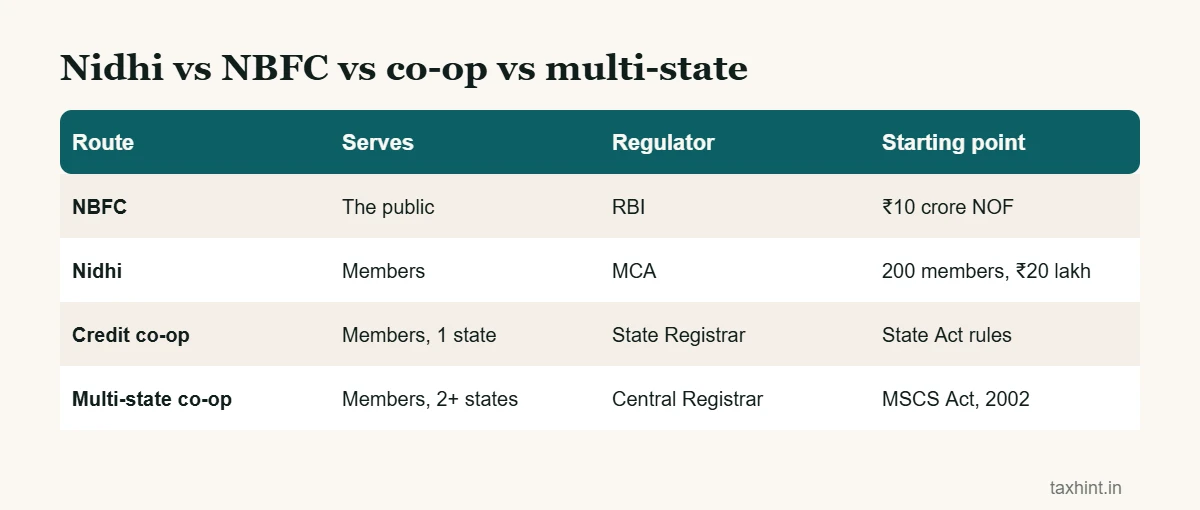
If you want to run a savings and lending business, there are four main structures in India, and they suit very different plans. A Nidhi company works only with members under company law. An NBFC can lend to the public with RBI’s licence. A credit co-operative society serves members under state law, and a multi-state society does the same across states.
Picking the wrong one is expensive to undo, so here is how they compare, and how to choose. All four are on our fintech registration services page.
In this guide
- The four routes side by side
- Nidhi company
- NBFC
- Credit co-operative society
- Multi-state co-operative society
- How to choose
- What about microfinance?
- Every route needs software
- FAQs
The four routes side by side
The short version, before the detail.
Nidhi company
A public company under the Companies Act and the Nidhi Rules, 2014. It accepts deposits from and lends to its members only. A new Nidhi must reach at least 200 members and a net owned fund of ₹20 lakh, then file Form NDH-4 within 120 days of incorporation to be declared a Nidhi. Good for community savings and small loans, especially in one area. See Nidhi company registration and NDH-4 filing.
NBFC
A company registered with RBI. It can lend to the public, raise funds from banks and grow across India. The trade-off is capital and regulation: most categories need a ₹10 crore net owned fund, and RBI returns, audits and conduct rules apply. See NBFC registration and how to start an NBFC.
Credit co-operative society
Registered under a state’s Co-operative Societies Act, owned and run by members who share a common bond. It takes member deposits and gives member loans. Capital needs and member rules depend on the state. See credit co-operative society registration and how to start one.
Multi-state co-operative society
Like a co-op, but registered with the Central Registrar under the Multi-State Co-operative Societies Act, 2002, with members in two or more states. It suits groups that already work across a region. See multi-state co-operative society registration.
How to choose
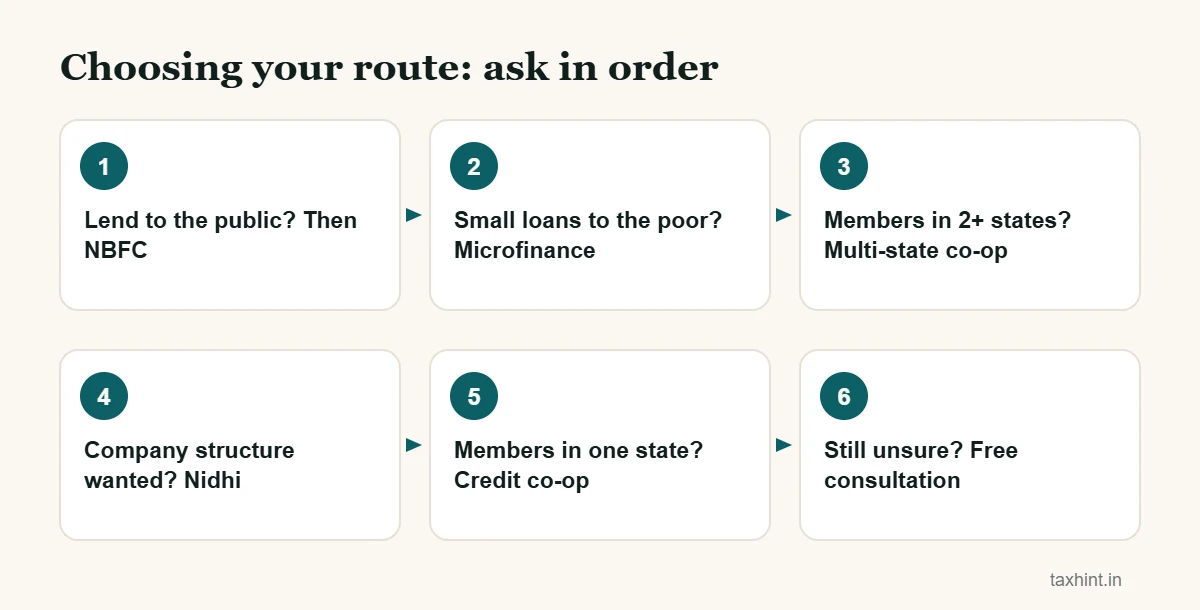
Answer these questions in order. The first “yes” usually points to your route.
What about microfinance?
If your plan is small loans to low-income households, look at a Section 8 microfinance company, which can work without an RBI licence while it meets the conditions, or an NBFC-MFI.
Every route needs software
Whichever you choose, member, deposit and loan records must be clean from day one. We offer Nidhi software, credit society software, multi-state society software and loan management software for NBFCs. Registration, software and first-year compliance can also be taken together; see the bundle.
Frequently asked questions
Which is easiest to start: Nidhi, NBFC or co-op?
A credit co-op or Nidhi usually needs far less capital than an NBFC. The right choice depends on who you want to serve and where.
Can a Nidhi or co-op lend to non-members?
No. Both work only with their members. Lending to the public needs an NBFC licence.
Which needs RBI registration?
An NBFC needs RBI’s Certificate of Registration. A Nidhi is governed by MCA, and co-operative societies by their Registrar.
Can we switch later?
Moving from one structure to another is possible in some cases but takes time. It is better to choose well at the start.
Can you help us choose?
Yes. The first consultation is free; share your plan, capital and area.
Next step: Still deciding? Share your plan and capital, and a CA or CS will tell you which route fits. Call +91 93117 95484, email [email protected], or use the form on our fintech registration services page.