November 23, 2026 · Guides
PAR 30 Microfinance: Definitions, Formula and a Worked Example

PAR 30 microfinance reporting rests on one ratio: the share of your outstanding loan portfolio that sits in loans with at least one instalment more than 30 days overdue. You divide the full outstanding principal of those loans by your total outstanding portfolio. It is the number most boards and lenders look at first, so it is worth computing the same way every month, whether by hand or from your microfinance software.
In this guide
- What portfolio at risk means
- PAR 1, PAR 30, PAR 60 and PAR 90
- The formula
- A worked example with illustrative numbers
- Mistakes that distort PAR
- What a healthy trend looks like
- Tracking PAR 30 in software
- FAQs
What portfolio at risk means
Portfolio at risk, or PAR, tells you how much of your lending is exposed because borrowers have stopped paying on time. It is a share of the whole loan book, not a count of late borrowers.
The key detail is that when one instalment is late, the entire outstanding principal of that loan goes into PAR, not just the missed instalment. A loan of ₹20,000 with ₹14,000 still to be repaid and one instalment of ₹1,200 overdue by 35 days contributes ₹14,000 to PAR 30, not ₹1,200. The global impact-investing standard (IRIS+) defines PAR 30 the same way: the full unpaid principal of loans with a payment more than 30 days overdue, excluding accrued interest. See the IRIS+ metric.
That is why PAR is stricter than a simple overdue amount. Two lenders can have the same overdue instalments and very different PAR if one has many small loans late and the other has a few large ones.
PAR 1, PAR 30, PAR 60 and PAR 90
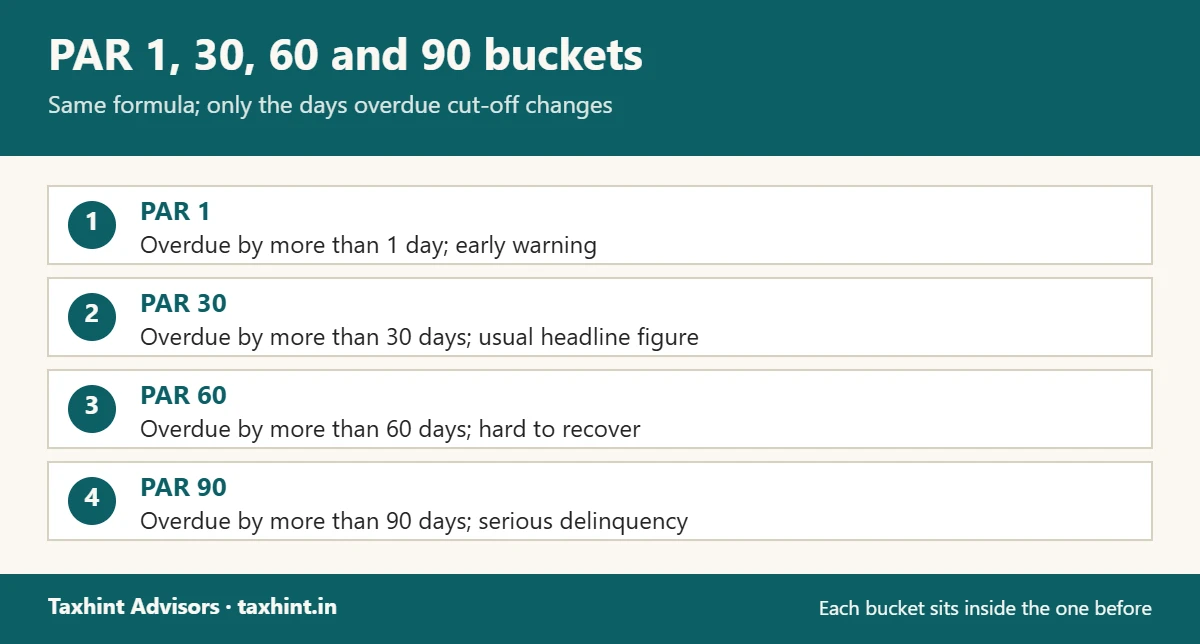
Whichever PAR 30 microfinance report you read, the number after “PAR” is the days overdue threshold. The calculation is identical; only the cut-off changes.
| Measure | Loans counted | What it tells you |
|---|---|---|
| PAR 1 | At least one instalment overdue by more than 1 day | Early warning. Includes every slip, even a one-day delay |
| PAR 30 | Overdue by more than 30 days | The usual headline figure for MFIs |
| PAR 60 | Overdue by more than 60 days | Loans that are getting hard to recover |
| PAR 90 | Overdue by more than 90 days | Serious delinquency, often treated as the non-performing line |
PAR 1 will always be at least as high as PAR 30, which will be at least as high as PAR 60, and so on. If your PAR 90 is higher than your PAR 30, the data is wrong.
Where a regulator or a lender sets its own definition of a non-performing loan, follow that definition for their reports. The buckets above are the general working measures.
The formula
PAR X = (Outstanding principal of loans with an instalment overdue by more than X days) ÷ (Total outstanding loan portfolio) × 100
Three points to get right.
- Use principal outstanding, not principal plus interest.
- Count the whole outstanding balance of a late loan, including instalments not yet due.
- Use the same date for both numbers. Compute on the last day of the month, not partly on the 28th and partly on the 31st.
A worked example with illustrative numbers
The figures below are made up to show the method. They are not from any real lender.
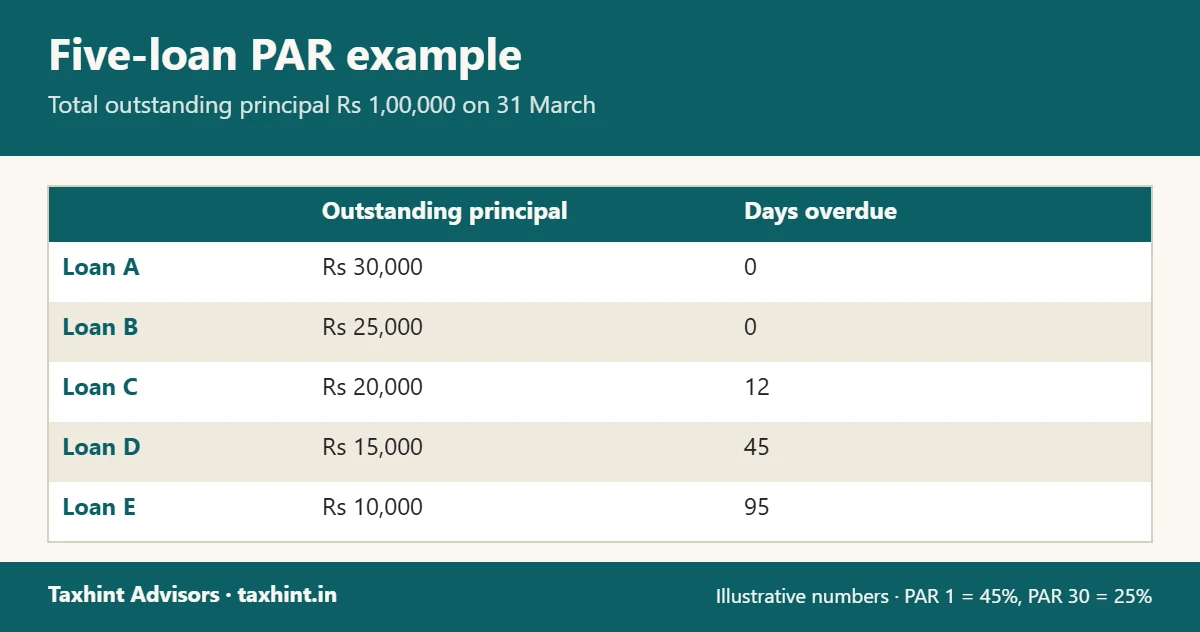
Take a Section 8 microfinance company with a small book of five loans on 31 March. The total outstanding principal is ₹1,00,000.
| Loan | Outstanding principal | Days overdue |
|---|---|---|
| A | ₹30,000 | 0 |
| B | ₹25,000 | 0 |
| C | ₹20,000 | 12 |
| D | ₹15,000 | 45 |
| E | ₹10,000 | 95 |
Now the buckets.
- PAR 1: loans C, D and E are overdue, so ₹20,000 + ₹15,000 + ₹10,000 = ₹45,000. PAR 1 = 45%.
- PAR 30: loans D and E, so ₹25,000. PAR 30 = 25%, which is the PAR 30 microfinance figure this small book would report.
- PAR 60: only loan E is beyond 60 days, so ₹10,000. Loan D at 45 days does not count. PAR 60 = 10%.
- PAR 90: loan E at 95 days, so ₹10,000. PAR 90 = 10%.
Notice that loan E sits in every bucket, and loan C only in PAR 1. That nesting is how you read the pattern. A wide gap between PAR 1 and PAR 30 means most slips get fixed within a month. A small gap means late loans tend to stay late.
Suppose the overdue instalment on loan D is cleared on 10 April. On the next month-end, D drops out of PAR 30 and PAR 1, provided nothing else has slipped. That is the point of watching it monthly.
Mistakes that distort PAR
- Counting only the overdue instalment. This understates PAR badly.
- Mixing dates. Overdue as of the 30th, portfolio as of the 31st.
- Restarting the overdue clock after a reschedule without saying so. A rescheduled loan should be flagged, so the board knows the number has been managed.
- Ignoring write-offs. If a loan is written off, PAR falls, but the loss has not gone away. Keep a separate write-off line next to PAR.
- Using different definitions across branches. One branch counts from the due date, another from the date the officer reported it.
What a healthy PAR 30 microfinance trend looks like
We do not quote an industry benchmark here. Acceptable levels depend on your borrowers, your lender covenants and your region, and any number we gave would be a guess. What we can say is how to read your own trend.
- Stable or falling over several months is the picture you want. A single good month tells you little.
- PAR 1 rising while PAR 30 holds is an early warning. Collection discipline is slipping at the meeting level before it shows up in the headline figure.
- PAR 30 moving into PAR 60 over consecutive months means loans are not recovering, so look at which centres or officers they sit with.
- Seasonal rises after festivals or harvest delays are normal in many areas. Compare with the same month last year, not only the previous month.
- One branch pulling the total is worth finding early. A branch-wise view matters more than the blended number.
For a wider look at how PAR sits beside collection efficiency, read our note on collection efficiency and portfolio at risk.
Tracking PAR 30 in software
Computing PAR 30 microfinance figures by hand is easy for five loans. It stops being easy for five hundred loans across several branches, which is where software helps. Taxhint’s platform has overdue tracking, business reports, customisable dashboards and analytics on performance metrics and trends, with branch-wise reports and a combined view for head office.
If your board or lender asks for PAR in a set format, bring that format to the demo. We will show how the overdue data maps to it. We do not claim a fixed PAR report out of the box, so check it against your own template.
FAQs
What is PAR 30 in microfinance?
It is the outstanding principal of loans with an instalment more than 30 days overdue, divided by total outstanding portfolio, shown as a percentage.
What is the difference between PAR 1 and PAR 30?
PAR 1 counts loans overdue by even one day. PAR 30 counts only those overdue by more than 30 days. PAR 1 is the earlier warning.
Do we count the whole loan or only the overdue instalment?
The whole outstanding principal of the late loan, including instalments not yet due. Accrued interest is left out.
Is PAR 90 the same as NPA?
Not automatically. PAR 90 is a measure; whether a loan is classed as non-performing depends on the rules that apply to your lender or the covenant you have signed. Check the definition your regulator or funder uses.
How often should we calculate PAR?
Monthly at minimum, on the same date each month. Branch managers may want to check PAR 1 weekly.
Can microfinance software calculate PAR?
Taxhint’s platform tracks overdue loans and has dashboards, business reports and analytics. If you use a set PAR format, bring it to the demo and we will show how the overdue data maps to it.
What PAR is acceptable?
There is no single figure that suits every lender. Judge it against your own trend, your loan covenants and your branch-wise numbers.
Want to see overdue data on your own numbers? Send us your PAR format and a sample of loans, and we will set the demo around them. Book a free demo: microfinance software starting ₹15,000. Call or WhatsApp +91 93117 95484, or write to [email protected].