November 23, 2026 · Guides
Section 8 Microfinance Compliance: The Yearly Calendar, Month by Month
Section 8 microfinance compliance follows one yearly rhythm: board meetings at least once every six calendar months, the AGM within six months of the year-end, then ADT-1 (15 days), AOC-4 (30 days) and MGT-7 (60 days) counted from the AGM, with director KYC (DIR-3 KYC Web) due by 30 June once every three financial years, and ITR-7 if you claim tax exemption. Miss the order and the dates slip. This post lays the year out month by month, with the RBI conditions that keep your exemption alive.
In this guide
- The Section 8 microfinance compliance calendar
- Board meetings and the AGM
- AOC-4, MGT-7 and ADT-1 after the AGM
- DIR-3 KYC, MBP-1 and DPT-3
- Income-tax: ITR-7 and the audit
- The RBI side: conditions, not returns
- Where microfinance companies slip
- FAQs
The Section 8 microfinance compliance calendar at a glance
Section 8 microfinance compliance starts from the fact that the company is a Section 8 company first, and that sets most of the load. If you are still at the incorporation stage, our page on Section 8 microfinance company registration covers what comes before the first filing. For a full service view, see Section 8 company compliance.
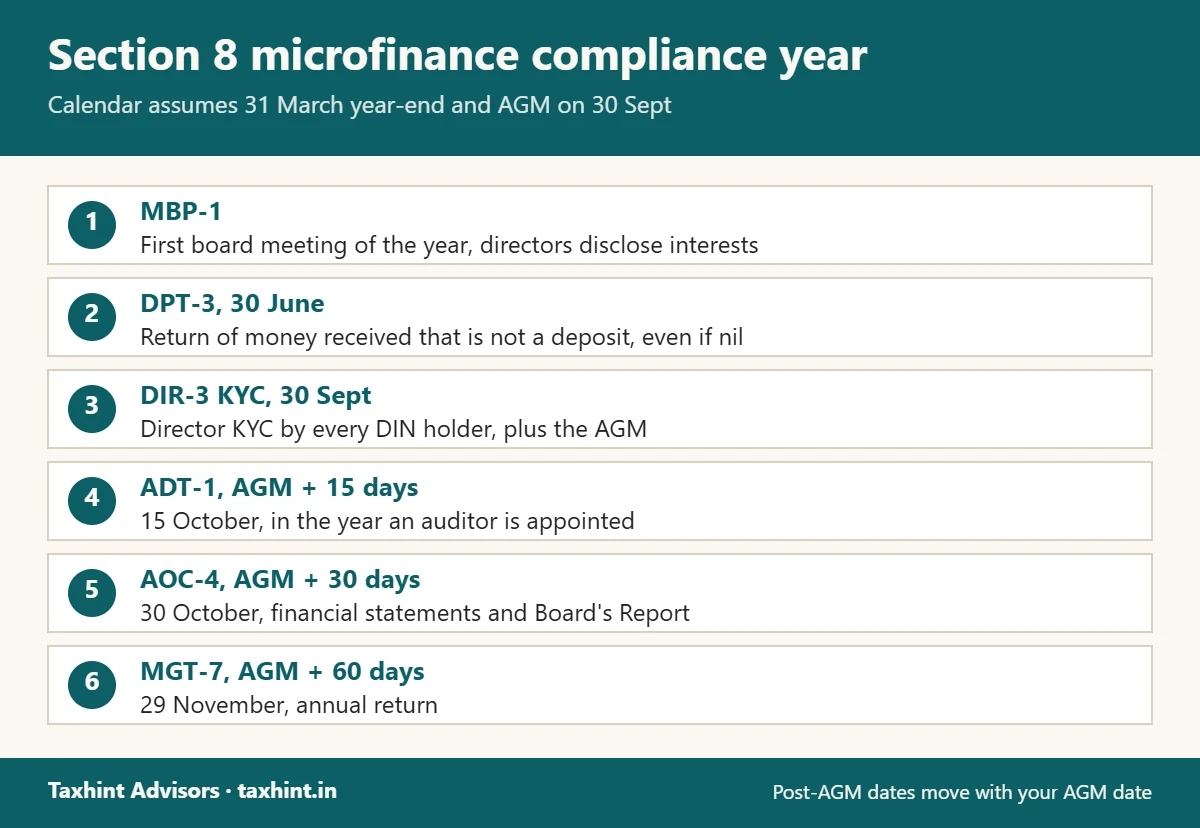
The calendar below assumes a financial year ending 31 March and an AGM held on the last day, 30 September. Your own AGM date moves the three post-AGM dates.
| When | What | Form |
|---|---|---|
| First board meeting of the year | Directors disclose their interests (Section 184) | MBP-1 |
| 30 June | Return of money received that is not a deposit, even if nil | DPT-3 |
| 30 June, in each director’s third year | Director KYC, once every three financial years (rule in force from 31 March 2026) | DIR-3 KYC Web |
| By 30 September | AGM, within six months of year-end | Minutes and notice |
| AGM + 15 days (15 October) | Auditor appointment, in the year an appointment is made | ADT-1 |
| AGM + 30 days (30 October) | Financial statements and Board’s Report | AOC-4 |
| AGM + 60 days (29 November) | Annual return | MGT-7 |
| 31 October and 30 April | Delayed payments to micro and small enterprises, only if any | MSME-1 |
| Income-tax due date | Return, where exemption is claimed | ITR-7 |
Board meetings and the AGM
The general rule is four board meetings a year. Section 8 companies get a relaxation through MCA’s notification G.S.R. 466(E) of 5 June 2015, as amended in 2017: the board must meet at least once in every six calendar months. The relaxation holds only if the company has not defaulted on filing its financial statements or annual return.
In practice we advise two or three meetings, not the bare minimum. One in April to May for approving accounts, one before the AGM, and one in October to November for review. A microfinance company has loan policies, pricing and Board-approved limits to revisit, and a minutes book with two lines a year looks thin when RBI or a bank reads it.
The AGM must be held within six months of the financial year-end, and the gap between two AGMs cannot exceed 15 months. For the first financial year, the first AGM may be held within nine months of the close. Everything after the AGM is a countdown, so book the date early. Our blog on AOC-4 and MGT-7 explains these two filings in detail.
AOC-4, MGT-7 and ADT-1 after the AGM
- AOC-4 carries the balance sheet, profit and loss and Board’s Report. It is due within 30 days of the AGM.
- MGT-7 is the annual return with the list of members, due within 60 days of the AGM. A Section 8 company files MGT-7, not the shorter MGT-7A.
- ADT-1 is filed within 15 days of the meeting at which the auditor is appointed. An auditor is appointed for a five-year term, so the form is not an annual filing; it comes up in the year of appointment or change.
One more form catches public Section 8 companies: MGT-14, for the board resolution approving the accounts and Board’s Report, within 30 days. Most microfinance Section 8 companies are private, so it rarely applies.
Consider a Section 8 company in Palwal with an AGM on 20 September. AOC-4 is due by 20 October and MGT-7 by 19 November. Late filing costs additional fees for each day of delay, and the delay shows up on the company’s MCA record when a bank or investor checks it.
DIR-3 KYC, MBP-1 and DPT-3
From 31 March 2026 director KYC is no longer a yearly filing. Each DIN holder files DIR-3 KYC Web once every three financial years, by 30 June, and within 30 days whenever their mobile number, email or address changes. If a director misses the cycle, the DIN is deactivated and has to be restored before that director can sign a form, so keep a note of each director’s due year.
MBP-1 is the director’s disclosure of interest under Section 184. Collect it at the first board meeting of each financial year, and again whenever the disclosure changes.
DPT-3 is due by 30 June and has to be filed even when the figure is nil. It matters for a lending company in a particular way: any money it receives that is not a deposit still gets reported. If you plan to raise funds from members or the public, read whether a Section 8 microfinance company can take deposits first, because the answer decides your RBI position.
Income-tax: ITR-7 and the audit
A Section 8 company that claims exemption under the charitable provisions files ITR-7. A Section 8 company without income-tax registration files as an ordinary company. The registration question is separate from incorporation, and we cover it in 12A and 80G for a Section 8 microfinance company.
The Income-tax Act, 2025 applies from 1 April 2026, so income of FY 2025-26 is still dealt with under the 1961 Act, and FY 2026-27 is the first year under the new Act. The return due date depends on whether accounts need to be audited, and notified dates have been revised in recent years. We confirm the date from the Income Tax Department each year and tell clients in writing, rather than quote one here that may change. For service details, see our 12A and 80G registration page.
The RBI side: conditions, not returns
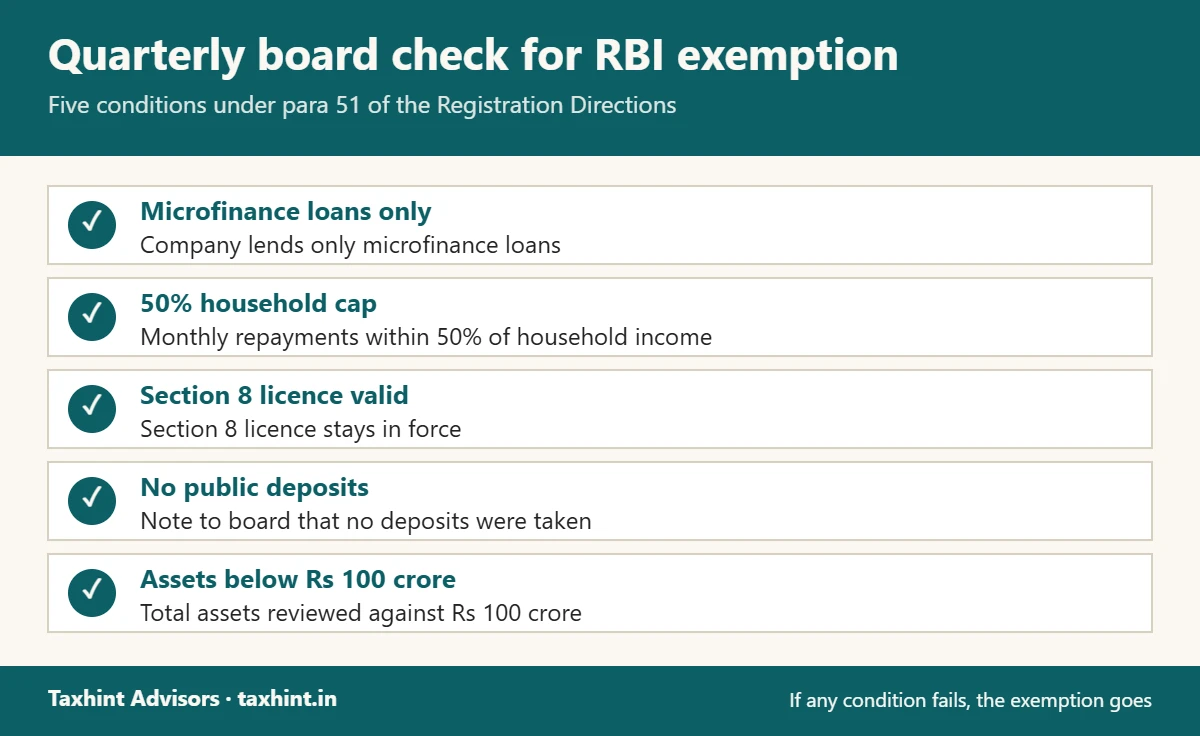
A Section 8 microfinance company is exempt from RBI registration only while it meets para 51 of the Registration Directions: only microfinance loans, each household’s monthly repayments within 50% of its income, a Section 8 licence, no public deposits, and assets below ₹100 crore.
We have not found a periodic RBI return that applies to such an exempt company, so we do not put one in the calendar. What we do put in is an internal check. Each quarter, the board should see total assets against ₹100 crore, a note that no deposits were taken, and a sample of loans tested against the 50% cap. If any of these conditions fails, the exemption goes with it. Our post on RBI’s microfinance rules explains the loan-level tests.
Where microfinance companies slip
- AGM held late. Everything after it is late too, and AOC-4 and MGT-7 inherit the delay.
- Accounts approved but not signed. Auditor’s report, Board’s Report and director signatures should be ready before the AGM notice goes out.
- DIR-3 KYC left to the last week. Mobile and email OTP failures are common. Start early.
- Treating nil DPT-3 as optional. It is not.
- No board note on the RBI conditions. This one hurts months later, when a lender asks for proof.
FAQs
Do Section 8 companies file MGT-7 or MGT-7A?
MGT-7. MGT-7A is for one-person companies and small companies, and a Section 8 company is excluded from the definition of small company.
How many board meetings must a Section 8 microfinance company hold?
At least one in every six calendar months, under the 2015 notification, as long as the company has not defaulted in filing its accounts or annual return. We advise two or three a year in practice.
What is the due date for AOC-4 and MGT-7?
AOC-4 within 30 days of the AGM and MGT-7 within 60 days of the AGM. For an AGM on 30 September, that means 30 October and 29 November.
Is ADT-1 an annual filing for a Section 8 company?
Not every year. An auditor is appointed for five years, and ADT-1 is filed within 15 days of the AGM at which an appointment is made.
Does a Section 8 microfinance company file RBI returns?
We have not found a periodic RBI return that applies to an exempt Section 8 microfinance company. The exemption depends on conditions in para 51 of RBI’s Registration Directions, which have to stay true throughout the year.
Is ITR-7 compulsory for a Section 8 company?
ITR-7 is the form for entities claiming exemption under the charitable provisions. A Section 8 company that has not claimed exemption files as an ordinary company.
What is the penalty for filing late?
The Companies Act charges additional fees for every day of delay on AOC-4 and MGT-7, and persistent default can invite action against the company and its officers. File inside the due date.
Want someone to run your Section 8 microfinance compliance for you? Get Free Consultation, or WhatsApp us on +91 93117 95484. Our CA and CS team tracks every date, drafts the minutes and files online.