November 25, 2026 · Guides
What Is EMI? Meaning, Formula and a Worked Example
EMI stands for equated monthly instalment. It is the fixed amount a borrower pays every month until a loan is fully repaid. Each EMI contains two parts: interest on the outstanding loan and a repayment of principal.
The word “equated” means the instalment amount stays the same each month, even though the split between interest and principal changes. In the early months most of the EMI is interest. Towards the end most of it is principal.
Lenders, borrowers and software all use the same idea, so it helps to understand it clearly.
In this guide
- How EMI is calculated
- A worked example
- Flat and reducing methods
- What changes the EMI
- EMI in lending software
- Common mistakes
- FAQs
How EMI is calculated
The standard reducing balance formula.
- EMI = P x r x (1 + r)^n divided by ((1 + r)^n minus 1).
- P is the loan amount, r is the monthly rate (annual rate divided by 12 and by 100) and n is the number of months.
- You can skip the maths and use the loan EMI calculator.
A worked example
Easy numbers.
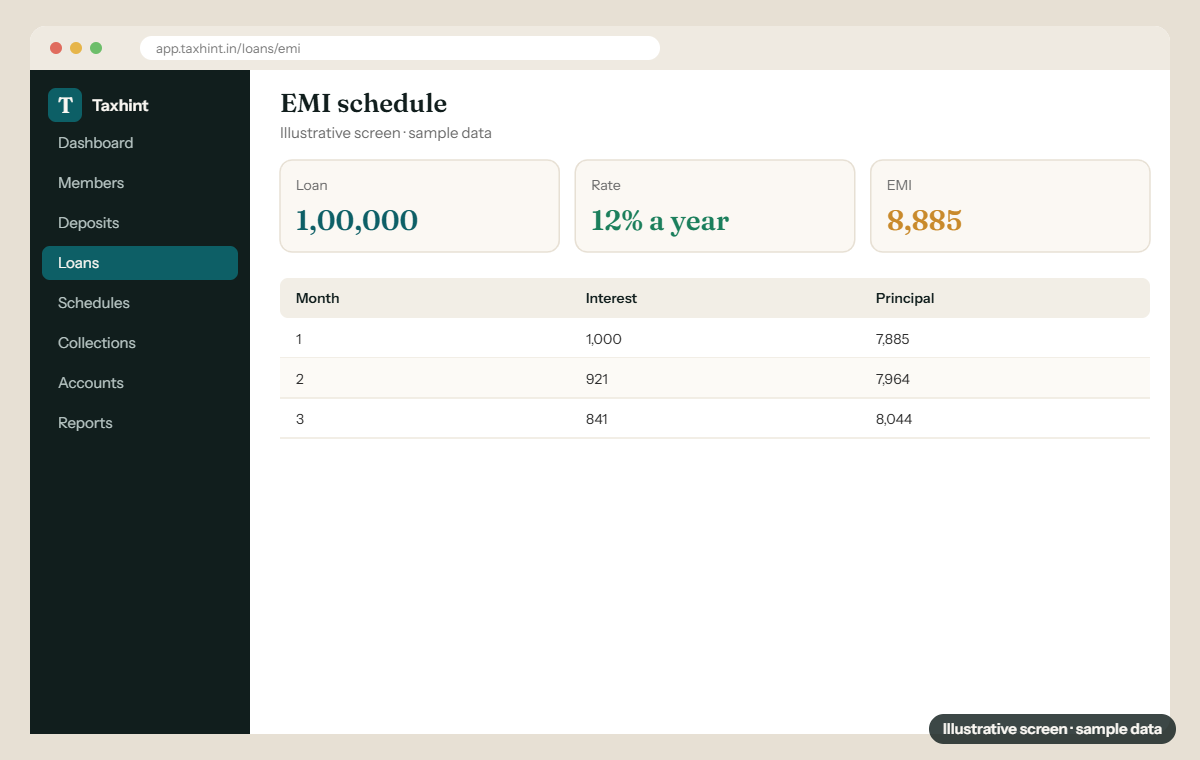
- Loan of 1,00,000 at 12% a year for 12 months.
- Monthly rate is 1%.
- EMI works out to about 8,885.
- Total paid is about 1,06,619, so total interest is about 6,619.
- In month 1, interest is 1,000 and principal repaid is about 7,885.
Flat and reducing methods
They give different costs.
- Reducing balance charges interest only on what is still owed. The example above uses it.
- Flat rate charges interest on the full original amount for the whole term.
- At the same quoted rate, flat costs more than reducing. See the flat vs reducing calculator.
What changes the EMI
Three levers.
- A bigger loan raises the EMI.
- A higher rate raises the EMI.
- A longer tenure lowers the EMI but raises the total interest.
EMI in lending software
What lenders need.
- A schedule generated at sanction with due dates and the split of each EMI.
- Receipts that match the schedule and handle part payment and early closure.
- Overdue and penal charges applied clearly. See repayment schedule explained.
See loan management software. Rules differ by lender type and change over time, so please verify with your CA or compliance officer.
Common mistakes
Avoid these.
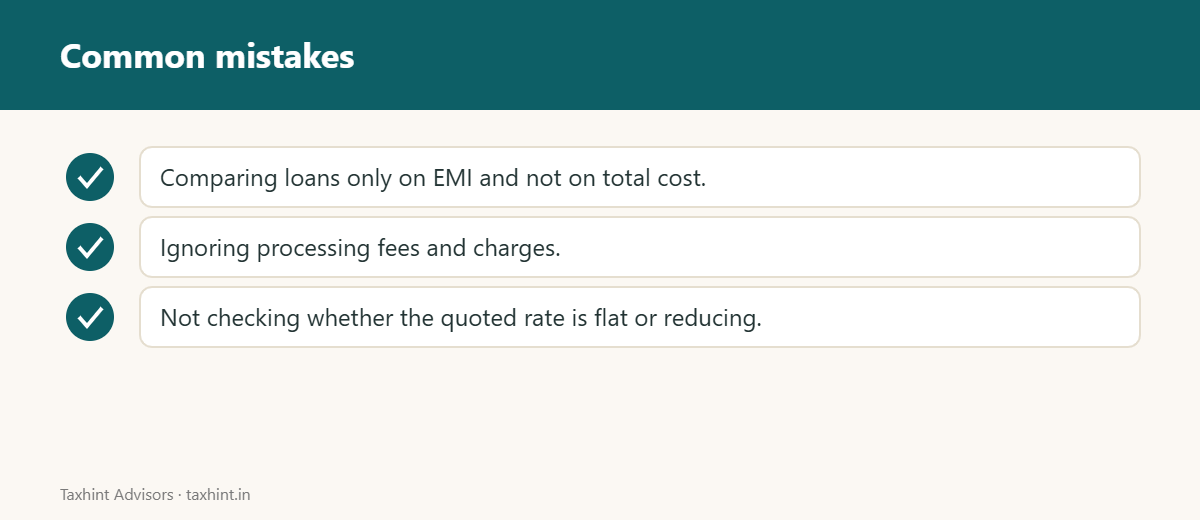
- Comparing loans only on EMI and not on total cost.
- Ignoring processing fees and charges.
- Not checking whether the quoted rate is flat or reducing.
Always ask for the full schedule in writing.
| Term | Meaning |
|---|---|
| Principal | Amount borrowed |
| Interest | Cost of borrowing |
| Tenure | Number of months |
| EMI | Fixed monthly payment |
Questions people often ask
People ask how EMI changes with a longer tenure, what happens when they prepay and whether charges are included. Keep clear written answers ready. Put the answer in writing and revisit it every quarter, because the first version is rarely the best.
- Tenure effect
- Prepayment
- Charges
A quick example to remember
For a loan of 1,00,000 at 12 percent a year for 12 months, the EMI is about 8,885 and the total interest is about 6,619. A longer tenure lowers the EMI but raises the total interest. This is illustrative and not financial advice.
- Shorter tenure, less interest
- Longer tenure, lower EMI
- Check charges separately
FAQs
What does EMI include?
Interest and a part of the principal.
Does EMI stay the same?
Usually yes for fixed rate loans. Floating rate loans can change.
Is flat or reducing better for the borrower?
Reducing balance is usually cheaper at the same rate.
Can I pay EMI early?
Prepayment terms are in your loan agreement.
Want schedules and EMIs generated correctly for every loan? Book a demo of Taxhint loan software. Talk to Taxhint on +91 93117 95484 or [email protected], or visit taxhint.in.