November 25, 2026 · Guides
What Is DPD? Days Past Due Explained With Examples
DPD stands for days past due. It counts how many days an instalment or payment has remained unpaid after its due date. If a payment is due on the 5th and received on the 20th, the account was 15 days past due at that point.
Lenders use DPD to measure risk, to decide follow-up action and to report to credit bureaus. A borrower’s DPD history can also affect future loan applications.
Here is how DPD works in practice.
In this guide
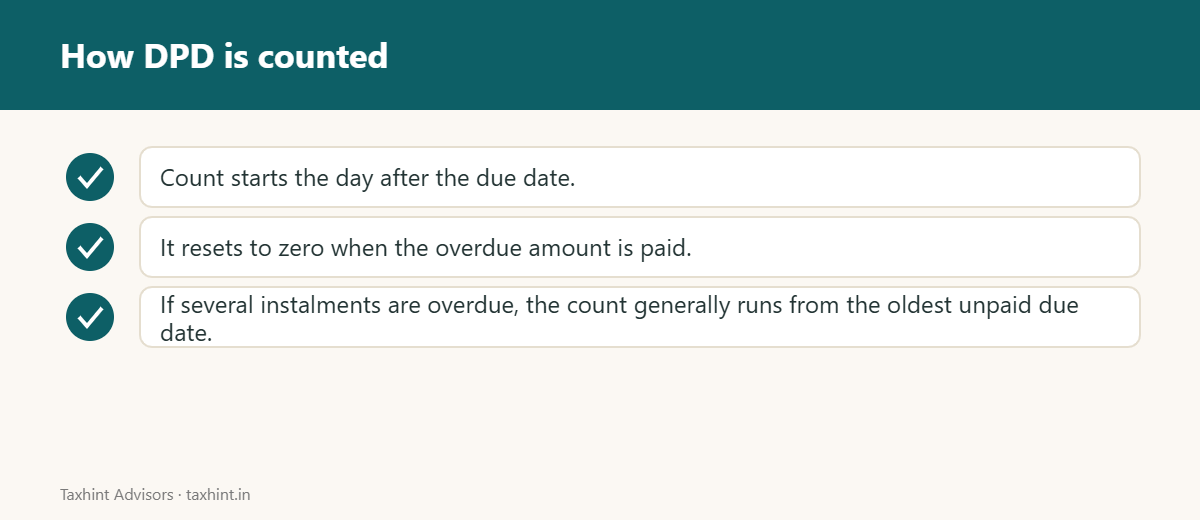
How DPD is counted
Simple rule.
- Count starts the day after the due date.
- It resets to zero when the overdue amount is paid.
- If several instalments are overdue, the count generally runs from the oldest unpaid due date.
A worked example
Dates and days.
- EMI due on 5 March.
- Not paid on 6 March: 1 DPD.
- Paid on 20 March: the account was 15 DPD before payment.
- After payment, DPD returns to 0 if nothing else is overdue.
DPD buckets
Lenders group accounts.
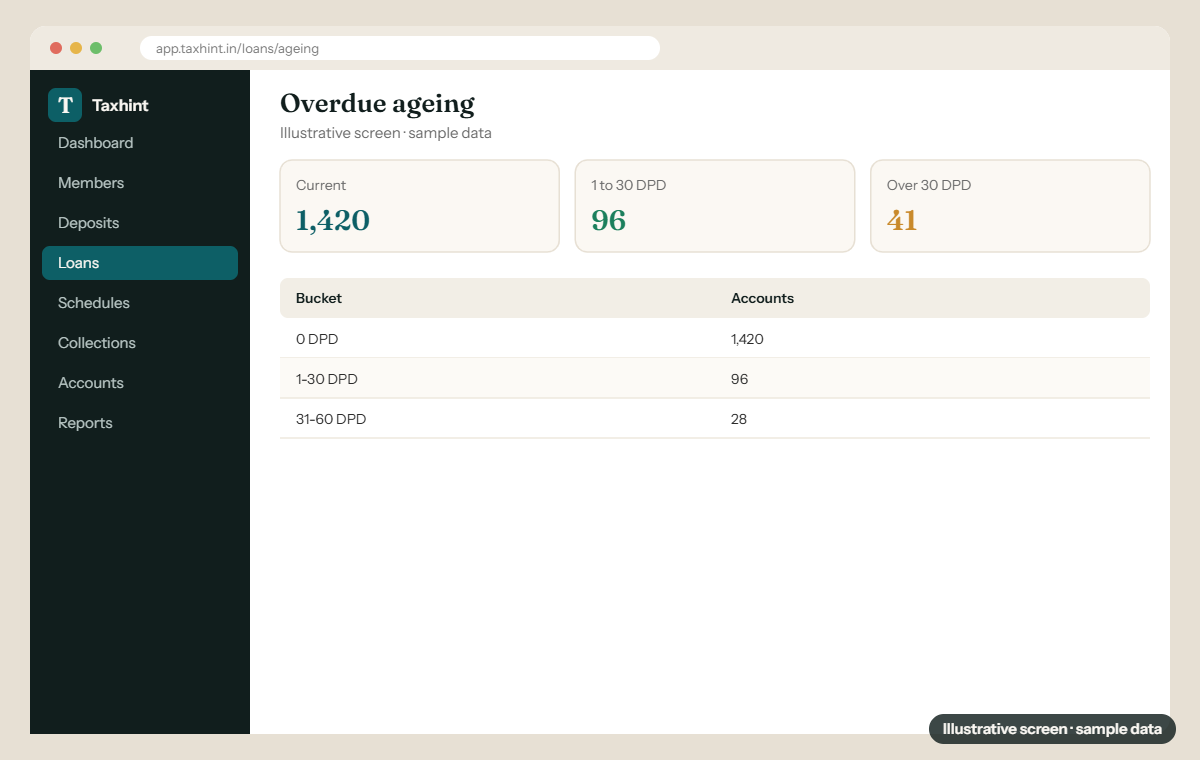
- Common groupings are current, 1 to 30, 31 to 60, 61 to 90 and above 90 days.
- Each bucket has a follow-up action: reminder, call, notice, visit, legal.
- Classification of an account as stressed depends on rules for your lender type. Please verify.
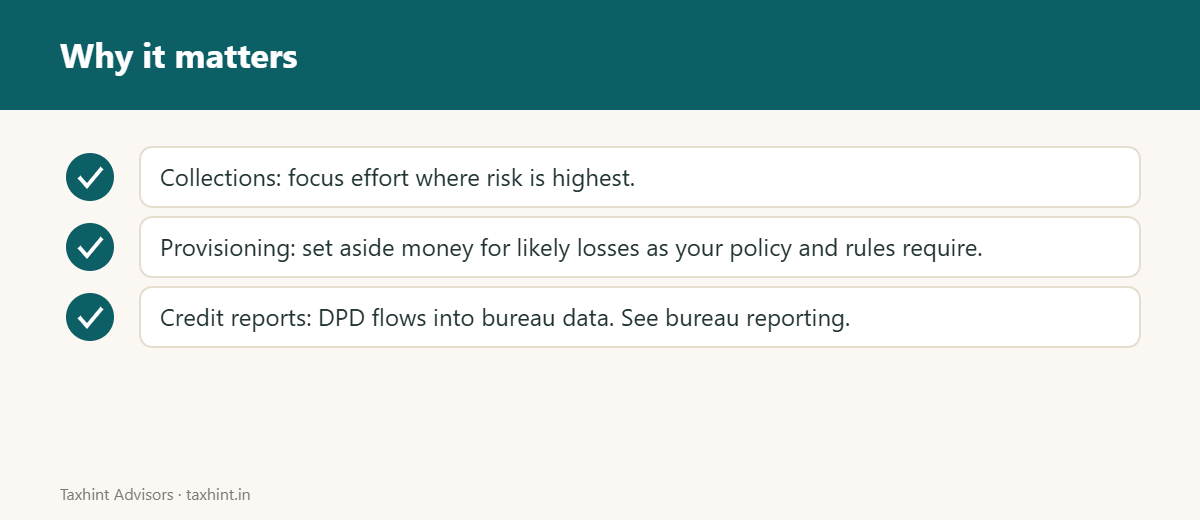
Why it matters
Three uses.
- Collections: focus effort where risk is highest.
- Provisioning: set aside money for likely losses as your policy and rules require.
- Credit reports: DPD flows into bureau data. See bureau reporting.
DPD in software
What to look for.
- Automatic DPD calculation each day.
- Ageing report by bucket, branch and agent.
- Alerts when an account crosses a bucket.
- Follow-up notes linked to the account. See overdue follow-up.
See loan management software. Rules differ by lender type and change over time, so please verify with your CA or compliance officer.
| Bucket | Typical action |
|---|---|
| 1-30 | Reminder and call |
| 31-60 | Notice and visit |
| 61-90 | Escalation |
| 90+ | Recovery as per policy |
A simple example
A loan instalment of 8,000 is due on the first of the month and is paid on the eleventh. For those ten days the account has ten days past due. If the instalment remains unpaid, the count continues and the account moves into higher overdue groups, as per your own policy and the rules that apply to you.
Common misunderstandings
- DPD is not the same as the loan being declared bad.
- It counts days from the due date, not from the day the reminder was sent.
- A part payment does not always reset the count; check your policy.
Why it matters in daily work
Collection teams use DPD to decide who to call first, managers use it to see the health of the book and regulatory reports use it to classify accounts. If the system counts DPD wrongly, every one of these decisions suffers.
Quick checklist
- Define how DPD is counted in your policy.
- Test with sample accounts including part payments.
- Compare the collection report and the bureau report.
- Review DPD buckets every month.
Please verify with your CA, CS or lawyer before you rely on it.
FAQs
Is DPD the same as default?
No. DPD counts days overdue; default is defined by your agreement and rules.
Does one day late count?
Yes, it is 1 DPD, though many lenders allow a short grace period.
How does DPD affect credit score?
Reported late payments can lower a borrower’s credit score.
Can software calculate DPD?
Yes, daily and automatically.
Want daily DPD and ageing reports? Book a demo of Taxhint loan software. Talk to Taxhint on +91 93117 95484 or [email protected], or visit taxhint.in.