November 23, 2026 · Guides
Co-Lending in Microfinance: What the RBI 2025 Rules Allow
Co-lending in microfinance lets a smaller lender source and service loans while a bank or larger NBFC funds most of each loan. Since 1 January 2026 it runs under one RBI rulebook, and the rules changed in ways that matter to anyone planning growth this way.
This guide explains what the new framework requires, where it helps a microfinance lender, and one point many promoters miss: co-lending is open only to RBI-regulated entities.
If you run an NBFC-MFI and want to grow faster than your own capital allows, co-lending in microfinance is one of the few routes RBI actively supports.
In this guide
- What co-lending in microfinance means
- The RBI 2025 Directions in brief
- Who can co-lend, and who cannot
- Where co-lending helps a microfinance lender
- A practical checklist before you sign
- A worked example
- Mistakes we see in co-lending in microfinance
- How we help
- FAQs
What co-lending in microfinance means
In a co-lending arrangement two lenders fund the same loan. One partner, usually the NBFC that knows the borrowers, sources and services the loan; the other, often a bank, puts in most of the money. The borrower sees one loan, one rate and one repayment schedule.
For microfinance this has an obvious pull. A lender with strong field teams but limited capital can reach more households without carrying every rupee on its own balance sheet.
The RBI 2025 Directions in brief
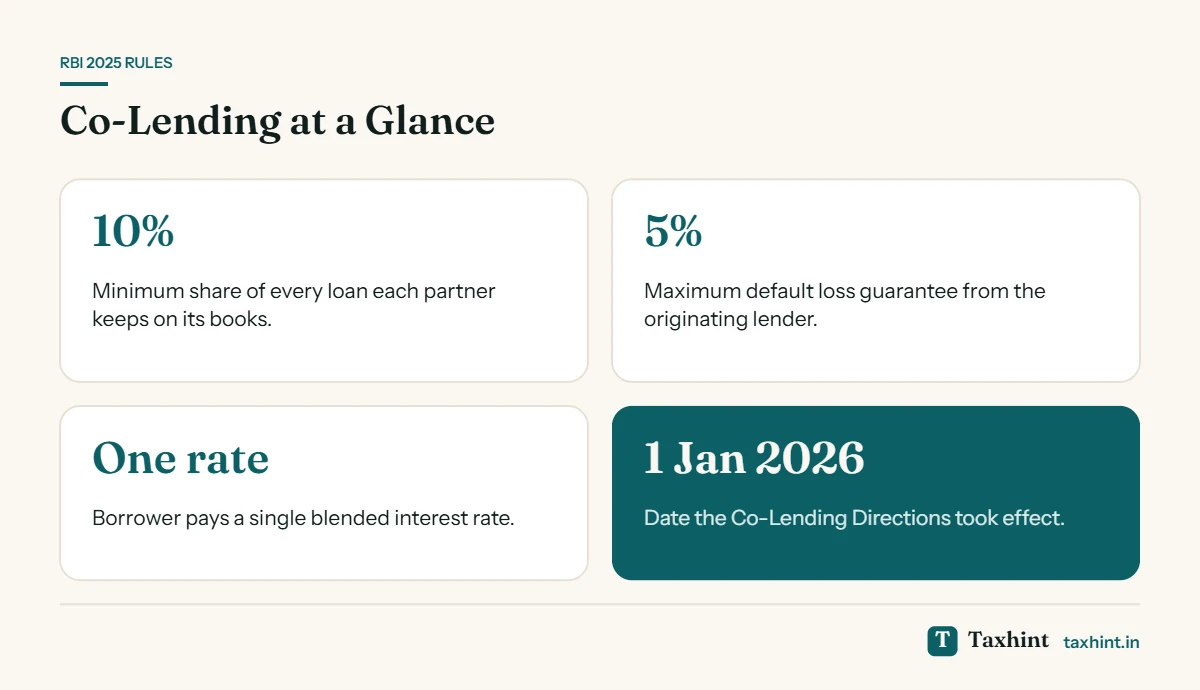
RBI issued the Co-Lending Arrangements Directions, 2025 on 6 August 2025, effective 1 January 2026. They replaced the 2020 priority-sector co-lending circular and now cover arrangements between banks and NBFCs and between NBFCs, across secured and unsecured loans.
- Minimum share: each partner must keep at least 10% of every individual loan on its own books. The old rule asked NBFCs to keep 20%.
- Default loss guarantee: the originating lender may give a guarantee of up to 5% of the outstanding loans under the arrangement, and no more.
- Blended rate: the borrower pays a single blended interest rate worked out from each partner’s share and rate.
- Same asset classification: if a loan turns bad for one partner, it is bad for both, with default information shared in close to real time.
- Quick booking: the partner has to take its share into its books within a short window after disbursement, so the originator is not left carrying the whole loan.
Digital co-lending also has to follow the Digital Lending Directions, 2025.
Who can co-lend, and who cannot
The Directions apply to regulated entities: commercial banks, NBFCs and certain other RBI-regulated lenders. A Section 8 microfinance company that relies on the RBI exemption is not a regulated entity, so it cannot enter a co-lending arrangement under these rules.
That is often the moment promoters start thinking about an RBI-registered vehicle. If co-lending is central to your plan, read our page on Section 8 to NBFC-MFI conversion and our guide to the NBFC-MFI licence.
Where co-lending helps a microfinance lender
For an NBFC-MFI, co-lending can stretch a limited net owned fund. With 10% retention, a lender can originate far more loans than it could fund alone, while earning on servicing. The 5% guarantee cap also stops partners from pushing the whole risk back on the smaller lender.
The catch is discipline. The blended rate, the KFS and the schedule must match across both partners’ systems, and asset classification has to stay in sync. Lenders that run collections on registers struggle here.
A practical checklist before you sign
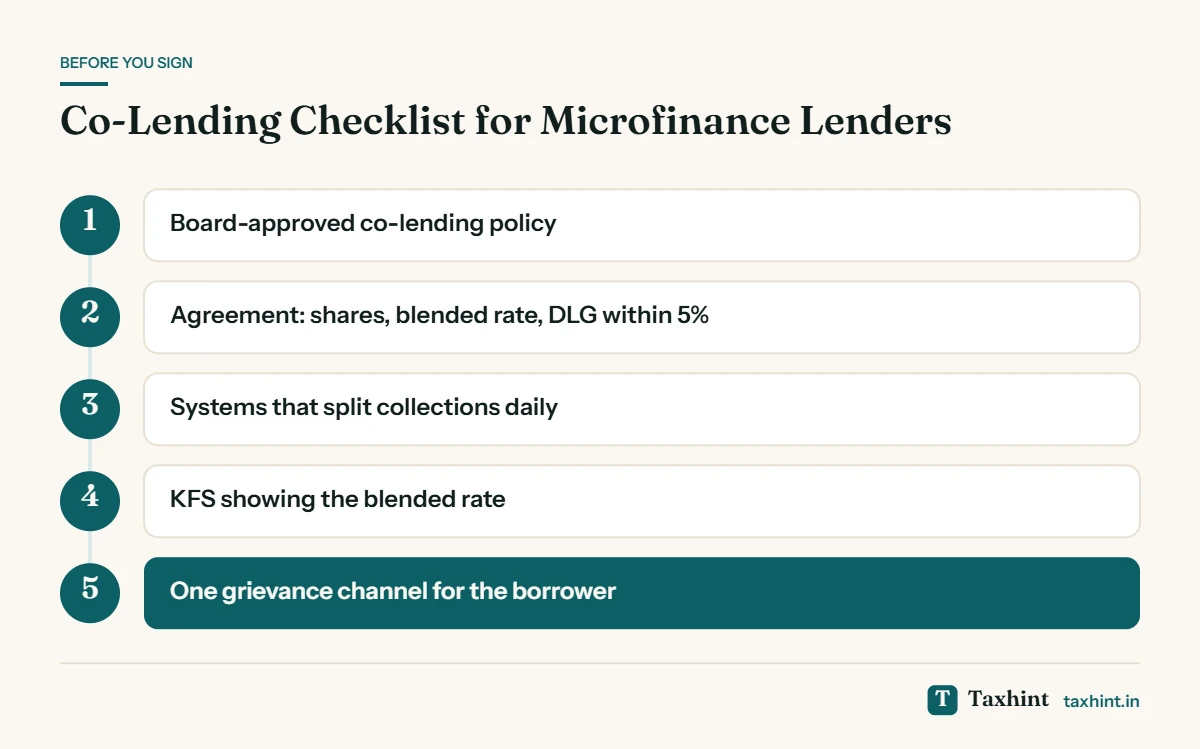
- Board-approved co-lending policy covering partner selection, pricing and exit.
- Agreement that sets each partner’s share, the blended rate, servicing fees and any default loss guarantee within the 5% cap.
- Systems that split every collection between partners the same day and report to credit bureaus correctly.
- A KFS for the borrower that shows the blended rate and all charges.
- Grievance handling that the borrower can use without knowing two lenders are involved.
Our microfinance software keeps partner shares and schedules on each loan.
A worked example
Say an NBFC-MFI sources a ₹40,000 loan and its bank partner funds 80%. The NBFC keeps ₹8,000 (20%), above the 10% floor; the bank holds ₹32,000. If the NBFC’s rate on its share is 26% and the bank’s is 20%, the blended rate the borrower pays works out from those shares, about 21.2% here. The borrower sees only that one rate on the KFS.
Across a portfolio of ₹10 crore under the arrangement, the most the NBFC could guarantee for defaults is ₹50 lakh (5%). Anything beyond that sits with each partner in proportion to its share.
Mistakes we see in co-lending in microfinance
- Two schedules for one borrower. If the partners’ systems compute EMIs differently, receipts and bureau reports stop matching. Agree one schedule and one rounding rule.
- Guarantees disguised as fees. Fees between partners cannot hide a credit enhancement beyond what the Directions permit.
- Classification drift. When one partner marks a loan overdue and the other does not, both are out of line with the rules.
- Treating it as funding only. Co-lending in microfinance still needs the originator to follow every borrower protection rule, because the borrower deals with you.
How we help
We draft co-lending policies and agreements, check them against the 2025 Directions, and set up the loan system so partner shares, blended rates and bureau reporting run correctly from the first disbursement. If you are still a Section 8 lender, we start with the NBFC-MFI registration route.
FAQs
Can a Section 8 microfinance company co-lend with a bank?
Not under the RBI Co-Lending Arrangements Directions, 2025, which apply to regulated entities. An exempt Section 8 company is not one. An NBFC-MFI can.
How much of each loan must an NBFC keep under co-lending?
At least 10% of every individual loan, under the 2025 Directions. Each partner has the same minimum.
Is a default loss guarantee allowed in co-lending?
Yes, from the originating lender, up to 5% of the outstanding loans under the arrangement.
When did the new co-lending rules start?
They were issued on 6 August 2025 and took effect on 1 January 2026.
Planning a microfinance company or already running one? Our CAs and CSs handle registration, RBI work and yearly compliance. Get Free Consultation or WhatsApp +91 93117 95484.