November 23, 2026 · Guides
Digital Lending Rules for Microfinance: What RBI’s 2025 Directions Mean for You
Digital lending rules for microfinance matter the moment a lender uses an app, a website or a partner platform to source, approve or collect loans. RBI pulled its earlier guidelines into one set of Digital Lending Directions in May 2025.
Many microfinance lenders think of themselves as field businesses, not digital lenders. But a loan applied for on an app, or approved through a partner’s platform, can fall within these rules. Here is what they ask.
In short, digital lending rules for microfinance are about the borrower seeing the full cost upfront, the money moving only between the borrower and the lender, and the lender owning every partner it uses.
In this guide
- Who the 2025 Directions cover
- What the borrower must get
- Lending service providers and apps
- Data, privacy and default loss guarantees
- How this lands in a microfinance business
- A typical microfinance journey, step by step
- Common gaps
- How we help
- FAQs
Who the 2025 Directions cover
The Digital Lending Directions, 2025 were issued on 8 May 2025 and apply to regulated entities, including NBFCs, that lend digitally themselves or through lending service providers (LSPs) and digital lending apps. Provisions on multi-lender platforms started on 1 November 2025.
An exempt Section 8 microfinance company is not a regulated entity, so the Directions do not bind it directly. They are still a good standard to copy, and they bind any NBFC or bank you partner with.
What the borrower must get
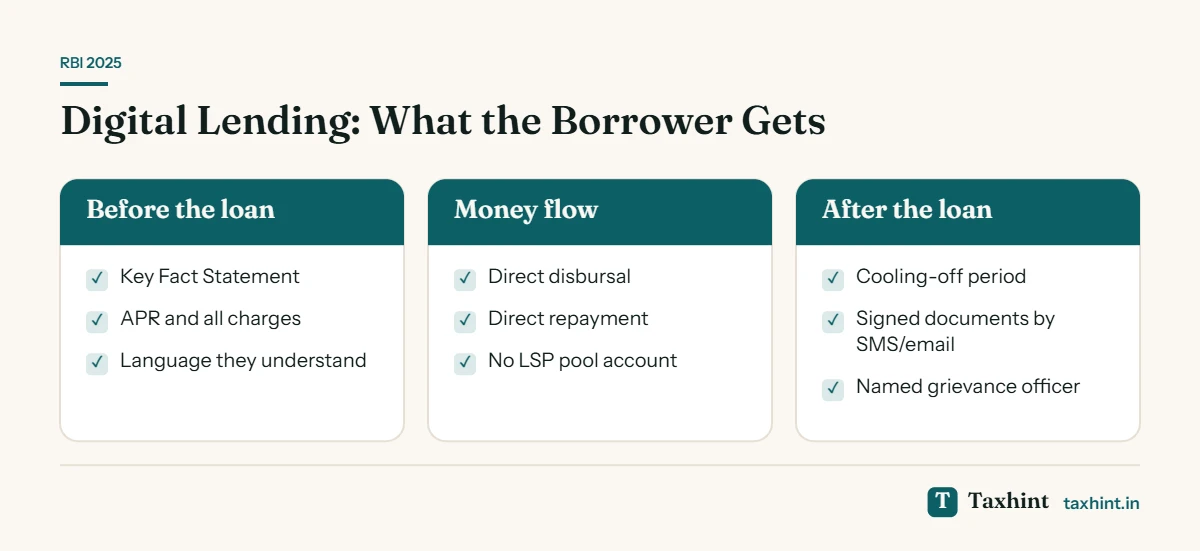
- Key Fact Statement: a KFS before the loan, showing the annual percentage rate and all charges, in line with RBI’s KFS circular.
- Direct money flow: disbursal and repayment go directly between the borrower’s account and the lender, not through an LSP’s pool account.
- Cooling-off period: a window in which the borrower can exit the loan by repaying principal and proportionate APR without penalty.
- Signed documents: loan documents sent automatically to the borrower’s verified email or SMS after the loan is executed.
- Grievance officer: named for the lender and the LSP, with an escalation path to RBI’s complaint system.
Lending service providers and apps
Lenders must do enhanced due diligence before signing with an LSP, looking at its technology, data privacy, storage and conduct with borrowers. The lender stays responsible for borrower outcomes even when work is outsourced.
Where an LSP works with several lenders, the borrower must see all matching offers, including from lenders whose offers did not match, so the comparison is fair.
Data, privacy and default loss guarantees
Data collection needs the borrower’s explicit consent and must be limited to what is needed. Biometric data is not to be stored by apps, and data must be kept in India. Any default loss guarantee from an LSP is capped at 5% of the portfolio, with conditions on how it is invoked.
How this lands in a microfinance business
Most microfinance lenders mix field and digital work. A loan officer may collect KYC on a tablet, approval may run in software, and repayments may come by UPI or eNACH. The more of the journey that is remote and automated, the more these rules matter.
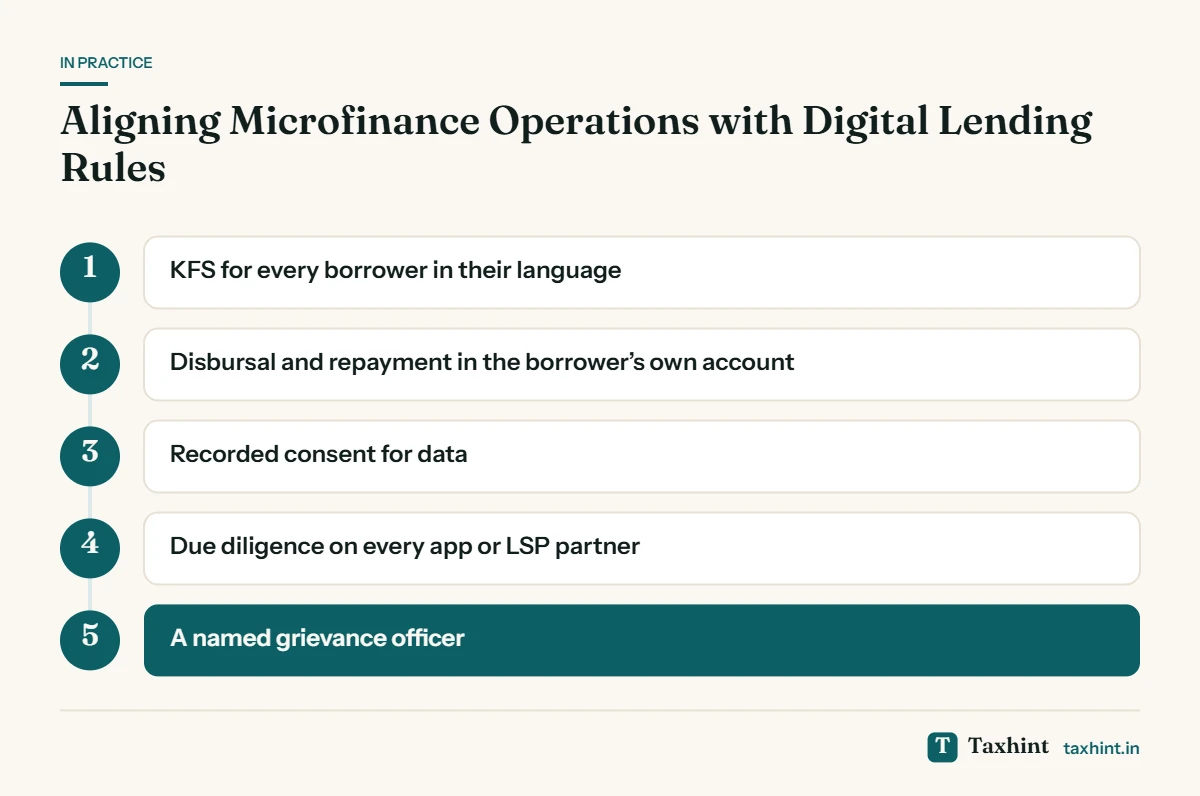
Practical steps: give every borrower a KFS in their language, keep disbursal and repayment in the borrower’s own bank account where possible, record consent for data, and name a grievance officer. Our guides on eNACH for microfinance EMIs and the Key Fact Statement go deeper.
A typical microfinance journey, step by step
A borrower in a centre applies through the loan officer’s tablet. KYC is captured, the bureau is checked in the background, and the software approves within the credit policy. The loan is credited to the borrower’s bank account and repaid by eNACH every week.
Under the digital lending rules for microfinance applied by a regulated lender, that journey needs: a KFS in the borrower’s language before the loan, consent for data captured on the tablet, disbursal straight to the borrower’s account, repayment straight to the lender, signed documents sent by SMS, and a named grievance officer printed on the loan card.
Common gaps
- KFS generated but not shown before signing.
- Collections routed through a field partner’s account before reaching the lender.
- Apps that read contacts or photos with no clear reason.
- No record of the borrower’s consent to data use.
- LSP agreements with no audit rights for the lender.
Each of these is easy to fix before an inspection and painful after one.
How we help
We review your app, LSP agreements and loan journey against the Directions, fix the KFS and consent flow, and set up our microfinance software so disbursal and repayment stay in the borrower’s own account.
FAQs
Do RBI digital lending rules apply to a Section 8 microfinance company?
Not directly, because a Section 8 company relying on the RBI exemption is not a regulated entity. They do apply to NBFCs and banks, including any partner you work with, and they are a sound standard to follow.
When did the Digital Lending Directions, 2025 come into force?
They were issued on 8 May 2025. Multi-lender platform provisions started on 1 November 2025.
Can an LSP collect repayments into its own account?
No. Disbursal and repayment must flow directly between the borrower’s account and the regulated lender.
Is there a cooling-off period for digital loans?
Yes. The borrower can exit within the cooling-off period by repaying principal and proportionate APR, without a penalty.
Running loans on spreadsheets? Book a free demo of our microfinance software, starting ₹15,000, or WhatsApp +91 93117 95484.