November 24, 2026 · Guides
How a Section 8 Microfinance Company Raises Funds
A Section 8 company cannot pay dividends to its members. That one fact shapes how Section 8 microfinance funds are raised: through borrowings, grants and donations, member contributions and retained surplus.
This guide explains each route, its limits and the records you need.
In this guide
- The core rule
- Funding routes
- A worked illustration
- Records to keep
- Mistakes to avoid
- Related reading
- Where this comes from
- Building a funding plan
- Tax and exemption points
- FAQs
The core rule
Under the Companies Act, a Section 8 company applies its profits to promote its objects and cannot pay a dividend to its members. Investors who expect dividends or share-price gains will not fit this structure. Lenders and grant-makers, who expect repayment or impact, do. Check your MOA for the exact wording of your objects and restrictions.
Funding routes
| Route | Notes |
|---|---|
| Member contributions | Shares or contributions that earn no dividend; confirm treatment with your auditor |
| Bank and NBFC loans | Repayable with interest; lenders look at governance and portfolio |
| Wholesale lenders | See SIDBI and NABARD |
| Grants and donations | Need 12A and 80G for donor benefits and clear utilisation reports |
| CSR funds | Need CSR-1 registration and an eligible activity; see CSR guide |
| Retained surplus | Surplus stays in the company and builds capital |
A worked illustration
This is illustrative, not a client case. A Section 8 lender starts with member contributions, adds a small grant for training, borrows from a bank once it has audited accounts, and keeps its surplus inside the company. In year three its net worth is higher because no dividend ever left. It then uses the stronger balance sheet to borrow more. The model grows slowly but steadily.
Records to keep
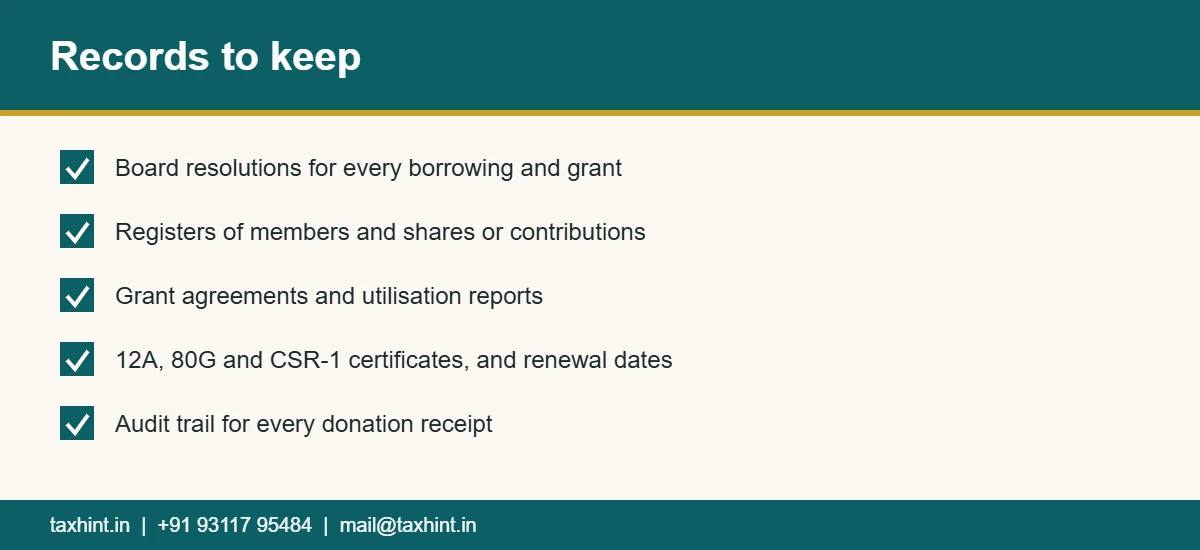
- Board resolutions for every borrowing and grant.
- Registers of members and shares or contributions.
- Grant agreements and utilisation reports.
- 12A, 80G and CSR-1 certificates, and renewal dates.
- Audit trail for every donation receipt.
Mistakes to avoid
- Paying “returns” to members in disguise.
- Mixing grant money with lending capital without approval.
- Missing donor reporting dates.
- Borrowing without board approval or charge filings; see board checklist.
Related reading
Read funding sources in India and ITR and exemptions.
Where this comes from
Source: Companies Act, 2013 – Section 8 (MCA). Figures and policies change, so check the latest version before relying on them.
Building a funding plan
Start by writing down how much money you will need for the next three years and in what form: lending capital, operating costs and capacity building. Match each need to a source. Operating deficits in the early years are often covered by grants and member contributions, lending capital by borrowings, and growth by retained surplus. Review the plan every year with your board and auditor.
Tax and exemption points
- 12A approval affects the tax treatment of surplus.
- 80G affects donor deductions.
- Keep donation receipts and utilisation records for scrutiny.
- Check the current rules each year; see our ITR guide.
FAQs
Can members earn interest on contributions?
Be careful. Disguised returns can breach the no-dividend rule. Ask your CA or CS first.
Can a Section 8 company borrow?
Yes, subject to its MOA and the company law.
Do donors get tax benefits?
If the company holds a valid 80G approval, subject to the law.
Does the rule apply to NBFC-MFI status?
If you also seek NBFC registration, RBI conditions apply in addition to company law.
Can we accept foreign funds?
Foreign contributions are governed by separate law and approvals. Take specialist advice before accepting any.
Planning a microfinance company or already running one? Our CAs and CSs handle registration, RBI work and yearly compliance. Get Free Consultation or WhatsApp +91 93117 95484.