November 24, 2026 · Guides
Microfinance Funding Sources in India: Where the Money Comes From

Every microfinance lender runs on borrowed and owned money. Choosing the right microfinance funding sources decides your cost of funds, your growth speed and how much freedom you keep.
This guide lists the main sources, what lenders look for, and how a young company can build credibility step by step.
In this guide
- The main sources
- What lenders check first
- Funding by stage
- A worked illustration
- Mistakes that raise your cost of funds
- Related reading
- Where this comes from
- Comparing cost of funds
- Diversify but keep it manageable
- FAQs
The main sources
| Source | Typical use | What they look at |
|---|---|---|
| Equity from owners | Starting capital and capital adequacy | Promoter track record |
| Bank term loans | On-lending portfolio | Net worth, portfolio quality, rating |
| NBFC and fund lenders | Term loans or structured lines | Governance and data quality |
| Development finance institutions | Wholesale loans and refinance | Mission, client protection, systems |
| Securitisation and direct assignment | Selling loan pools | Portfolio quality; see portfolio sale |
| Grants and CSR | Programmes, capacity, first-loss support | Registration, impact; see CSR funding |
What lenders check first
- Legal status, registrations and clean MCA filings.
- Board strength and fit and proper directors; see fit and proper.
- Audited accounts and an auditor lenders trust.
- Portfolio quality: PAR and collection efficiency; see metrics compared.
- MIS that ties to the ledger; see MIS reports.
- Client protection, grievance and fair practices.
Funding by stage
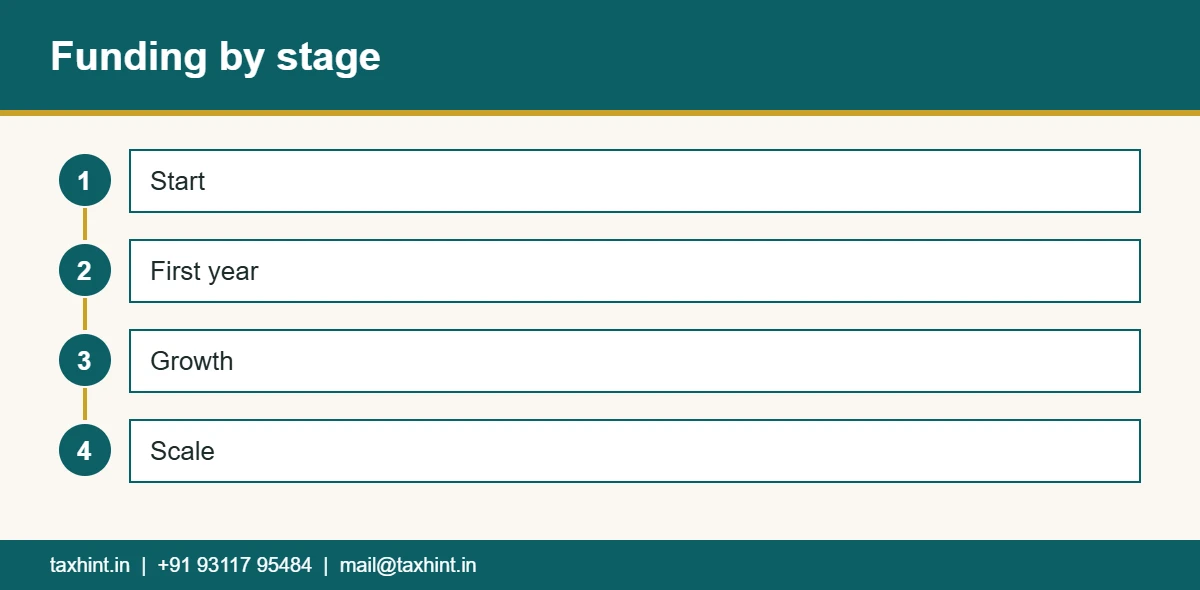
- Start: owners’ capital, small grants and a clean legal structure.
- First year: small bank or NBFC loans against a modest, well-run portfolio.
- Growth: bigger lines, rating and wholesale lenders.
- Scale: securitisation, debt instruments and larger institutional lines.
A worked illustration
This is illustrative, not a client case. A new Section 8 lender starts with owner contributions and a small grant. After twelve months of clean audited accounts and low overdue, it approaches a bank for a small term loan. The bank asks for MIS, policies and a board-approved pricing policy. Because the lender had these ready, the talks took weeks rather than months. The lesson: documents and discipline buy cheaper money.
Mistakes that raise your cost of funds
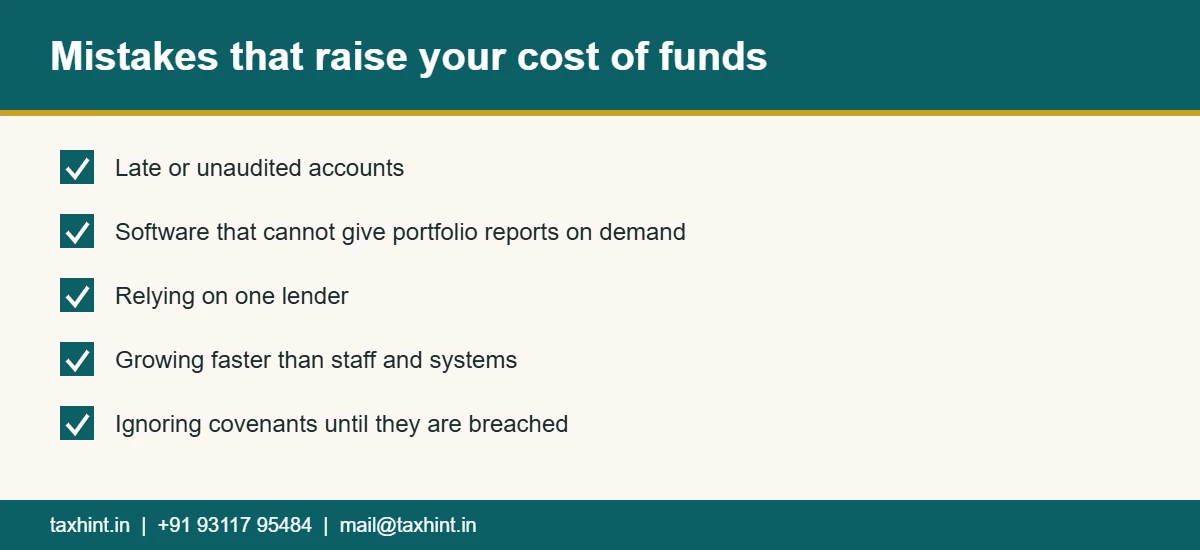
- Late or unaudited accounts.
- Software that cannot give portfolio reports on demand.
- Relying on one lender.
- Growing faster than staff and systems.
- Ignoring covenants until they are breached.
Related reading
See how a Section 8 company raises funds and SIDBI and NABARD.
Where this comes from
Source: SIDBI, institutional finance and micro lending development. Figures and policies change, so check the latest version before relying on them.
Comparing cost of funds
Do not compare only the interest rate. Add processing fees, security or guarantee costs, covenants that limit growth, reporting burden and the time it takes to draw the loan. A slightly higher rate with light covenants can be cheaper in practice than a low rate that forces you to hold idle cash. Build a simple sheet with each offer, its total yearly cost and its conditions, and let the board decide on that sheet.
Diversify but keep it manageable
- Aim for several lenders so one refusal does not stop disbursement.
- Stagger repayment dates so large instalments do not fall together.
- Track covenants in one register with owners and dates.
- Keep a funding plan for the next twelve months, updated each quarter.
FAQs
Can a Section 8 company take bank loans?
Yes, as a company it can borrow, subject to its MOA and lenders’ terms.
Which source is cheapest?
It varies with rating, size and market conditions. Compare total cost, including fees and covenants.
Do funders expect a rating?
Many do, especially larger lenders. See our grading and rating guide.
Should we take grants?
Grants help with capacity and first-loss support but come with reporting duties. Match them to your plan.
How much funding should we plan for?
Work back from your disbursement plan and repayment schedule. Our fund requirement calculator helps you estimate it.
Planning a microfinance company or already running one? Our CAs and CSs handle registration, RBI work and yearly compliance. Get Free Consultation or WhatsApp +91 93117 95484.