November 24, 2026 · Guides
Microfinance Credit Bureau Reporting: Common Errors and How to Fix Them
Every microfinance credit bureau reporting file is a statement about a real family. A wrong overdue flag can block that family from its next loan, and a duplicate record can double-count their debt. Bad data also hurts the lender, because other lenders use the same bureau to decide who to approve.
This guide lists the mistakes that appear most often, shows a practical monthly checking routine, and explains how to handle a dispute when one arrives.
In this guide
- Why it matters more in microfinance
- The errors we see most
- A worked illustration
- A monthly quality check
- Handling a dispute
- Related reading
- Where this comes from
- FAQs
Why it matters more in microfinance
Microfinance borrowers are often first-time borrowers with thin credit history. One reporting mistake can become their entire credit record. Regulated lenders are expected to report regularly and accurately, and RBI and the bureaus treat data quality as the lender’s responsibility, not the bureau’s.
The errors we see most
| Error | What goes wrong | Where to fix it |
|---|---|---|
| Missing or wrong ID | Record rejected or matched to a wrong person | Enrolment form and KYC capture |
| Spelling variants of the same name | Duplicate members; double exposure | Member master and data entry rules |
| Closed loan still shown open | Borrower looks over-indebted | Closure process in the system |
| Wrong days past due | Borrower wrongly shown delinquent | Due-date logic and holiday handling |
| Wrong overdue amount | Dispute and complaint | Collection posting and reversals |
| Late submission | Stale data for other lenders | Month-end close schedule |
A worked illustration
This is an illustration, not a real borrower. A member pays her final instalment on the 28th, but the branch posts it on the 2nd of next month. The month-end file shows the loan as overdue by two instalments. She applies to another lender and is declined. The fix is not only to correct her record. It is to make the posting rule “collections are dated as of the day collected” and to block back-dated entries without a checker.
A monthly quality check
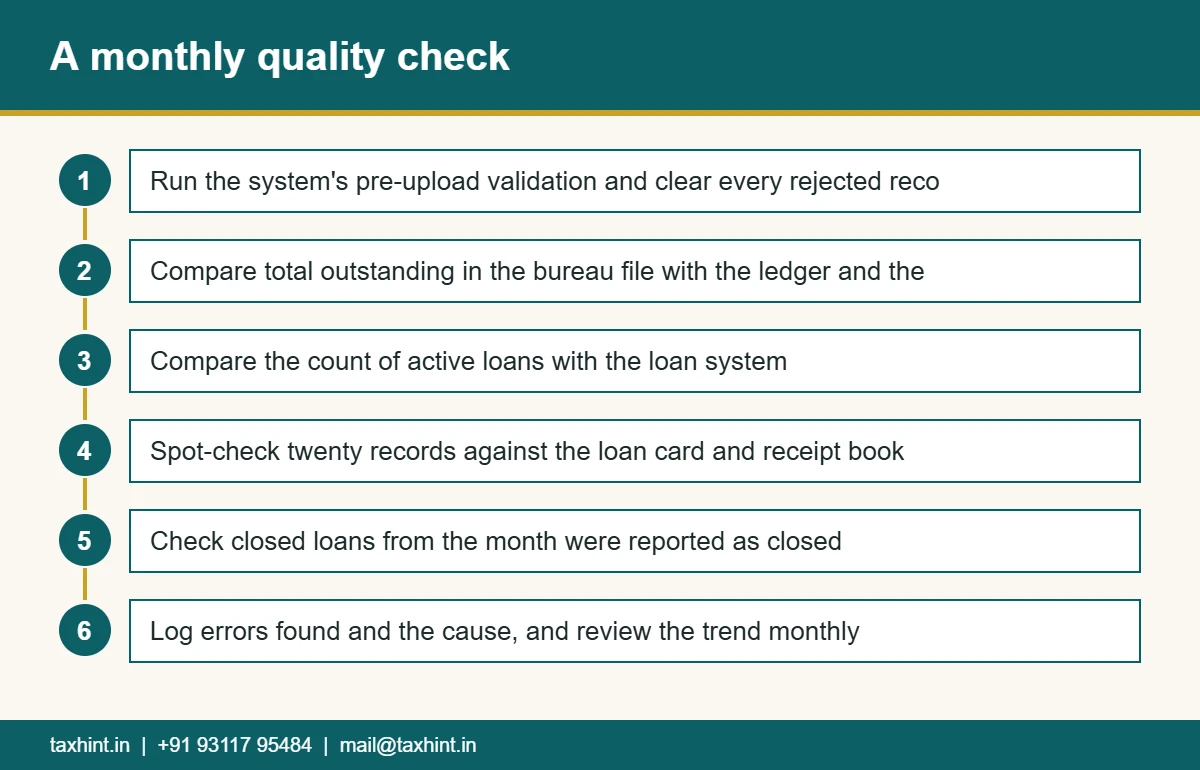
- Run the system’s pre-upload validation and clear every rejected record at source.
- Compare total outstanding in the bureau file with the ledger and the MIS report.
- Compare the count of active loans with the loan system.
- Spot-check twenty records against the loan card and receipt book.
- Check closed loans from the month were reported as closed.
- Log errors found and the cause, and review the trend monthly.
Handling a dispute
When a borrower or another lender raises a dispute, acknowledge it, check the loan record and receipts, correct the data through the bureau’s dispute process within its timeline, and keep the evidence. Tell the borrower what was changed. Repeated disputes from one branch point to a training or process problem, not bad luck.
Related reading
Start with credit bureau membership. A good loan system validates files before upload; see our microfinance software and the MIS reports list.
Where this comes from
Source: RBI (NBFC – Microfinance Institution) Directions, 2025. RBI updates these Directions from time to time, so confirm the current text before acting.
FAQs
How often must a lender report to the bureaus?
As the bureau rules and RBI instructions require for your category. Most lenders report monthly or more often.
Who is responsible for errors in the file?
The lender that submits the data is responsible for its accuracy.
How long does a dispute take to resolve?
The bureau process sets timelines. Act quickly, because the borrower may be waiting for a loan.
Can errors affect a borrower’s next loan?
Yes. Wrong overdue flags or duplicate records can lead to rejections.
Can software prevent these errors?
Validation rules and posting controls remove most of them, but staff training is still needed.
Running loans on spreadsheets? Book a free demo of our microfinance software, starting ₹15,000, or WhatsApp +91 93117 95484.