November 23, 2026 · Guides
CIC Membership for Microfinance: Bureaus, Reporting Dates and the Bureau File
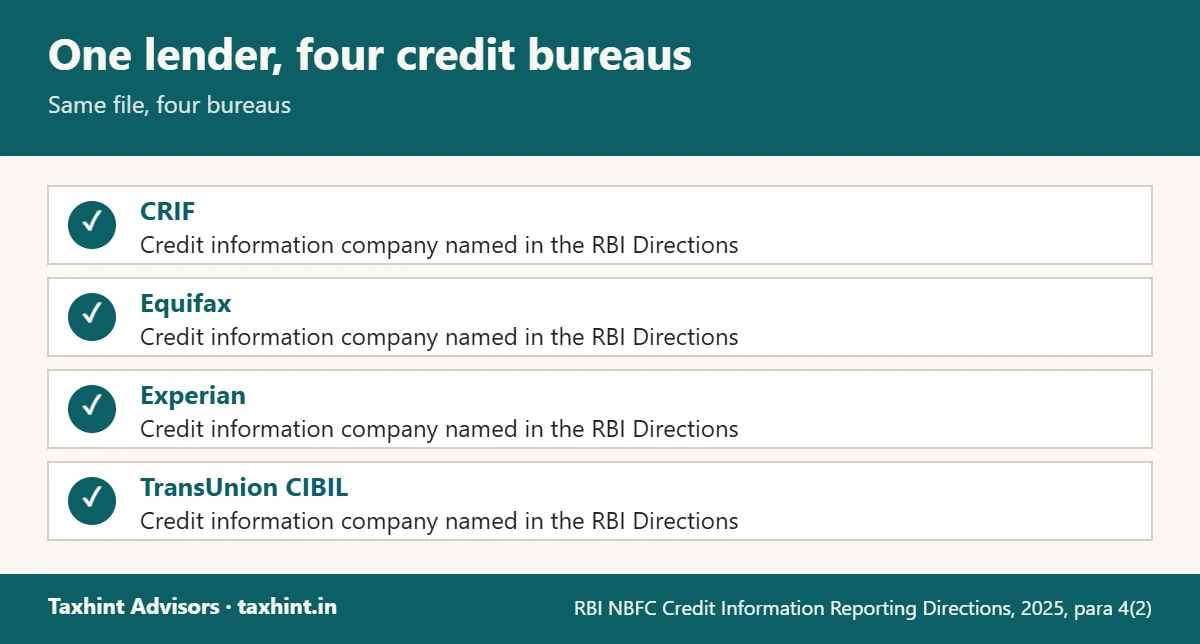
CIC membership microfinance rules are simple for NBFC-MFIs: it is mandatory. RBI’s NBFC credit information reporting rules require each covered lender to join all four credit information companies (CICs): CRIF, Equifax, Experian and TransUnion CIBIL. Data goes to them several times a month in a standard format. A Section 8 company that is exempt from RBI registration is not named in those Directions, so for such a company the decision rests on its funders and its own policy.
Either way, CIC membership in microfinance comes with the same work: clean borrower data, a monthly rhythm, and software that can produce the file. Here is how CIC membership microfinance reporting fits together.
In this guide
- CIC membership microfinance: who must join and what it costs
- CIC membership microfinance for a Section 8 company
- Reporting dates and deadlines
- Data format: UCRF and the MFI form
- What the borrower record must hold
- How software produces the bureau file for CIC membership microfinance
- Mistakes that get files rejected
- FAQs
CIC membership microfinance: who must join and what it costs
The Reserve Bank of India (Non-Banking Financial Companies – Credit Information Reporting) Directions, 2025 apply to nine categories of NBFC, and NBFC-MFI is one of them (paragraph 3). On CIC membership, microfinance lenders are told in paragraph 6 that a credit institution must become a member of every CIC registered with RBI, and paragraph 4(2) names the four.
The fee is capped. Paragraph 7 sets the one-time membership fee at no more than ₹10,000 per CIC, and paragraph 8 caps the annual fee at ₹5,000 per CIC. Historical data also has to go to all CICs (paragraph 10(1)).
If you are setting up an NBFC-MFI, CIC membership belongs on your list with the CoR application. Software that handles both the borrower record and the bureau file, such as our microfinance software, makes the first month easier. Our microfinance company registration page covers the wider licensing path.
CIC membership microfinance for a Section 8 company
A Section 8 company that gives only microfinance loans, takes no public deposits and has assets below ₹100 crore is exempt from RBI registration. The credit information Directions list registered NBFC categories, and Section 8 companies are not mentioned in the text we read. So we cannot tell a promoter that RBI forces membership on an exempt company.
In practice, we advise joining anyway. A Section 8 company’s borrowers may well have loans from other lenders, and the 50% household repayment test needs that information. Bureau reports also help when banks or funders ask how you monitor repayment. Ask each bureau how CIC membership works for a microfinance entity of your type before you commit. Our Section 8 microfinance company registration page explains the exemption in full.
Reporting dates and deadlines
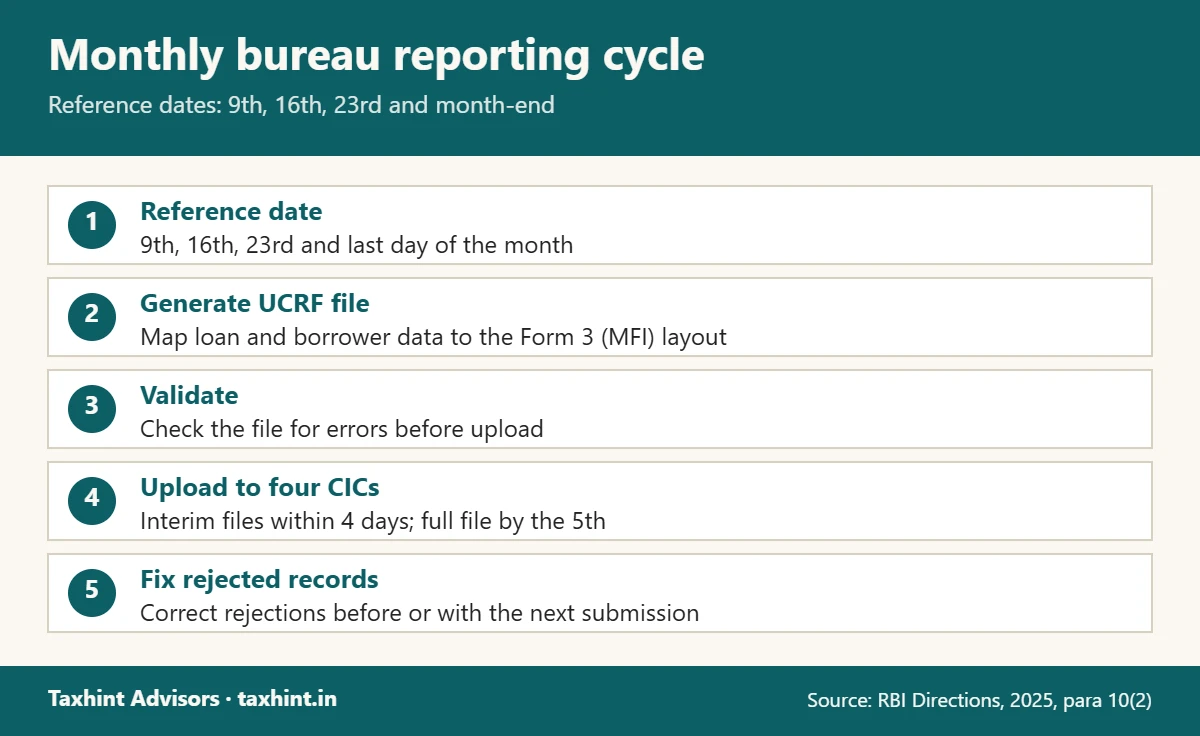
Paragraph 10(2) of the NBFC Directions fixes four reference dates a month: the 9th, 16th, 23rd and the last day. A full file as on month-end is due by the 5th of the next month. For the 9th, 16th and 23rd, only incremental accounts are reported, and they are due within four calendar days of the date. The Directions note that this paragraph was substituted with effect from 1 July 2026.
| Reference date | What to send | Due |
|---|---|---|
| 9th | Incremental accounts | Within 4 calendar days |
| 16th | Incremental accounts | Within 4 calendar days |
| 23rd | Incremental accounts | Within 4 calendar days |
| Last day of month | Full file | By the 5th of next month |
Paragraph 10(3) adds that repayments, including the last instalment, must not be left unreported. For a weekly collection business that matters, because a loan closed in week three has to appear as closed.
Data format: UCRF and the MFI form
Paragraph 9 requires reporting in the Uniform Credit Reporting Format, a standard, non-proprietary format with three forms. Form 1 is consumer, Form 2 is commercial, and Form 3 is the microfinance (MFI) segment. Self-help group member data is also reported in Form 3 (paragraph 13).
Three points from the Directions are worth noting. Paragraph 11 says the Credit Information Companies Act gives statutory backing for sharing credit information, so a separate consent for reporting is no longer needed. Paragraph 12(10), added from 1 July 2026, requires the borrower’s CKYC number to be reported where available. And paragraph 34 requires an SMS or email alert to the borrower about default or days past due when data is submitted, where contact details exist.
Alongside this, paragraph 54 of the Credit Facilities Directions, 2025 requires NBFCs to report household income to CICs. That means the income figure you record at sanction has to travel into the file as well.
What the borrower record must hold
CIC membership microfinance reporting is only as good as the record behind it. Before onboarding the first member, check that the system stores each of these:
- Legal name as per KYC document, date of birth and gender.
- PAN or Aadhaar-based ID details as collected, plus the CKYC number where it exists. Our post on borrower KYC documents covers the collection side.
- Mobile number and email, because the default alerts depend on them.
- Household income and the group or centre the member belongs to. See JLG and SHG group lending software.
- Loan account details: sanction date and amount, tenure, instalment, outstanding, days past due and closure date.
Our KYC and credit bureau reports guide shows how the pre-sanction bureau check sits on top of this.
How software produces the bureau file for CIC membership microfinance
The cycle is simple in principle. The software takes the loan and borrower data as on the reference date, maps each field to the UCRF layout, writes the file, and lets you validate it before upload. The bureau then sends back accepted and rejected records, and you correct the rejected ones before or with the next submission.
If you still do this in Excel, you rebuild the file four times a month and fix rejections by hand. With a proper system, the data is already structured per borrower, so the file becomes a report you run rather than a project. When you evaluate any vendor, ask them to show three things on a demo login: the field mapping to Form 3, the validation errors before upload, and the day-past-due logic for weekly and fortnightly schedules.
On the Taxhint platform, the borrower record carries Aadhaar and PAN verification, CIBIL score check and upload, and C-KYC upload. The software also generates the UCRF bureau reporting file from that same record, so the monthly run is a report, not a rebuild. Book a demo and we will walk through the file for your product mix. Our software guide for Section 8 microfinance companies has the wider checklist.
Mistakes that get files rejected
We do not have a list of rejection counts to quote, so we will stay with what the Directions imply and what is easy to check.
- A loan closed in the field but not closed in the system, so the old status keeps going out.
- Name spelt one way in KYC and another in the loan record.
- Missing mobile or email, so the alert cannot go.
- Skipping the incremental file on the 9th, 16th or 23rd because the full file is only due monthly.
Portfolio quality ties in too: the same days-past-due data feeds portfolio at risk, so a clean bureau file and a reliable PAR report come from the same discipline.
The Directions are on the RBI site: NBFC Credit Information Reporting Directions, 2025.
FAQs
Is CIC membership microfinance reporting compulsory for NBFC-MFIs?
Yes. The NBFC credit information reporting Directions, 2025 cover NBFC-MFIs and require membership of all four CICs.
Which are the four credit information companies?
CRIF, Equifax, Experian and TransUnion CIBIL, as named in paragraph 4(2) of the Directions.
What is the cost of CIC membership for a microfinance company?
The fee for CIC membership is capped. The Directions cap the one-time fee at ₹10,000 per CIC and the annual fee at ₹5,000 per CIC.
How often must microfinance data be reported to CICs?
On the 9th, 16th, 23rd and last day of each month. The full month-end file is due by the 5th of the next month, and the interim files within four calendar days.
What is Form 3 (MFI) in UCRF?
It is the microfinance segment of the Uniform Credit Reporting Format. SHG member-level data is also reported in this form.
Does a Section 8 microfinance company have to join CICs?
The Directions do not name Section 8 companies exempt from RBI registration. We advise joining anyway, but check onboarding with each bureau and with your funders.
Do I need borrower consent to report to CICs?
Paragraph 11 says the statutory backing under the Credit Information Companies Act makes a separate consent unnecessary. Keep your loan application declarations in order all the same.
Must I report the CKYC number?
Yes, where it is available, under paragraph 12(10) added from 1 July 2026.
Want to see how bureau reporting, KYC and collections work on one borrower record? Book a free demo of our microfinance software, starting ₹15,000, or WhatsApp +91 93117 95484.