November 24, 2026 · Guides
PMLA Reporting for a Microfinance Lender: CTR, STR and FIU-IND
PMLA reporting is not only for banks. NBFCs are reporting entities under the Prevention of Money Laundering Act and its Rules, and an NBFC-MFI that handles cash from thousands of borrowers must have a working reporting process.
This guide explains the main reports, the dates that matter, who files them and how to avoid the common failure: nobody owns the process until a notice arrives.
In this guide
- The people the law expects you to appoint
- The main reports
- What it looks like in microfinance
- Set-up steps
- Records
- Related reading
- Where this comes from
- FAQs
The people the law expects you to appoint
A reporting entity must appoint a Principal Officer, who is responsible for furnishing reports to the Financial Intelligence Unit, India (FIU-IND), and a Designated Director who is responsible overall for compliance. Their names, designations and addresses are communicated to FIU-IND, and the entity registers on FIU-IND’s FINnet portal to file reports electronically.
The main reports
| Report | What it covers | Timing |
|---|---|---|
| Cash Transaction Report (CTR) | Cash transactions of ₹10 lakh or more, and series of connected cash transactions that together exceed that amount in a month | By the 15th of the following month |
| Suspicious Transaction Report (STR) | Any transaction, cash or not, that looks suspicious, including attempts | Within seven working days of concluding that it is suspicious |
| Counterfeit Currency Report | Cash transactions involving forged notes | As the rules specify |
Thresholds and timelines come from the PML Rules and RBI instructions. Confirm the current text; the table is a summary.
What it looks like in microfinance
Loan repayments in microfinance are small and frequent, so individual cash amounts are usually well below the CTR threshold. The reporting risk usually lies elsewhere: a large cash deposit from a director or a vendor, a borrower repaying several loans in one go in cash, or unexplained third-party repayments. These should flow to the principal officer through a simple internal alert process.
Set-up steps
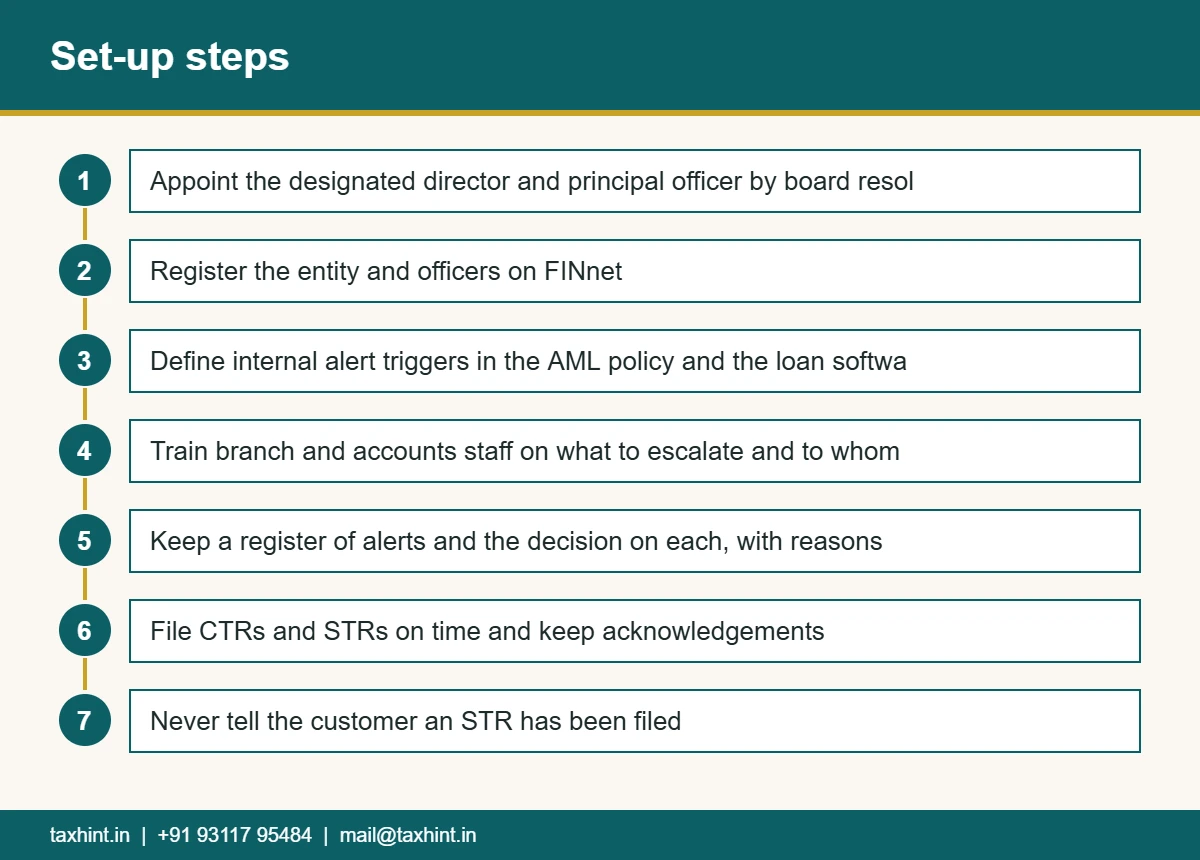
- Appoint the designated director and principal officer by board resolution.
- Register the entity and officers on FINnet.
- Define internal alert triggers in the AML policy and the loan software.
- Train branch and accounts staff on what to escalate and to whom.
- Keep a register of alerts and the decision on each, with reasons.
- File CTRs and STRs on time and keep acknowledgements.
- Never tell the customer an STR has been filed.
Records
Maintain records of transactions and identification for the period the Rules prescribe, and make them available to competent authorities on request. Records must allow reconstruction of individual transactions.
Related reading
This sits beside your AML and KYC policy and the RBI returns calendar.
Where this comes from
Source: FIU-IND – obligations of reporting entities and FINnet. RBI updates these Directions from time to time, so confirm the current text before acting.
FAQs
Do small microfinance lenders file CTRs?
If you handle cash transactions at or above the threshold you must report them. Many small lenders file few or none, but they still need the process.
What is an STR?
A report of a transaction or attempted transaction that appears suspicious, filed with FIU-IND through FINnet.
How soon must an STR be filed?
Within seven working days of the principal officer concluding that the transaction is suspicious.
Can we tell the borrower about an STR?
No. Disclosing a report to the customer is called tipping off and is prohibited.
Who files the reports?
The Principal Officer files through the FINnet portal.
Planning a microfinance company or already running one? Our CAs and CSs handle registration, RBI work and yearly compliance. Get Free Consultation or WhatsApp +91 93117 95484.