November 24, 2026 · Guides
Microfinance Institution Grading and Rating: What Agencies Look At
A good rating lowers your cost of funds and opens doors with banks and DFIs. Microfinance institution grading and rating look at more than profit: governance, portfolio quality, systems and how you treat borrowers.
This guide explains what agencies assess and how a lender can prepare in a year.
In this guide
- Rating and grading
- What agencies assess
- A twelve-month preparation plan
- A worked illustration
- Common weaknesses
- Related reading
- Where this comes from
- Data room checklist
- After the rating
- Cost and timing
- FAQs
Rating and grading
| Type | What it is |
|---|---|
| Credit rating | An opinion on the ability to repay specific debt, by a registered rating agency |
| Institutional grading | A broader assessment of the institution, including governance, systems and mission |
| Code of conduct assessment | A check against client protection and conduct standards |
What agencies assess
- Governance: board independence, committees and fit and proper directors.
- Capital adequacy and liquidity.
- Portfolio quality: PAR, write-offs and concentration.
- Systems: MIS, internal controls and audit; see MIS reports.
- Client protection and grievance handling.
- Funding mix and relationship with lenders.
A twelve-month preparation plan
- Month 1-2: gap review against rating criteria.
- Month 3-4: fix policies and committees; see board committees.
- Month 5-6: strengthen MIS and reconciliation.
- Month 7-8: internal audit and board review of findings.
- Month 9-10: gather data and prepare rating documents.
- Month 11-12: meet the agency and respond to queries.
A worked illustration
This is illustrative, not a client case. An agency asks a lender for loan-level data and finds that the portfolio report and the ledger differ by a small amount every month because of manual postings. The lender fixes the integration and reconciles daily. The next review shows no difference, and the agency notes improved controls. Systems fixes often move a rating faster than growth does.
Common weaknesses
- Board with little independent challenge.
- High concentration in one state or product.
- Weak reconciliation and delayed audits.
- Thin capital buffer; see NOF tracking.
- Complaints not tracked or analysed.
Related reading
See funding sources and social performance reporting.
Where this comes from
Source: SIDBI – microfinance initiatives including code of conduct assessment. Figures and policies change, so check the latest version before relying on them.
Data room checklist
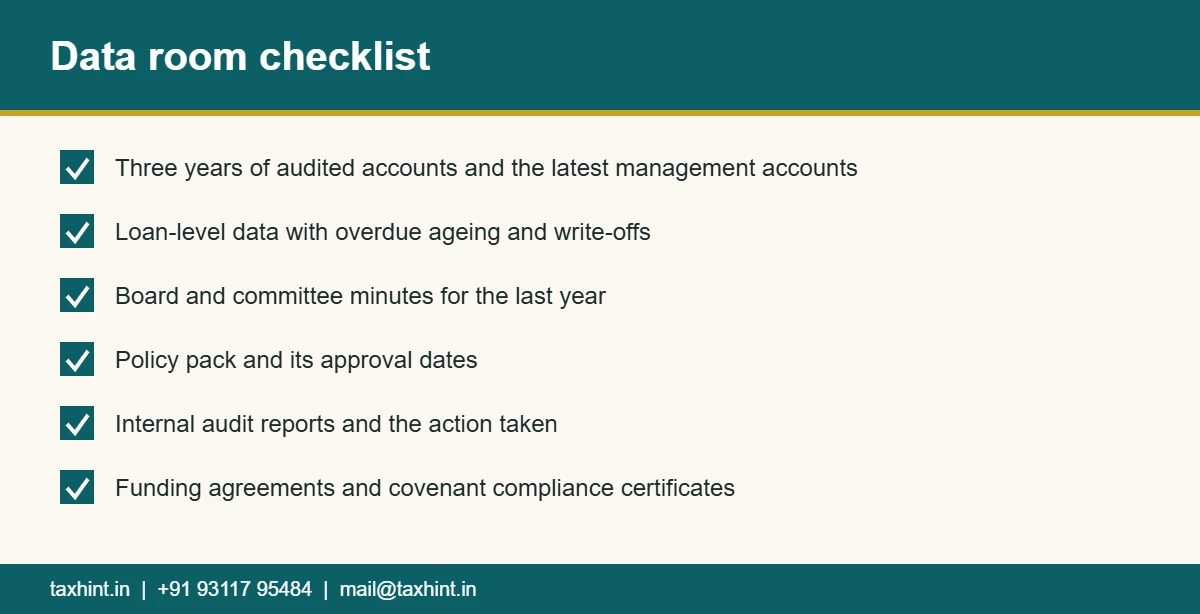
- Three years of audited accounts and the latest management accounts.
- Loan-level data with overdue ageing and write-offs.
- Board and committee minutes for the last year.
- Policy pack and its approval dates.
- Internal audit reports and the action taken.
- Funding agreements and covenant compliance certificates.
After the rating
Treat the report as a to-do list. Take each weakness the agency lists, assign an owner and a date, and report progress to the board every quarter. Share the rating with lenders only along with your plan to improve it. A lender who sees action trusts the next rating more than the last one.
Cost and timing
Rating agencies charge fees and need several weeks. Budget for the first survey and the yearly review, and plan the timing so the rating is ready before a big funding round. Ask the agency for a list of documents in advance so the process does not stall.
FAQs
Is a rating mandatory?
Not in every case, but many lenders and larger funders expect one.
How long does a rating take?
It depends on the agency and how ready your data is.
Does the rating expire?
Ratings are reviewed periodically. Plan for annual surveillance.
Can a Section 8 company get rated?
Yes, agencies assess governance, portfolio and systems regardless of structure.
Does a rating guarantee funding?
No, but it is a strong input for lenders and often a condition for larger lines.
Which agencies rate microfinance lenders?
Several registered agencies do. Compare their criteria and fees and speak to lenders they have rated.
Planning a microfinance company or already running one? Our CAs and CSs handle registration, RBI work and yearly compliance. Get Free Consultation or WhatsApp +91 93117 95484.