November 21, 2026 · Guides
Section 8 vs NBFC-MFI: Which Microfinance Route Fits You?
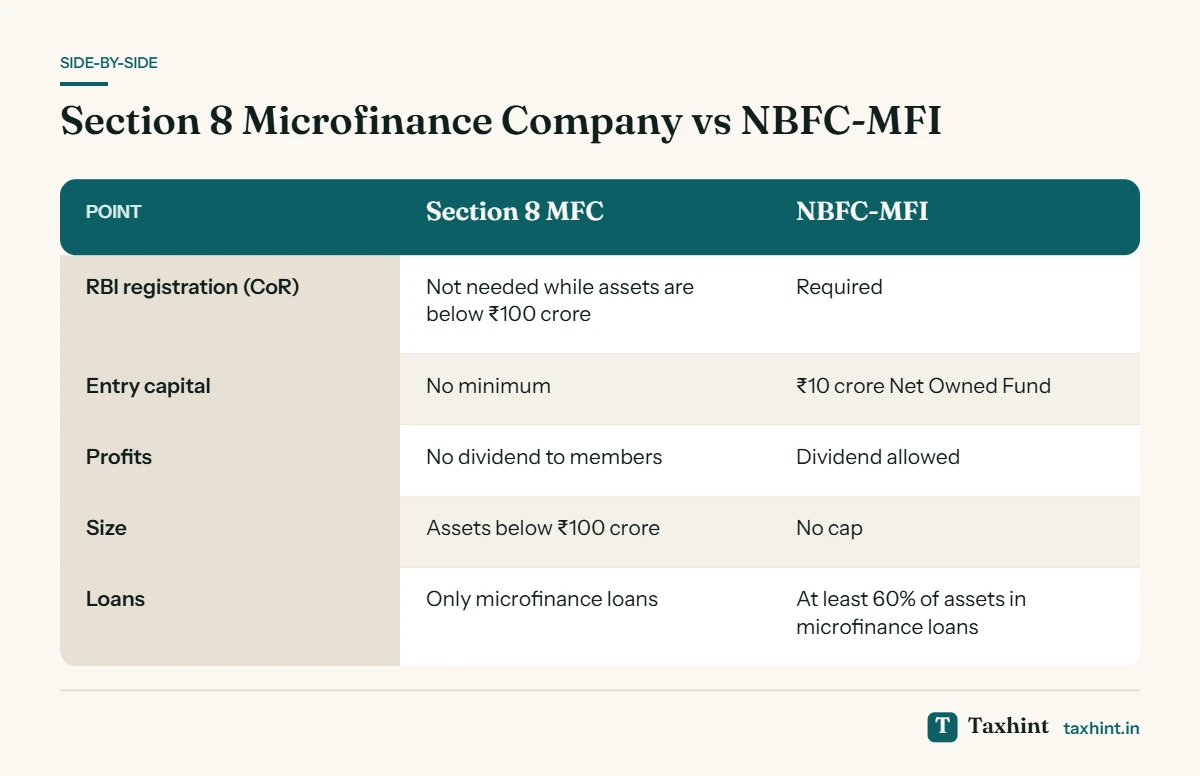
Section 8 vs NBFC-MFI comes down to two questions: do you want to earn returns for investors, and can you put ₹10 crore of net owned fund into the company? A Section 8 microfinance company needs no RBI registration while it stays within the exemption, but it can never pay a dividend. An NBFC-MFI can pay returns and grow without an asset ceiling, but it needs ₹10 crore NOF and RBI’s certificate of registration before the first loan.
The Section 8 vs NBFC-MFI choice also shapes your compliance for years, so it is worth getting right at the start. For the full process on each side, see our pages on Section 8 microfinance company registration and NBFC-MFI registration. This post puts the two routes side by side and works through who should pick which.
In this guide
- Section 8 vs NBFC-MFI comparison table
- The differences that decide the choice
- Who should pick which: five scenarios
- Switching routes later
- FAQs
Section 8 vs NBFC-MFI comparison table
| Point | Section 8 microfinance company | NBFC-MFI |
|---|---|---|
| Legal form | Company licensed under Section 8 of the Companies Act, 2013 | Company (usually private limited) registered with RBI as an NBFC-MFI |
| Registration | SPICe+ (INC-32) with MCA; licence and incorporation together under Rule 19 | SPICe+ incorporation, then certificate of registration from RBI under Section 45-IA, applied on PRAVAAH |
| RBI registration | Exempt under paragraph 51 while all conditions hold | Mandatory before lending |
| Minimum capital | None under the Companies Act | ₹10 crore net owned fund |
| Profit and dividend | Income applied only to objects; no dividend to members | Can earn profit and pay dividends, subject to RBI rules |
| Public deposits | Not allowed (a condition of the exemption) | Not allowed (NBFC-MFIs are non-deposit-taking) |
| Loan rules | Only microfinance loans: collateral-free, households with annual income up to ₹3,00,000, repayments capped at 50% of monthly household income | At least 60% of total assets in microfinance loans on the same definition; the balance can be other lending |
| Asset cap | Assets must stay below ₹100 crore for the exemption | No asset ceiling for the route itself |
| Compliance load | MCA filings (AOC-4, MGT-7), audit, ITR-7 if section 11 exemption is claimed | MCA filings, audit, plus RBI returns, statutory auditor’s certificate by 31 December, SRO and credit bureau membership |
| Funding access | Members’ capital, grants, donations; any borrowing checked against the public-deposit definition | Equity from investors, plus borrowing from banks and financial institutions |
| Time to start lending | As soon as incorporation is done and Board policies are adopted | After incorporation, raising NOF and RBI review, which has no fixed timeline |
The differences that decide the choice
Capital
This is where most promoters decide. The ₹10 crore NOF for an NBFC-MFI has to be raised and certified by the statutory auditor before you apply. A Section 8 company has no such floor; it can start with whatever the members, a parent trust or donors put in. Our post on how to start a microfinance company in India walks through the funding side of both.
Profit
A Section 8 company’s surplus goes back into its objects. Promoters can draw reasonable salaries for real work, but no dividend can be paid to members. If your backers expect a return on their money, Section 8 is the wrong vehicle, however attractive the lower entry cost looks.
What you can lend
A Section 8 microfinance company must give only microfinance loans to keep its exemption. One gold loan or one vehicle loan with collateral takes it outside paragraph 51. An NBFC-MFI has more room: at least 60% of assets in microfinance loans, with the rest available for other lending. Both follow the same microfinance loan definition and the 50% household repayment cap. Our post on RBI microfinance rules covers those tests in detail, and the source directions are on the RBI website.
Compliance
Section 8 compliance is mostly MCA and income tax: Board meetings, AGM, AOC-4 within 30 days of the AGM, MGT-7 within 60 days, and the ITR. An NBFC-MFI adds a second regulator. Quarterly returns for base layer NBFCs are due within 21 days of each quarter, the statutory auditor’s certificate by 31 December, and SRO and credit bureau memberships are mandatory. In practice that means an NBFC-MFI needs a compliance person from day one, where a small Section 8 lender can manage with a good CA firm.
Growth ceiling
The Section 8 exemption ends when assets reach ₹100 crore. That is a long way off for most new lenders, but a fast-growing programme should track assets every quarter. An NBFC-MFI has no such ceiling for the route itself.
Who should pick which: five scenarios
These examples are illustrative, built from situations we see often. They are not client stories, but they show how the Section 8 vs NBFC-MFI decision usually plays out.
A Faridabad trust already lending to women’s groups
The trust has run small loans from donor money for years and wants audited, company-form accounts. It has no investors expecting returns and no plan to take deposits. Section 8 fits well here: no capital floor, no RBI application, and the trust’s existing programme moves into the company.
A Bihar SHG federation with grant funding
Grant money, low-income borrowers, collateral-free loans. Again Section 8. The federation should check that every loan product meets the ₹3,00,000 household income test before the first disbursement.
A group of investors with ₹12 crore and a plan to scale
They want returns, plan to borrow from banks and expect to cross ₹100 crore of assets in a few years. NBFC-MFI is the route. Section 8 would block dividends and run into the asset ceiling.
A Palwal promoter with ₹50 lakh who wants a lending business
Neither route fits neatly. Section 8 rules out profit for him, and ₹50 lakh is far short of the ₹10 crore NOF. We usually advise such promoters to look at other structures, or to start a charitable programme through Section 8 only if the social purpose is genuine.
An existing NBFC that wants to add microfinance
If microfinance is to become the main business, it would need to meet the 60% test and become an NBFC-MFI. Our NBFC registration page explains the broader NBFC categories.
Whichever route you choose, lending at scale needs a proper system for household income checks, repayment caps and portfolio reports. MFI software built for these rules saves a lot of manual tracking, and the same records serve RBI or MCA scrutiny.
Switching routes later
Promoters often ask whether they can start as Section 8 and move to NBFC-MFI when they grow. It is possible, but plan it carefully.
If a Section 8 microfinance company’s assets reach ₹100 crore, or it starts taking deposits or giving non-microfinance loans, it falls outside paragraph 51 and needs RBI registration as an NBFC. To register as an NBFC-MFI it would also need ₹10 crore NOF.
If the promoters want a company that can pay dividends, the Section 8 company itself has to convert into another kind of company. Rule 21 of the Companies (Incorporation) Rules, 2014 sets the steps: a special resolution at a general meeting, with an explanatory statement disclosing the company’s objects, the reasons for conversion and any concessions, tax benefits, concessional land or conditional donations it has received. The resolution is filed with the Registrar in MGT-14, and the company applies to the Regional Director in Form INC-18. The rules are on India Code.
Conversion is slow and the Regional Director looks closely at what happens to grants and concessions. If you expect to need investor returns within a few years, it is usually simpler to choose the NBFC-MFI route at the start, or to keep the Section 8 company for the charitable programme and set up a separate NBFC when capital is ready.
FAQs
Section 8 vs NBFC-MFI: what is the main difference?
A Section 8 microfinance company is not-for-profit, cannot pay dividends and is exempt from RBI registration within set conditions. An NBFC-MFI is a for-profit NBFC that needs ₹10 crore NOF and an RBI certificate of registration.
Does a Section 8 microfinance company need RBI registration?
Not while it gives only microfinance loans, holds a Section 8 licence, takes no public deposits and keeps assets below ₹100 crore, under paragraph 51 of RBI’s 2025 directions.
Can a Section 8 microfinance company pay dividends?
No. Its income must be applied to its objects, and no dividend can be paid to members.
How much capital does an NBFC-MFI need?
A new NBFC-MFI needs ₹10 crore net owned fund, certified by the statutory auditor, before applying for RBI’s certificate of registration.
Can either route accept public deposits?
No. A Section 8 microfinance company loses its exemption if it takes public deposits, and NBFC-MFIs are non-deposit-taking.
What share of loans must be microfinance in each route?
All loans for a Section 8 company relying on the exemption. At least 60% of total assets for an NBFC-MFI.
Can a Section 8 company convert to a normal company later?
Yes, under Rule 21 of the Companies (Incorporation) Rules, 2014: special resolution, MGT-14 to the Registrar, and an application in INC-18 to the Regional Director.
Which route is faster to start lending?
Section 8, because there is no RBI application. An NBFC-MFI waits for RBI review, which has no fixed timeline, after raising ₹10 crore NOF.
Not sure which route suits your plan? Get Free Consultation with our CA and CS team: call or WhatsApp +91 93117 95484, or mail [email protected]. We have worked with 5,000+ businesses across 28 states since 2014, 100% online.