November 21, 2026 · Guides
RBI Microfinance Rules Explained in Plain Words (2026)
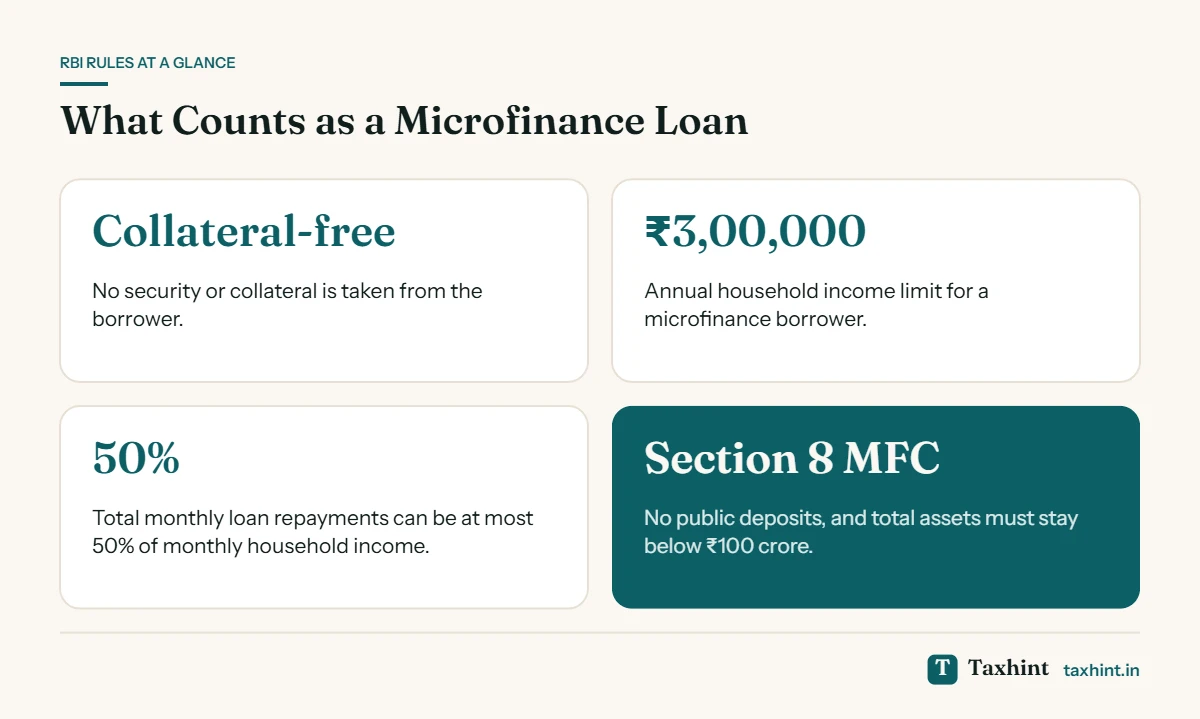
The RBI guidelines for microfinance come down to a few rules. A microfinance loan is a collateral-free loan to a household earning up to ₹3,00,000 a year, and that household’s total monthly loan repayments cannot go above 50% of its monthly income. The lender prices loans under a Board-approved policy and cannot charge for prepayment. These rules came in with RBI’s 2022 microfinance framework and now sit inside the consolidated NBFC directions RBI issued on 28 November 2025.
In this guide
- Where the rules sit in 2026
- What counts as a microfinance loan
- The ₹3 lakh household income test
- The 50% repayment cap
- Pricing, prepayment and fair practices
- NBFC-MFI: 60% qualifying assets and ₹10 crore NOF
- How the rules apply to a Section 8 company
- Checklist before your first loan
- FAQs
Where the RBI guidelines for microfinance sit in 2026
RBI’s Master Direction on the Regulatory Framework for Microfinance Loans took effect on 1 April 2022. For the first time, one definition of microfinance applied to every regulated lender: commercial banks, small finance banks, regional rural banks, co-operative banks and NBFCs, including NBFC-MFIs.
On 28 November 2025, RBI reissued its NBFC rulebook as consolidated directions. The RBI guidelines for microfinance carried over, but they are now spread across four documents, and promoters who read only the 2022 text tend to miss half of them.
| Topic | Where it sits now (directions dated 28 November 2025) |
|---|---|
| Definition, household income, 50% cap, pricing policy | NBFC Credit Facilities Directions, 2025, Chapter V (paras 51 to 61) |
| Prepayment, rate display, loan card, recovery conduct | NBFC Responsible Business Conduct Directions, 2025, Section H (paras 76 to 97) |
| NBFC-MFI definition, 60% qualifying assets, SRO membership | NBFC Microfinance Institution Directions, 2025 (paras 8, 12 and 46) |
| ₹10 crore NOF, Section 8 exemption | NBFC Registration, Exemptions and Scale Based Regulation Directions, 2025 (paras 39 to 43 and 51) |
An NBFC-MFI follows all four from day one. Our page on NBFC-MFI registration covers the RBI application on PRAVAAH. A Section 8 company deals with a shorter list, which we come to below.
What counts as a microfinance loan
Paragraph 51 of the RBI Credit Facilities Directions, 2025 defines it. A microfinance loan is a collateral-free loan to a household with annual income up to ₹3,00,000. Household has a narrow meaning here: husband, wife and their unmarried children. A married son living under the same roof is, on a plain reading, a separate household.
Two points catch people out.
- End use does not matter. If the household qualifies and the loan is collateral-free, it is a microfinance loan whether the money buys a buffalo, a sewing machine or a term of school fees, and whether you lend directly or through a partner.
- Collateral-free means exactly that. The loan cannot be linked to a lien on the borrower’s deposit account, and it cannot be backed by hypothecation of any security.
We ask clients to copy this definition word for word into their credit policy. A field officer working with Bihar SHG groups or a Palwal livelihood programme needs a test she can apply on the spot, and this is it.
The ₹3 lakh household income test
The ₹3,00,000 ceiling applies to the whole household’s annual income. Take a woman who earns ₹90,000 a year from tailoring, married to a man who earns ₹2,40,000 driving an auto. Her household earns ₹3,30,000, so she does not qualify, however small her own income is.
RBI does not give one formula for assessing income. Each lender needs a Board-approved policy, and paragraph 52 lists the indicative factors: household profile, sources of income and expenses. Income is assessed over at least one year and corroborated from other sources. RBI’s FAQ adds that expenses only cross-check the reported income, and that expected income from the asset the loan will buy cannot be counted.
Paragraph 54 asks lenders to report household income to the credit information companies, so the loan form needs a proper household income field that flows into your bureau file.
The 50% repayment cap
This rule changes daily operations more than any other. Under paragraphs 55 and 56, a household’s total monthly repayments, principal plus interest on all existing loans and on the loan you are about to give, cannot exceed 50% of its monthly household income.
Take a Faridabad household earning ₹20,000 a month. Its ceiling is ₹10,000 a month in total instalments. If it already pays ₹6,500 to two other lenders, the most you can add is ₹3,500 a month. RBI’s FAQ confirms that non-microfinance loans count too, so the two-wheeler EMI goes into the sum.
A household already above 50% is not pushed into default. Paragraph 57 lets its existing loans run to maturity, but no lender can give it a fresh loan until it is back within the limit. You only learn about other EMIs from the bureau report and from the family itself.
Paragraph 59 also requires a Board policy that lets repayment frequency match the borrower’s cash flow. A vegetable vendor earns daily and a dairy farmer is paid every fortnight, so one weekly schedule for everyone sits badly with it.
Pricing policy, prepayment and fair practices
RBI does not fix an interest rate for microfinance loans. Paragraph 60 asks for a Board-approved pricing policy covering the interest rate model, the components of the rate, the range of spread for each category of borrower, and a ceiling on interest and all other charges. Paragraph 61 adds that rates and charges must not be usurious and are open to RBI’s supervisory scrutiny.
Write the pricing policy before the first disbursement, with real numbers in it. “Rates will be reasonable” is hard to defend in front of an auditor.
The Responsible Business Conduct Directions then set out how you deal with the borrower:
- No prepayment charge on microfinance loans (para 81).
- Late payment charges only on the overdue amount, not on the whole loan (para 81).
- Minimum, maximum and average interest rates displayed in every office, in your literature and on your website (para 82).
- Changes in rates or charges notified well in advance and applied only from then on (para 83).
- A loan card carrying a simple pricing factsheet, with entries in a language the borrower understands (paras 78 and 79), and a standard loan agreement in that language (para 77).
- Insurance or any other non-credit product only with the borrower’s full consent, with its fee shown on the loan card (para 80).
Recovery has its own rules. Calling a borrower persistently, or before 9 a.m. or after 6 p.m., counts as a harsh recovery practice (para 91). Field staff can visit the borrower’s home or workplace only after the borrower has missed two or more successive appointments at the designated place (para 90). For a group lending model, that place is usually the centre meeting. You also have to tell the borrower at disbursal how to raise a recovery complaint (para 92).
NBFC-MFI rules: 60% qualifying assets and ₹10 crore NOF
An NBFC-MFI is a non-deposit-taking NBFC that keeps at least 60% of its total assets, net of intangible assets, in microfinance loans on an ongoing basis (para 8(3) of the Microfinance Institution Directions). RBI brought this down from 75% to 60% in June 2025. If an NBFC-MFI stays below 60% for four quarters in a row, it has to approach RBI with a remediation plan (para 12). One weak quarter does not trigger it.
The capital bar is high. A new NBFC-MFI needs Net Owned Fund of ₹10 crore to start business (para 39 of the Registration Directions). Existing NBFC-MFIs are on a glide path that reaches ₹10 crore on 31 March 2027 (para 42), and an NBFC that misses the required level is not eligible to hold its Certificate of Registration (para 43). Our note on how Net Owned Fund is calculated explains why ₹10 crore of paid-up capital does not automatically mean ₹10 crore of NOF.
Every NBFC-MFI must also join at least one RBI-recognised Self-Regulatory Organisation for NBFC-MFIs and follow its code of conduct (para 46). It must also keep a capital adequacy ratio of at least 15% (paras 16 and 17).
How the rules apply to a Section 8 microfinance company
Trusts, NGOs and SHG federations that cannot raise ₹10 crore usually look at the Section 8 route. Paragraph 51 of the RBI Registration, Exemptions and Scale Based Regulation Directions, 2025 exempts a company from registration under Sections 45-IA, 45-IB and 45-IC of the RBI Act when all four conditions hold:
- It gives only microfinance loans as defined in the Credit Facilities Directions, and no household’s monthly loan obligations exceed 50% of its monthly income.
- It is licensed under Section 8 of the Companies Act, 2013, or Section 25 of the Companies Act, 1956.
- It does not accept public deposits.
- Its asset size is below ₹100 crore.
The ₹3 lakh definition and the 50% cap are written into the exemption, so a Section 8 company that ignores them is no longer exempt and is lending without registration. One loan to a ₹4 lakh household, or one family pushed past 50%, puts the exemption at risk.
Paragraph 57 exempts these companies from most of the Registration Directions and from the Public Deposits Directions. The detailed pricing and conduct chapters are written for NBFCs. We still advise every Section 8 client to adopt a Board pricing policy, the no-prepayment rule and the recovery hours as if they applied. RBI’s FAQ encourages microfinance lenders outside the framework, such as trusts and societies, to follow it, and banks or donors funding you will likely ask to see these policies.
Keep an eye on the ₹100 crore line. Once assets reach ₹100 crore, the exemption ends and RBI registration becomes necessary. If you plan to grow fast, read our comparison of Section 8 and NBFC-MFI structures before deciding. If Section 8 fits, our team handles Section 8 microfinance company registration through to the first Board policies.
A practical checklist before your first loan
- Put the loan definition, the meaning of household and your income assessment method into a Board-approved credit policy.
- Build the 50% test into the loan form: household income, existing EMIs from the bureau report, the proposed EMI and the resulting ratio.
- Adopt a pricing policy with a rate model, spreads and a ceiling on all charges, and display minimum, maximum and average rates.
- Print loan cards and agreements in the local language.
- Train collection staff on the 9 a.m. to 6 p.m. rule and the designated-place rule, and set up a recovery complaint channel.
- Get credit bureau membership so you can pull reports before lending and report household income with each loan.
- Section 8 companies: check asset size every quarter against ₹100 crore.
Applying the RBI guidelines for microfinance by hand works for the first few hundred borrowers. After that, errors creep in. When you compare microfinance software, ask the vendor to show the 50% repayment check running on a live application, along with the bureau pull and loan card printing. Taxhint’s microfinance software starts at ₹15,000.
FAQs on RBI microfinance rules
What are the RBI guidelines for microfinance in simple words?
A microfinance loan is a collateral-free loan to a household with annual income up to ₹3,00,000. Total monthly repayments of the household on all loans cannot exceed 50% of monthly household income. Lenders price loans under a Board-approved policy, cannot charge for prepayment and must follow fair recovery practices.
What is the income limit for a microfinance loan?
The limit is ₹3,00,000 of annual household income. Household means husband, wife and their unmarried children, so the income of both spouses is added together.
Can a microfinance lender take collateral or a security deposit?
No. A microfinance loan must be collateral-free. It cannot be linked to a lien on the borrower’s deposit account and cannot be backed by hypothecation of any security.
Is there an interest rate cap on microfinance loans?
RBI does not fix a rate. The lender’s Board must approve a pricing policy that sets out the rate model, its components, the spread for each borrower category and a ceiling on interest and all other charges. Rates must not be usurious and are open to RBI’s supervisory scrutiny.
Can a microfinance lender charge a prepayment penalty?
No. Paragraph 81 of RBI’s Responsible Business Conduct Directions, 2025 bars any prepayment charge on microfinance loans. Late payment charges can be levied only on the overdue amount.
Do RBI microfinance rules apply to a Section 8 company?
Partly. A Section 8 company is exempt from RBI registration only if it gives microfinance loans as RBI defines them, keeps every household within the 50% repayment cap, takes no public deposits and stays below ₹100 crore of assets. So the definition and the cap bind it in practice.
What is the minimum Net Owned Fund for an NBFC-MFI?
A new NBFC-MFI needs Net Owned Fund of ₹10 crore under paragraph 39 of RBI’s 2025 Registration Directions. Existing NBFC-MFIs must reach ₹10 crore by 31 March 2027.
What happens if an NBFC-MFI falls below 60% qualifying assets?
An NBFC-MFI must keep at least 60% of its total assets, net of intangibles, in microfinance loans. If it stays below 60% for four consecutive quarters, it has to approach RBI with a remediation plan.
Not sure which of these rules binds your structure? Speak to a CA or CS on our team before the first loan goes out. Get Free Consultation on WhatsApp at +91 93117 95484 or write to [email protected].