November 21, 2026 · Guides
Section 8 Microfinance Company Registration Process on SPICe+ (Step by Step)
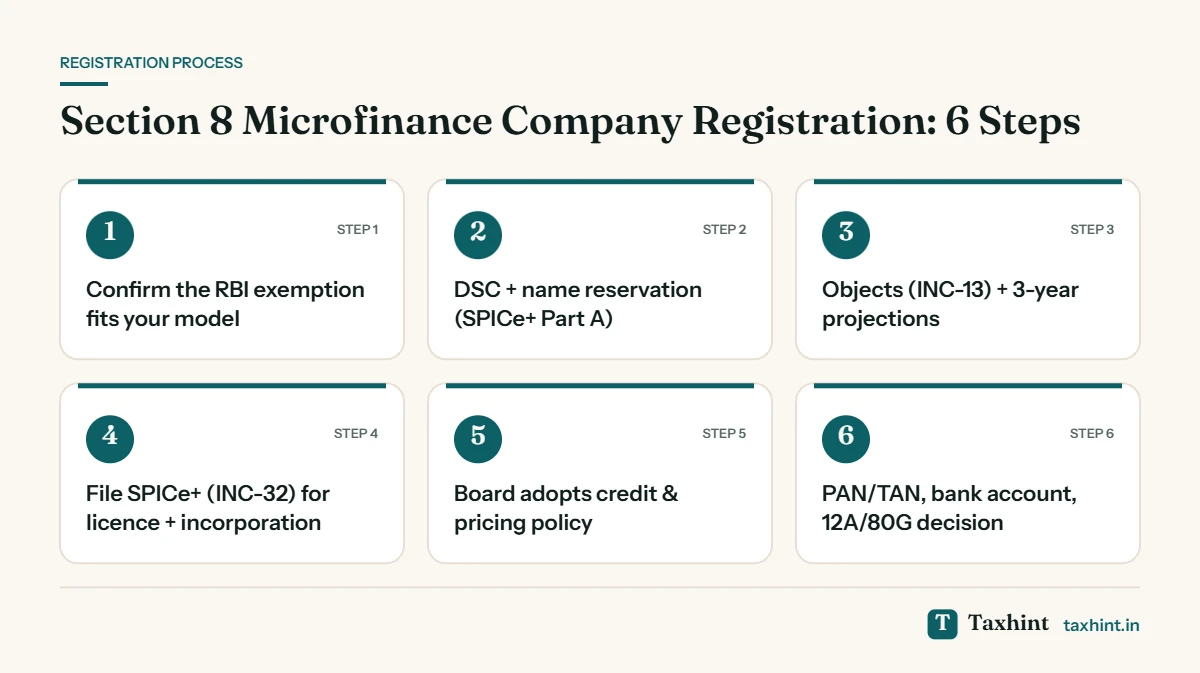
The section 8 microfinance registration process runs end to end on the MCA V3 portal. You get DSCs, reserve the name in SPICe+ Part A, then file SPICe+ Part B, which carries the Section 8 licence request under Rule 19 along with the MoA in Form INC-13, the three-year projections and the declarations. AGILE-PRO-S goes with it for the bank account, EPFO and ESIC. When the Central Registration Centre approves, the certificate of incorporation comes with PAN and TAN.
In this guide
- The process at a glance
- Before you file: check the RBI exemption
- Step 1: DSCs
- Step 2: Name reservation in SPICe+ Part A
- Step 3: MoA in INC-13, AoA and projections
- Step 4: Declarations and supporting papers
- Step 5: SPICe+ Part B and the licence
- Step 6: AGILE-PRO-S
- After incorporation
- Common resubmission reasons
- FAQs
The section 8 microfinance registration process at a glance
| Stage | Form or action | What it does |
|---|---|---|
| 1 | DSC | Digital signatures for every director and subscriber |
| 2 | SPICe+ Part A | Name reservation, ₹1,000 fee, name held for 20 days |
| 3 | INC-13, AoA, projections | Charitable objects, no-dividend clause, three-year income and expenditure estimate |
| 4 | Declarations | Professional’s and applicants’ declarations under Rule 19, DIR-2 consents, office proofs |
| 5 | SPICe+ Part B (INC-32) | Licence plus incorporation in one application, with DIN, PAN and TAN |
| 6 | AGILE-PRO-S | Bank account, EPFO, ESIC and, if wanted, GSTIN |
| 7 | Post-incorporation | Board meeting, auditor, INC-20A where the company has share capital, credit policies |
Before you file: check the RBI exemption fits
A Section 8 company lends without an RBI Certificate of Registration only while it meets four conditions in paragraph 51 of RBI’s 2025 Registration Directions. It must give only microfinance loans (collateral-free, to households earning up to ₹3,00,000 a year, within the 50% repayment cap), hold a Section 8 licence, take no public deposits and keep assets below ₹100 crore.
If your plan includes gold loans, loans to small shopkeepers above that income, or collecting deposits from the public, stop here. That business needs a different structure. If the plan fits, our page on Section 8 microfinance company registration sets out the full scope, and the rest of this article walks through the filing itself.
Step 1: DSCs for directors and subscribers
Every proposed director and subscriber needs a digital signature certificate, because each one signs the forms and declarations on the portal. If you register as a private company, you need at least two directors and two subscribers, and at least one director must have stayed in India for 182 days or more in the previous calendar year.
Get the DSC in the name exactly as it appears on PAN. A name spelt one way on PAN and another way on Aadhaar is a small problem now and a resubmission later.
Step 2: Name reservation in SPICe+ Part A
Name reservation happens in SPICe+ Part A. The fee is ₹1,000, and once approved the name is held for 20 days, with paid extensions available up to 60 days. Our explainer on the SPICe+ form covers the general mechanics. For a Section 8 company, two points matter.
- The name has to carry one of the words the CRC expects for Section 8 companies, such as Foundation, Forum, Association, Federation, Chambers, Confederation or Council.
- The objects you enter must stay within Section 8(1)(a) of the Companies Act, 2013. The CRC reads them against the SPICe+ Part A instruction kit, so keep them specific to poverty relief and livelihood support.
Step 3: MoA in INC-13, AoA and three-year projections
A Section 8 company does not use the standard linked e-MoA. Its memorandum is drafted in Form INC-13 and the articles are drafted to match. Both go into the Part B application as attachments signed by the subscribers.
The MoA needs three things done properly. The objects clause states the charitable purpose and how lending serves it. The income and property clause says profits and income go only to promoting the objects. The no-dividend clause bars any dividend or distribution to members. The AoA should also cover how directors are appointed and that any change to the MoA or AoA needs prior Central Government approval under Section 8(4).
Rule 19 also asks for an estimate of income and expenditure for the next three years. For a microfinance company this is where the plan becomes concrete: expected loan book, interest income, staff and field costs, provisioning and where the surplus goes. A projection showing large surpluses with no clear use for them invites questions about whether the company is really charitable. If you are new to Section 8 companies generally, our page on registering a Section 8 company covers the basics that apply to every object.
Step 4: Declarations and supporting papers
Rule 19 of the Companies (Incorporation) Rules, 2014 asks for two declarations along with the draft MoA and AoA:
- Form INC-14, a declaration by an advocate, chartered accountant, company secretary or cost accountant that the MoA and AoA have been drawn up under Section 8 and its rules, and that all requirements have been complied with.
- Form INC-15, a declaration by each person making the application.
Alongside these, collect DIR-2 consent from each director, identity and address proofs for every director and subscriber, and the registered office papers: a utility bill not older than two months, a notarised rent agreement or ownership proof, and the owner’s NOC. Our checklist of documents for a Section 8 microfinance company lists each paper with the format the CRC expects.
We also prepare a draft credit policy at this stage even though it is not filed. Writing it forces the promoters to settle loan sizes, tenure and the household income test, and the projections then match what the company will actually do.
Step 5: SPICe+ Part B (INC-32) and the Section 8 licence
SPICe+ Part B is where incorporation and the Section 8 licence are applied for together. You enter director and subscriber details (DIN is allotted through the form for directors who do not have one), registered office, capital or guarantee details, and attach INC-13, the AoA, the projections, INC-14, INC-15 and the supporting proofs. The form is then signed with DSCs and certified by a practising professional.
Government costs at this stage are the SPICe+ filing fee, which depends on authorised capital, and state stamp duty on the MoA and AoA, which differs by state. DSC costs are separate. We give clients a state-specific estimate before filing because the stamp duty part varies so much.
On approval, the CRC issues the certificate of incorporation along with the licence, and the company’s PAN and TAN are allotted with it.
Step 6: AGILE-PRO-S
AGILE-PRO-S is filed with Part B. It opens the company’s bank account with your chosen bank and registers the company with EPFO and ESIC, and in some states it covers professional tax and shops registration too. GSTIN can be applied for through it. Interest on loans is exempt from GST, so a company earning only interest may not need GSTIN at the start; fee-based services change that.
Pick a bank that already handles microfinance or NGO accounts. Disbursements and collections at scale need cash management and bulk transfer facilities, and changing banks after a year is painful.
After incorporation: what to do in the first six months
The certificate ends the MCA part of the section 8 microfinance registration process. The next six months decide whether the company starts lending on a clean footing.
- Hold the first Board meeting within 30 days of incorporation (Section 173(1)). The Board appoints the first auditor within 30 days of incorporation (Section 139(6)).
- Check whether INC-20A applies. Section 10A applies to companies having a share capital. A Section 8 company with share capital must file the declaration of commencement of business in INC-20A within 180 days of incorporation, after subscribers pay for their shares. A Section 8 company limited by guarantee without share capital falls outside it. The penalty for missing it is ₹50,000 on the company and ₹1,000 a day on each officer in default, up to ₹1 lakh.
- Deposit subscription money, open the loan and collection accounts, and get the PAN and TAN set up with your accountant.
- Adopt Board policies before the first loan: credit and household income assessment, the 50% repayment cap, pricing, KYC and fair practices.
- Decide on 12A and 80G registration with the Income Tax Department if you want tax exemption or donor deductions.
- Set up loan records from day one. MFI software that tracks household income and existing EMIs keeps the 50% cap auditable. Taxhint’s microfinance software starts at ₹15,000.
Common resubmission reasons
When the CRC marks an application for resubmission, you get 15 days from that date to correct and refile using the same user ID. These are the usual reasons on Section 8 microfinance files:
- Name resembles an existing company, LLP or trademark, or lacks a Section 8 word.
- Objects go beyond Section 8(1)(a), for example a general clause allowing any lending business.
- Projections that do not match the objects, or show surplus with no stated use.
- Utility bill older than two months, or rent agreement and NOC in different names.
- Name or address mismatch between PAN, Aadhaar and the DSC.
- INC-14 or INC-15 unsigned or undated.
Most of these can be caught in one careful review before filing, which is the cheapest stage of the section 8 microfinance registration process to fix anything. A resubmission costs up to two weeks, and a rejection means a fresh application and fee.
FAQs on the SPICe+ process for Section 8 microfinance
How long does the section 8 microfinance registration process take?
The timeline depends on how quickly DSCs are issued and whether the CRC asks for resubmission. Name reservation and Part B are processed separately, and every resubmission adds up to 15 days. A file with clean drafting and matching documents moves fastest.
Is INC-13 the same as the e-MoA?
No. A Section 8 company’s memorandum is drafted in Form INC-13 and attached to SPICe+ Part B, along with articles drafted to match. The linked e-MoA used by ordinary private companies does not apply.
Which declarations are needed under Rule 19?
Form INC-14, a declaration by an advocate, chartered accountant, company secretary or cost accountant, and Form INC-15, a declaration by each applicant. These go with the draft MoA, AoA and a three-year estimate of income and expenditure.
Does a Section 8 company need to file INC-20A?
Only if it has a share capital. Section 10A covers companies having a share capital, so a Section 8 company with share capital files INC-20A within 180 days of incorporation. A company limited by guarantee without share capital is outside it.
What government fees apply to a Section 8 microfinance company?
₹1,000 for name reservation, the SPICe+ fee linked to authorised capital, and state stamp duty on the MoA and AoA. DSC costs are separate.
Is there a minimum capital for a Section 8 microfinance company?
The Companies Act sets no minimum paid-up capital for a Section 8 company, and RBI’s ₹10 crore Net Owned Fund rule applies to NBFC-MFIs. In practice you need enough funds for the loans you plan, which the three-year projections should show.
Is GST registration needed through AGILE-PRO-S?
GSTIN is optional in AGILE-PRO-S. Many microfinance companies earning only interest do not need it at the start, but fee-based services change that, so take advice on your product mix.
Want a CA and CS to draft the objects, projections and declarations so the file goes through without a resubmission? Get Free Consultation on WhatsApp at +91 93117 95484 or email [email protected].