November 21, 2026 · Guides
Software for a Section 8 Microfinance Company: What You Actually Need

The right software for a Section 8 microfinance company starts from the RBI exemption conditions. It has to help you prove, loan by loan, that every borrower’s household earns up to ₹3 lakh a year and repays no more than half its monthly income, that you take no deposits, and that total assets stay below ₹100 crore. After that come group lending, field collection and books your auditor can test.
In this guide
- Why a Section 8 lender needs different software
- What the RBI conditions mean for your software
- Group lending and field collection
- Audit-ready books and ROC/ITR data
- What you can leave out
- Questions to ask in a demo
- Cost and setup time
- FAQs
Why a Section 8 lender needs different software
Most loan software in India is sold to NBFCs, Nidhi companies and credit societies. Those businesses take deposits, give gold loans and run a wide product shelf. A Section 8 microfinance company can do none of that if it wants to keep its exemption from RBI registration.
The exemption holds only while four things stay true together: the company gives only microfinance loans, it holds a Section 8 licence, it takes no public deposits, and its assets are below ₹100 crore. A microfinance loan, in turn, is a collateral-free loan to a household with annual income up to ₹3,00,000, where the household’s monthly repayments on all loans stay within 50% of its monthly income. We cover the legal side on our Section 8 microfinance company registration page.
Each of those conditions turns into something your system must record or check. That is the lens we use when promoters ask us to set up microfinance software for a newly registered Section 8 company. If you are still at the planning stage, start with our guide on starting a microfinance company in India.
What software for a Section 8 microfinance company must check
| Exemption condition | What the software has to do |
|---|---|
| Only microfinance loans | Offer only collateral-free loan products; no gold, property or deposit-backed loans configured |
| Household income up to ₹3 lakh | Record household income at loan entry, with the basis for the figure |
| Repayments within 50% of monthly income | Capture existing EMIs of the household and compare the new instalment against the cap |
| No public deposits | No savings, FD, RD or similar deposit products running in the company’s books |
| Assets below ₹100 crore | Give management a regular view of portfolio size and growth so the Board can track it every quarter |
Income check at loan entry
The ₹3 lakh limit applies to the household, meaning husband, wife and their unmarried children, not just the borrower. So the loan application needs fields for household income and how your staff arrived at it. RBI leaves the method to your Board-approved policy, which means the software should store the evidence the policy asks for.
Taxhint’s platform includes Aadhaar and PAN verification, document upload through the user and member apps, and a bank statement analyzer. For a borrower with a bank account, the statement is often the most reliable income evidence you will get. For a household that deals only in cash, your field officer’s assessment notes become the record, and they should sit in the loan file rather than in a notebook.
The 50% repayment cap
Many small lenders slip on this one. The cap counts every loan the household is repaying, including loans from banks, NBFCs and other microfinance lenders. RBI’s FAQs on microfinance loans spell out that both microfinance and other loans count.
You cannot see those other loans without a credit bureau check. Taxhint’s software has CIBIL score check and upload built in, so the bureau report sits with the application. In practice, the officer adds up existing EMIs from the report, adds your proposed instalment, and compares the total with half of monthly household income. When you take a demo from any vendor, ourselves included, ask to see exactly how that comparison is recorded for your loan formats.
No deposit modules
Taxhint’s platform serves Nidhi companies and credit societies too, so it includes savings, fixed deposit, recurring deposit and MIS accounts. For a Section 8 microfinance company, we simply do not configure those products during setup. The same goes for gold loans, property loans and loans against deposits. With the module absent, there is nothing for a staff member to open by mistake.
We are strict about this because the deposit condition is the easiest one to break without noticing. A field team in a Palwal livelihood programme might start “keeping savings safe” for SHG members with good intentions. Once that money sits in the company’s books, the exemption is in question.
Asset-size tracking
The ₹100 crore line sounds far away for a new company, and for most it is. Still, the Board should see the number every quarter, and growth can be faster than expected once branches open. Taxhint’s business reports and analytics dashboards show portfolio figures branch-wise and in total, which gives the Board a quick view. The final asset figure always comes from the audited balance sheet, so treat the dashboard as the early warning and the accounts as the record.
Group lending and field collection
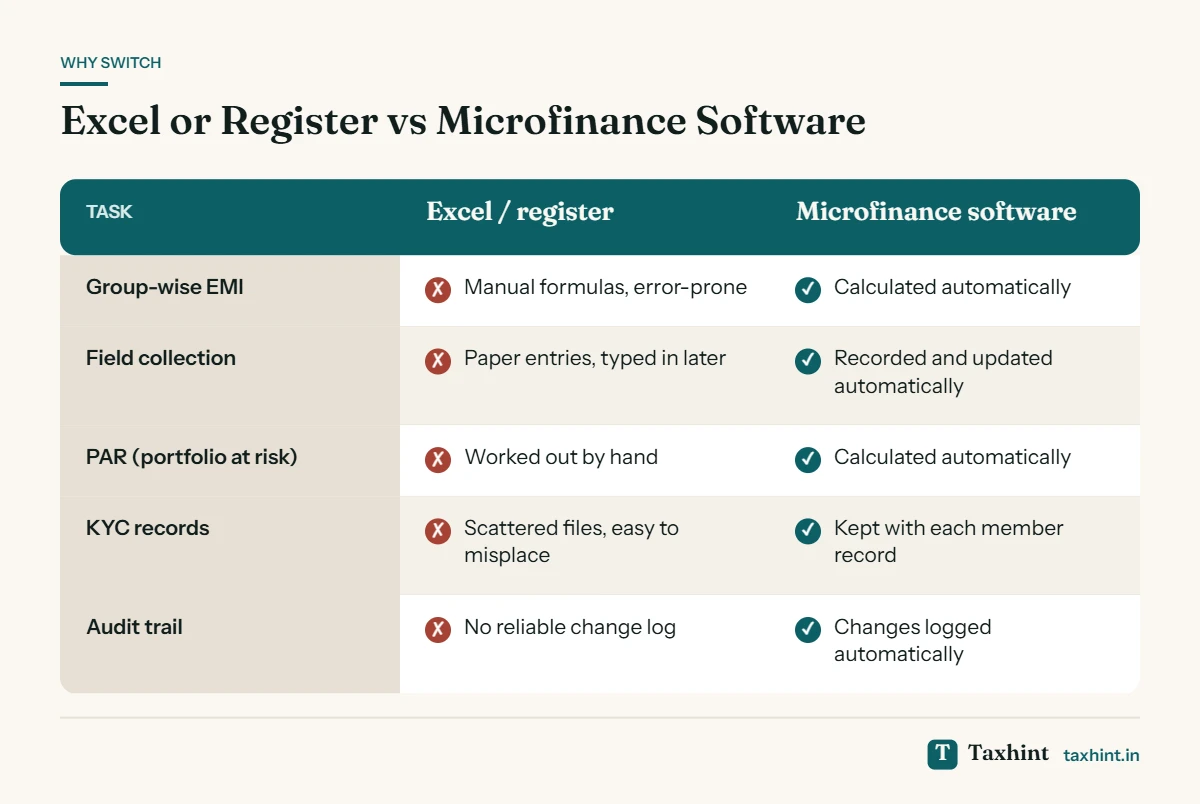
Most Section 8 microfinance companies lend through joint liability groups or self-help groups. Your software should let you create groups and centres, attach members to them, and run meeting-day collections. Taxhint’s software does this: groups and centres are set up with their members, and collections taken at centre meetings post to each member’s account through the agent app. We compare the group models in more detail in JLG and SHG group lending software.
Field collection is where cash leaks happen. The collection app gives agents real-time data on who is due and who has paid, and geo-tagging records where a collection was made. SMS, email and WhatsApp integration can send repayment reminders and payment alerts to borrowers. For borrowers who can pay digitally, the platform supports payment gateway and QR code payments, plus NACH and e-mandate. Our separate post on the microfinance collection app covers daily cash handling and receipts.
Audit-ready books and ROC/ITR data
A Section 8 company files AOC-4 within 30 days of its AGM and MGT-7 (not MGT-7A) within 60 days. It files ITR-7 if it claims exemption under Section 11, otherwise ITR-6. All of these need clean, reconciled numbers, and the auditor will test the loan book line by line.
The features that help most here rarely make it into a sales pitch:
- User activity logs that record who created, edited or approved each entry
- Multi-tier access control, so the person who sanctions is not the person who reconciles cash
- IP binding, which restricts logins to set locations
- Customisable print forms for receipts and loan agreements
- Statutory compliance reports that follow Companies Act guidelines
- Branch-wise reports and a holiday calendar per branch, so schedules do not fall on closed days
We usually advise new companies to close each month with a reconciliation between the software’s collection report and the bank and cash book. If those agree every month, year-end becomes a much shorter job for everyone, including us.
What you can leave out
A full-featured platform carries things a Section 8 lender does not need. Apart from deposits and secured loans, you may not need debit and credit card management or a virtual IFSC facility in year one. Leaving modules out keeps training simple, and field staff in a small town learn a short menu much faster than a long one.
Because price depends on modules, branches and users, a lean setup also costs less.
Leaving something out today does not lock you in. If a Faridabad trust starts with one branch and five users, then opens two more branches in a year, branches and users can be added later. What should never be added is a deposit product or a secured loan, at least while the company relies on the Section 8 exemption.
Questions to ask in a demo
Bring your actual loan product and a sample borrower file to the demo. Then ask:
- Where does the system record household income, and can it hold the documents or notes behind it?
- How does the CIBIL report link to the application, and where is the 50% calculation recorded?
- Can deposit products and secured loans be left out of our setup entirely?
- How are groups, centres and meeting-day collections handled on the agent app?
- What does the user activity log show, and who can see it?
- Which reports will our auditor get for the loan book at year-end?
- How is our existing data migrated and reconciled against current books?
If a vendor cannot answer the first two with your own sample file, keep looking.
Cost and setup time
Taxhint’s microfinance software starts at ₹15,000. The final price depends on the number of branches, users and modules. Setup includes configuration, data migration, role-wise staff training and support after go-live. The software is cloud-based by default, with on-premise deployment available on request.
Most deployments go live in two to four weeks, depending on branch count, data quality and format needs. For a fuller view of what drives price across vendors, read microfinance software cost in India.
FAQs
Does a Section 8 microfinance company need different software from an NBFC?
It needs the same core loan features but a narrower setup. Deposit products and secured loans should be left out, and the system must record household income and existing EMIs for every loan, because the RBI exemption depends on each loan meeting the microfinance definition.
Can Taxhint’s software handle JLG and SHG lending?
Yes. Groups and centres are set up with their members, and collections taken at centre meetings post to each member’s account through the agent app.
Can the software stop a loan that breaks the ₹3 lakh or 50% limit?
The software records household income, documents and the CIBIL report with each application, which is what the check needs. How the limits are applied depends on your loan formats and Board policy, so ask to see it worked through on your own sample file during the demo.
How much does microfinance software cost for a Section 8 company?
Taxhint’s microfinance software starts at ₹15,000. The final price depends on branches, users and modules.
How long does it take to go live?
Most deployments go live in two to four weeks, depending on branch count, data quality and format requirements.
Is the software cloud-based?
Yes. It is cloud-hosted by default, so every branch and user works from the same live data. On-premise deployment is available on request.
To see it working with your own loan product, Book a free demo. Microfinance software starts at ₹15,000. Call or WhatsApp +91 93117 95484, or email [email protected].