November 25, 2026 · Guides
What Is a Credit Bureau Score? How Lenders Use It
A credit bureau score is a number that summarises how reliably a person or business has repaid credit in the past. Credit bureaus build it from data that lenders report, such as loans taken, repayments, and any delays.
Lenders use it as one input in lending decisions. A high score generally signals reliable repayment; a low score signals risk.
Here is how it works.
In this guide
What goes into a score
Common factors.
- Payment history: on time or delayed. See days past due.
- Amount of credit and how much is used.
- Length of credit history.
- Number of recent applications.
How lenders use it
One input.
- Screening applications.
- Setting limits and rates as policy allows.
- Monitoring existing borrowers.
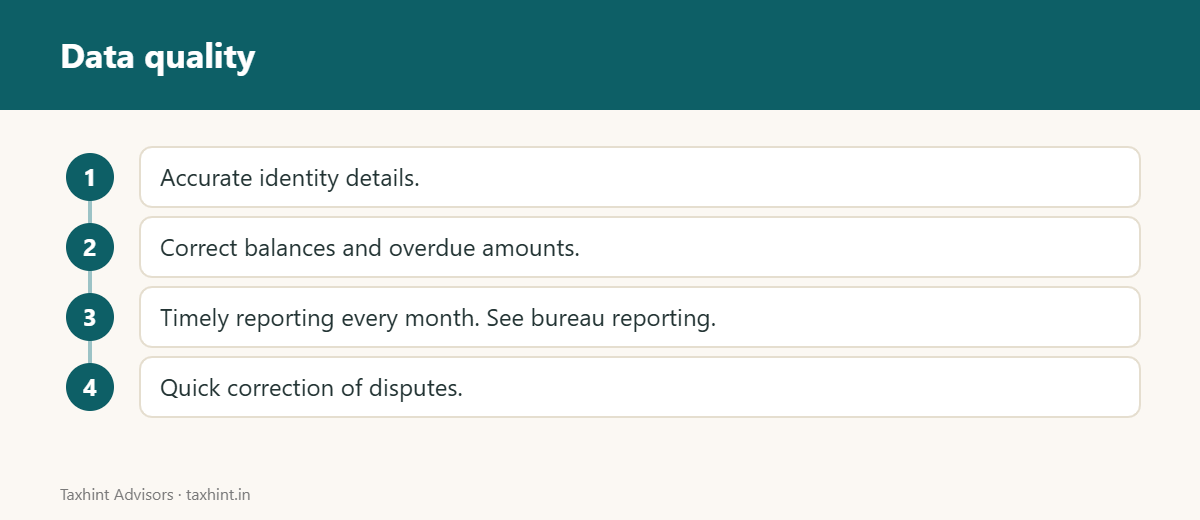
Data quality
Garbage in, garbage out.
- Accurate identity details.
- Correct balances and overdue amounts.
- Timely reporting every month. See bureau reporting.
- Quick correction of disputes.
What lenders must do
Rules apply.
- Regulated lenders have reporting duties. Please verify.
See loan management software. Rules in this area are specific and change, so please verify the current position with your CA or CS.
| Factor | Effect |
|---|---|
| Late payments | Lowers score |
| On time payments | Raises score |
| Many applications | Can lower score |
Questions people ask
Who creates the score? Credit bureaus, using the repayment data that lenders report.
Can I improve my score? By paying on time and keeping borrowing reasonable.
Does a low score mean no loan? Not always; lenders also look at other factors as per their policy.
Practical tip
Check your report once a year and correct any errors with the lender. Put it in your written procedure so that every new staff member follows it from the first day.
Why lenders look at the score
A score is a quick summary of how someone has repaid before. A lender uses it with income, existing loans and its own policy.
It is one input and not the final decision.
- Pay every EMI on or before the due date
- Do not take many loans at once
- Keep card use moderate
- Check the report for errors
- Correct mistakes through the lender
Common myths about credit scores
Many people think that checking their own score lowers it, or that salary alone decides the score. In general, your own check is treated differently from a lender enquiry, and the score is built from repayment history and credit use.
Policies differ by bureau and lender, so read the details they publish.
- Myth: only big loans count. Small loans and cards count too
- Myth: closing a card always helps
- Myth: a score never changes
- Fact: steady on time payments help over time
Simple ways to read your report
Open your report and check four things: personal details, the list of accounts, payment history and recent enquiries. Errors in any of these can pull the score down.
If something looks wrong, ask the lender to correct it and then ask the bureau to update the record.
- Is my name and PAN correct
- Are closed loans shown as closed
- Are there accounts I do not recognise
- Are late payments shown correctly
FAQs
Is a bureau score the same as a bank’s rating?
No. It is based on bureau data, not one bank’s view.
Who reports to bureaus?
Member lenders, as per their agreements and rules.
Can borrowers dispute errors?
Yes, through the lender and bureau process.
Can Taxhint produce the file?
Taxhint loan software can produce the bureau file in UCRF format.
Want a clean bureau file every month? Book a demo of Taxhint loan software. Talk to Taxhint on +91 93117 95484 or [email protected], or visit taxhint.in.