November 23, 2026 · Guides
12A and 80G for a Section 8 Microfinance Company: What the New Act Changes
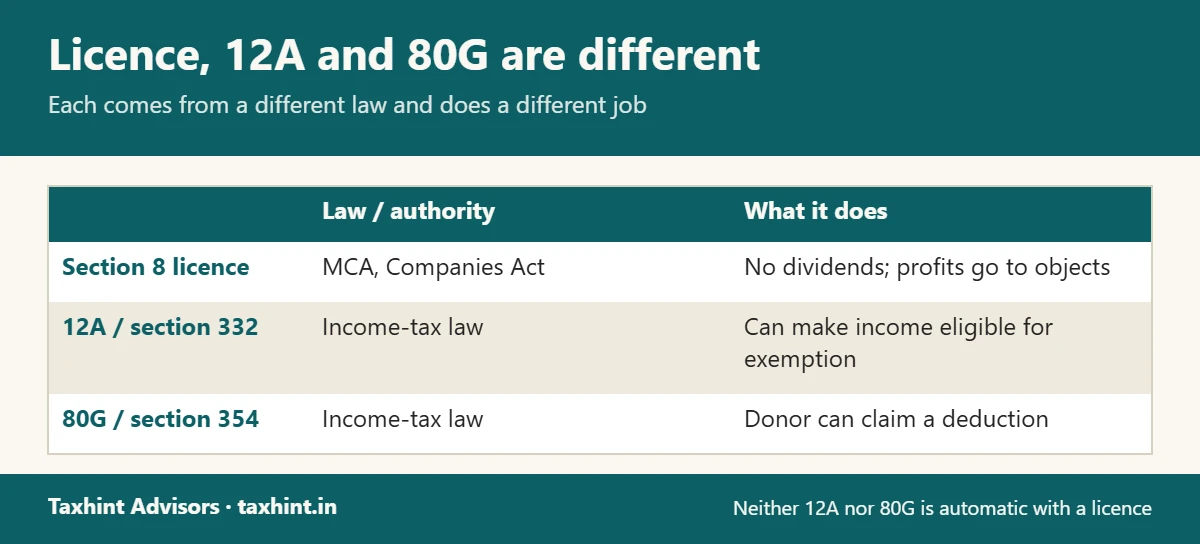
12A 80G for a microfinance company means two separate things. Registration under the income-tax law (12A earlier, now section 332 of the Income-tax Act, 2025) is what can make a Section 8 company’s income eligible for exemption. 80G (now section 354) only lets donors claim a deduction. Neither is automatic with a Section 8 licence, and neither is a guarantee: whether a lending company qualifies depends on its objects, its books and the tax officer’s view.
In this guide
- Section 8 licence is not a tax exemption
- What changed with the Income-tax Act, 2025
- 12A 80G for a microfinance company: does lending qualify?
- 80G: when it helps a microfinance company
- How and when to apply
- Does 12A or 80G affect the RBI exemption?
- What we usually advise on 12A 80G
- FAQs
Section 8 licence is not a tax exemption
A Section 8 company gets its licence from MCA under the Companies Act. That licence says the company cannot pay dividends and must apply profits to its objects. It does not say a rupee of the company’s income is exempt from tax.
Tax exemption sits in a different law and needs a different registration. If you are starting a company, our page on Section 8 microfinance company registration deals with the MCA side. For the income-tax side, the 12A and 80G route is explained at 12A and 80G registration.
A company that skips income-tax registration is taxed like any other company on its surplus. That is a perfectly legal choice, and some small microfinance companies make it. The choice should be made with figures in front of you, not by default.
What changed with the Income-tax Act, 2025
The Income-tax Act, 2025 replaces the 1961 Act from 1 April 2026. For charities and similar bodies, the provisions were recast and renumbered more than they were rewritten.
| Old reference | New reference | What it does |
|---|---|---|
| Section 12A / 12AB | Section 332 | Registration of the non-profit organisation |
| Section 80G(5) | Section 354 | Approval that lets donors claim a deduction (donor deduction is in section 133) |
| Section 2(15) | Section 2(23) | Definition of charitable purpose |
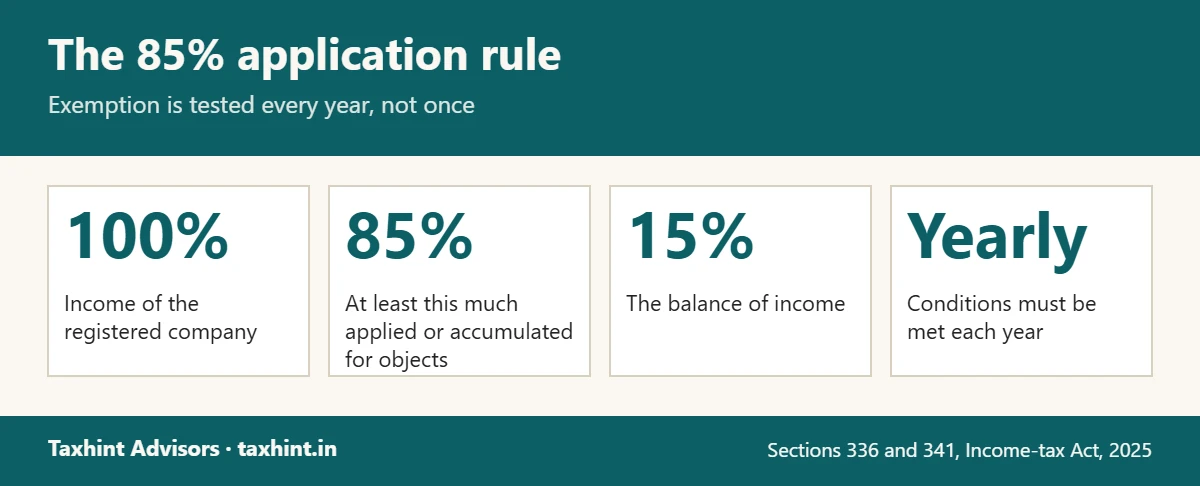
| Applying income under sections 11 and 12 | Sections 336 and 341 | At least 85% of income applied or accumulated for the objects |
Section 332(1) names a company registered under section 8 of the Companies Act, 2013 as an eligible applicant, so a Section 8 microfinance company can apply. You can read the section on the Income Tax Department’s website. Applications now use Form 104 (provisional) and Form 105 (regular), and the order comes in Form 107 with a Unique Registration Number.
Registrations valid and uncancelled on 1 April 2026 carry on until their original expiry, so a company that already holds 12AB and 80G does not need to re-apply merely because the new Act started. One that has lapsed does not revive on its own and needs a fresh application. FY 2025-26 and earlier years are still assessed under the 1961 Act. Rules, forms and CBDT clarifications are still being issued, so we check the current text before every filing.
12A 80G for a microfinance company: does lending qualify?
This is the hard question, and nobody can answer it from a brochure. Section 332(2) requires that the applicant be set up for charitable purposes as defined in section 2(23), or for public religious purposes, and that its property be used wholly for those purposes in India.
The definition keeps the same heads as before, such as relief of the poor and advancement of any other object of general public utility. Microfinance for low-income households can fit within relief of the poor, but that depends on how the objects are drafted and what the company actually does. Take a Section 8 company in Bihar that lends only to households of landless labourers at a modest service charge, against one that lends to small traders at market rates. Both are Section 8 companies. The tax officer is unlikely to see them the same way.
Two points need care.
- Objects clause. It must be written for the poor and the cause, not for lending as a business.
- Business-type receipts. The “general public utility” head has a limit on commercial receipts. Interest on loans is the company’s core income, so whether and how that limit bites needs to be examined with your objects and books. We do not give a standard answer.
Registration also does not exempt anything automatically. Exemption depends each year on applying at least 85% of income for the objects, filing the return and audit report on time, and keeping the books in order. A registered company that drifts from its objects can lose the benefit.
80G: when it helps a microfinance company
Approval under section 354 matters only if you expect donations from individuals or companies who want a deduction. A microfinance Section 8 company funded mainly by promoter capital, bank loans or grant agreements may never need it.
If you do want donor funding, remember three things. The approval is for five tax years even where the registration is for ten, so track both expiry dates. The institution reports donations received, and the donor’s certificate is generated from that statement. And a deduction for the donor is the donor’s benefit, not the company’s income exemption; the two should never be confused in a pitch.
How and when to apply
A new company that has not started activity can apply for provisional registration, valid for three tax years. A new company that has already started activity applies for regular registration, valid for five tax years, and the application table asks for it within six months of commencing activities. Renewal applications go in at least six months before expiry, using Form 105.
Where the entity’s total income did not cross ₹5 crore in each of the two preceding tax years, the Act allows ten years in place of five for the regular cases. We do not assume it for a client; the tax officer’s order shows the period actually granted.
The file normally carries the incorporation papers, MoA and AoA, the licence under Section 8, financial statements and a short activity note. For a microfinance company we add a loan policy, a sample loan file and the borrower-eligibility rule, because the officer will want to see how a loan advances the stated objective. The compliance rhythm that follows is in our Section 8 microfinance annual compliance post.
Does 12A or 80G affect the RBI exemption?
No. The RBI exemption in para 51 of the Registration Directions asks for microfinance loans only, within the 50% household repayment cap, a Section 8 licence, no public deposits and assets below ₹100 crore. Income-tax registration is not one of the conditions. The two regimes run side by side, and each can be held or lost without the other. The loan-level tests are covered in our note on RBI’s microfinance rules.
What we usually advise on 12A 80G for a microfinance company
- Draft the objects clause with the income-tax registration in mind, before incorporation, not after.
- Decide on 12A after the first year’s plan is clear, with a projected surplus in hand.
- Apply for 80G only if you will actually raise donations.
- Keep the loan book, charges and objects aligned; they are what the officer will read.
- Never advertise a “tax-free” company. We do not know any client’s outcome in advance, and neither does anyone else.
FAQs
Is 12A registration compulsory for a Section 8 microfinance company?
No. It is optional. Without it, the company is taxed like an ordinary company on its surplus. Registration is what makes exemption possible, and it depends on the company meeting the conditions each year.
Is 12A now section 332?
Yes. Under the Income-tax Act, 2025, registration of non-profit organisations is in section 332, and the donor-side approval formerly under 80G(5) is in section 354.
Will my existing 12AB and 80G continue?
Registrations that are valid and uncancelled on 1 April 2026 continue until their original expiry under the transition provisions. Check the expiry date and renew at least six months before it ends.
Can a company that lends money get 12A?
It can apply, since a Section 8 company is an eligible applicant. Whether the registration is granted and the income exempted depends on the objects, the actual activity and the officer’s examination. We cannot promise an outcome.
Do I need 80G to run a microfinance company?
No. 80G only helps donors claim a deduction. If your funding comes from capital, loans or grants, it may never matter.
Does 12A affect the RBI exemption for Section 8 microfinance companies?
No. RBI’s exemption conditions do not mention income-tax registration. They concern the loan type, the Section 8 licence, deposits and asset size.
Who files ITR-7?
Entities that claim exemption under the charitable provisions file ITR-7. A Section 8 company without registration files as an ordinary company.
Not sure whether your microfinance company needs 12A and 80G? Get Free Consultation, or WhatsApp us on +91 93117 95484. Our CA and CS team reads your objects and projected figures first, then tells you plainly what is worth applying for.