November 23, 2026 · Guides
Best Microfinance Software in India: A Buyer’s Evaluation Checklist
The best microfinance software in India is the one that runs your own loan products, groups and collection routine correctly on your own data, which you can only judge by testing it. No ranking will tell you that. This guide gives you a checklist to score any vendor, what to test in a demo, and where Taxhint fits.
In this guide
- Why there is no single best
- Start with your lender type
- The evaluation checklist
- What to test in a demo
- Contract and support questions
- How Taxhint fits
- Price
- FAQs
Why there is no single best microfinance software in India
Promoters often ask us for the best microfinance software in India, expecting a name. We cannot honestly give one. A Section 8 company with three field officers in Palwal needs something very different from an NBFC-MFI with a dozen branches.
What we can give is a method. Decide what you need, make every vendor prove it on a test login, and compare the results side by side. If a vendor will not let you test with your own cases, that tells you something too.
For the cost side of the decision, see our note on microfinance software cost in India. For a longer list of demo questions, our microfinance software buyer’s guide goes further.
Start with your lender type
The same microfinance software should be set up differently for different lenders, and you should ask each vendor how.
- Section 8 microfinance company: loans only, no public deposits. Ask if deposit modules can be left off.
- NBFC-MFI: more branches and more staff. Branch-level accounts, multi-tier access and user activity logs matter more.
- Nidhi company or credit society: different law, different audit formats and deposit products. These usually need a separate product, not a configuration of an MFI one.
If you are a non-profit lender, ask each vendor how they set up a Section 8 company, with deposits off and the setup built around loans, groups and collections.
The evaluation checklist
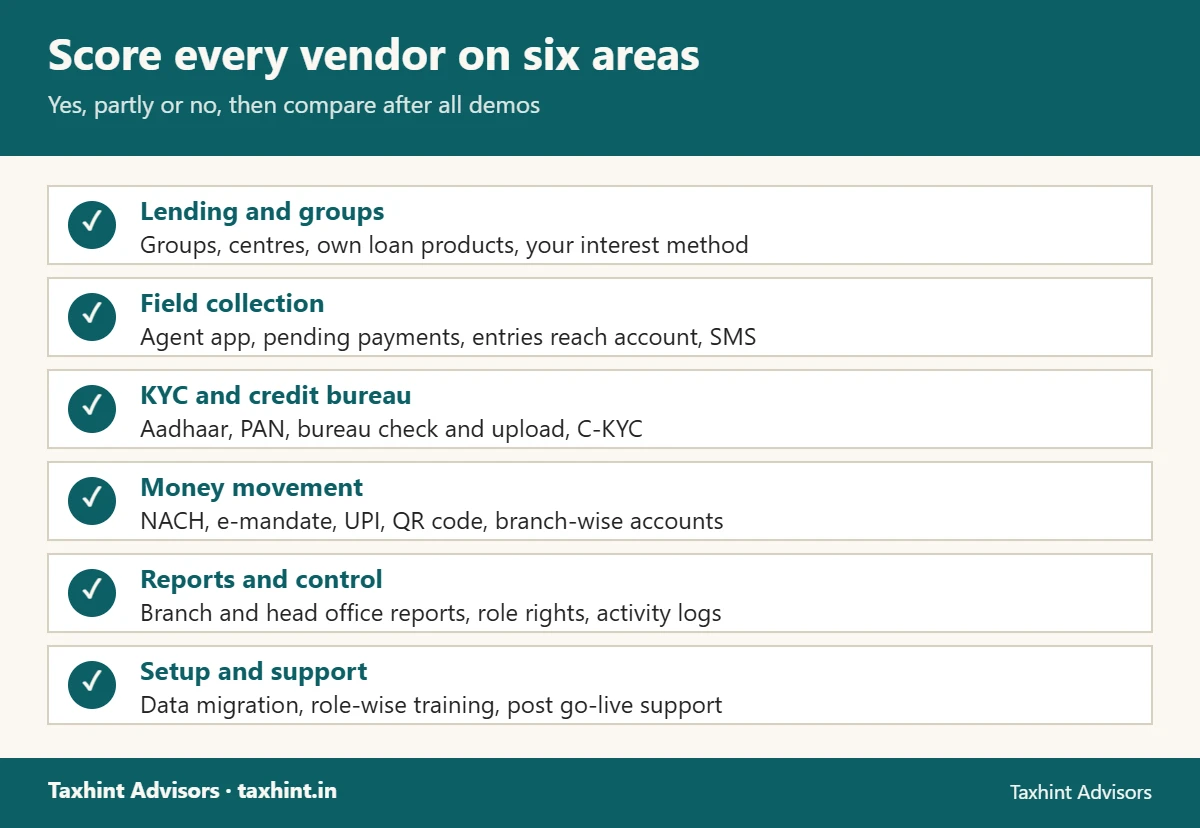
Score each line as yes, partly or no. Add notes. Compare across vendors only after all demos are done.
Lending and groups
- Can you set up groups and centres, add members with KYC, and give loans to each member inside the group?
- Can you configure your own loan products without paying for custom development each time?
- Does it support the interest method you use?
Field collection
- Is there a mobile app for agents that shows pending payments and records repayments?
- Does an entry made in the field reach the member’s account without re-typing?
- Can location be attached to an entry, and can borrowers be notified by SMS?
KYC and credit bureau
- Aadhaar and PAN verification, credit bureau check and upload, and C-KYC upload on the borrower record?
- Does the next loan cycle reuse the borrower’s existing record?
Money movement
- NACH, e-mandate, UPI, QR code payment and similar options if you want less cash handling?
- Branch-wise accounts, disbursements and customisable print forms?
Reports and control
- Dashboards and reports you can read at branch level and head office level?
- Rights set per role, separate logins, and user activity logs?
- Can you get your report formats, such as the one your lender or board uses, from the system?
Setup and support
- Is data migration from Excel or your old system included, and is it reconciled before go-live?
- Is training given role by role?
- What does support look like after go-live?
What to test in a demo
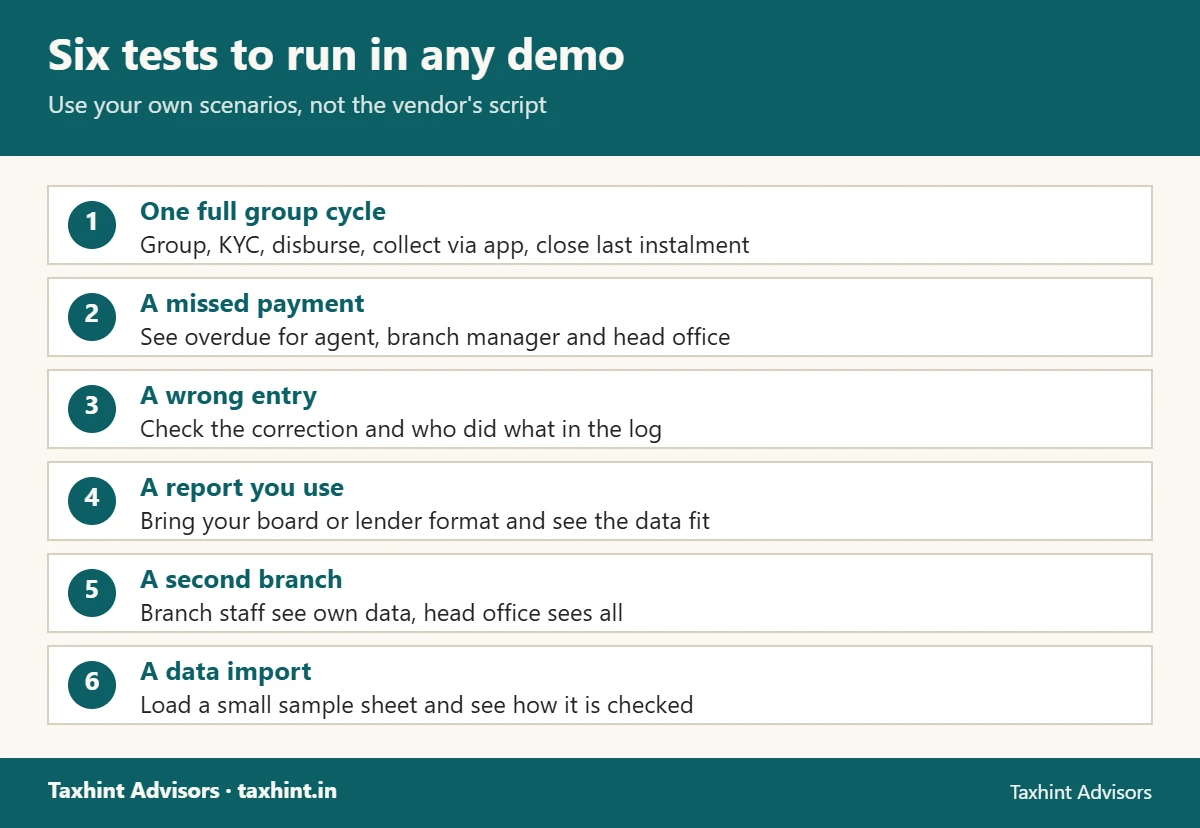
Ask for a demo built on your scenarios, not the vendor’s script. These are the tests we would run.
- One full group cycle. Create a group, add members with KYC, disburse, collect through the app, close the last instalment.
- A missed payment. Skip one instalment and see how the overdue shows for the agent, the branch manager and head office.
- A wrong entry. Make a mistake and see how it is corrected, and whether the activity log shows who did what.
- A report you already use. Bring your board or lender format and ask the vendor to show how the data fits it.
- A second branch. Check that branch staff see only their own data while head office sees everything.
- A data import. Give a small sample sheet and see how it is loaded and checked.
For portfolio-at-risk reporting specifically, use your own definition and check that the vendor’s overdue data matches it.
Contract and support questions
- Is hosting cloud-based, and can it be on your own server if you need that?
- What exactly does the price include? Platform access, setup, migration, training, support?
- What happens when you add a branch or a user?
- Who owns the data, and can you export it?
- Who do you call when a field officer cannot log in on a collection day?
Write the answers down. Verbal promises from a demo rarely survive until the contract stage.
How Taxhint fits
Taxhint is a CA and CS firm that has served businesses since 2014, with 5,000+ businesses across 28 states, set up and supported 100% online. Our microfinance software is cloud-based, with a web login for branches and head office and three Android apps: a Collection App for agents, a User App for applicants and a Member App for borrowers.
On the checklist above, the platform covers group and JLG lending, field collection with real-time pending payments, Aadhaar and PAN verification, CIBIL check and upload, C-KYC upload, NACH, e-mandate, QR code payment, branch-wise accounts, dashboards, multi-tier access and user activity logs.
Where it may not fit: if you need a core banking system for a larger lender, or software for a Nidhi company or credit society, we have separate products for those. Tell us in the first call and we will say so plainly.
One practical advantage is that we also handle registrations, so the loan products you register for can go into the software as they are. If you have not registered yet, speak to us about registration first, since we handle that too.
Price
Taxhint’s microfinance software: Starting ₹15,000. The final figure depends on branches, users and modules, and we give an exact quote after the demo. Use the same question with every vendor: what is included in the quote, and what is extra.
FAQs
Which is the best microfinance software in India?
It depends on your lender type, number of branches and loan products. Shortlist two or three vendors, run the same test cases on each and score them with a common checklist.
What features should microfinance software have?
At minimum: group and centre lending, a field collection app, KYC and credit bureau checks, branch-wise accounts, reports and dashboards, and role-based access with activity logs.
Is cloud or on-premise better?
Cloud lets branches and field staff work from anywhere with internet access. Taxhint’s software is cloud by default, and on-premise can be quoted on request.
Can a Section 8 microfinance company use it?
Yes. A Section 8 company takes no public deposits, so the deposit modules are left off and the setup focuses on loans, groups and collections.
How long does implementation take?
Most Taxhint deployments go live in two to four weeks, depending on branches, records and print formats.
Is training included?
Yes. Training is given role by role during setup, and support continues after go-live.
How much does it cost?
Taxhint’s microfinance software starts at ₹15,000. The final price depends on branches, users and modules.
Judge it on your own cases. Send us your branch count and loan products and we will run the demo around them. Book a free demo: microfinance software starting ₹15,000. Call or WhatsApp +91 93117 95484, or write to [email protected].