November 23, 2026 · Guides
Can a Microfinance Company Take Deposits in India?
No. A Section 8 microfinance company cannot take public deposits, and neither can an NBFC-MFI. If you want to know whether a microfinance company can take deposits, the honest answer is that the model is built the other way round: you raise capital, grants and borrowings, and you lend. Deposit-taking from members belongs to a different structure, the Nidhi company.
Promoters from Palwal to Purnia ask us this almost every week, usually because a village group has savings and wants a “company” to hold it. Here is how the rules actually work, and where the line sits between money you may receive and a deposit you may not.
In this guide
- Can microfinance company take deposits? The short answer by entity type
- Why a Section 8 microfinance company cannot take deposits
- The NBFC-MFI position
- Contributions versus deposits
- How a Section 8 microfinance company funds itself
- Nidhi company: the lawful deposit route
- What happens if you take deposits anyway
- FAQs
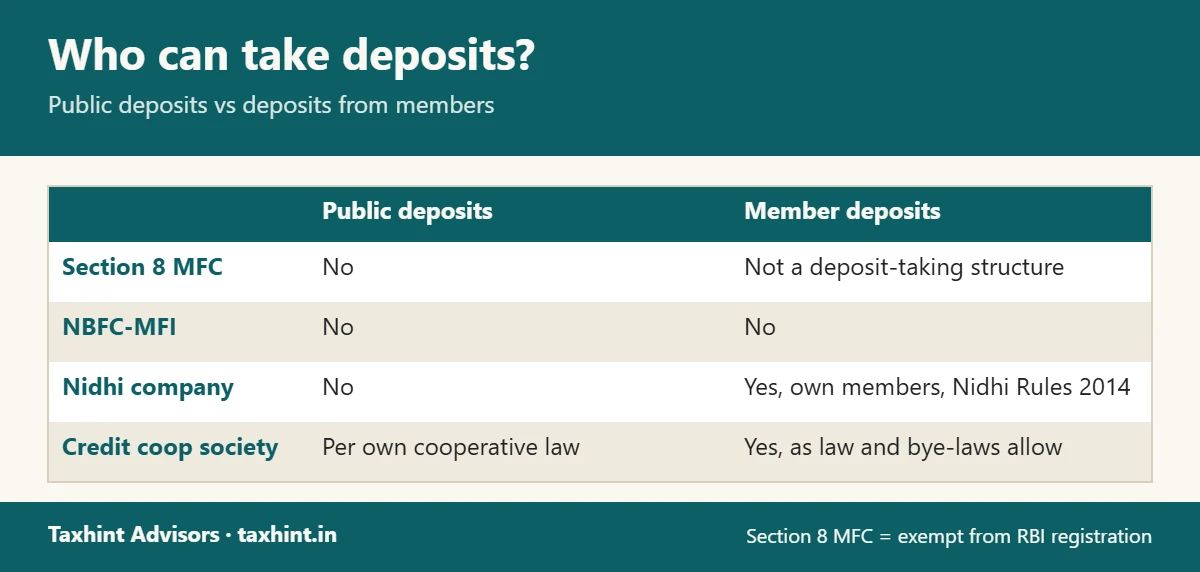
Can microfinance company take deposits? The short answer by entity type
| Entity | Public deposits | Deposits from members |
|---|---|---|
| Section 8 microfinance company (exempt from RBI registration) | No. Not accepting public deposits is a condition of the exemption. | Not a deposit-taking structure. Treat any refundable savings as off-limits. |
| NBFC-MFI | No. It is defined as a non-deposit-taking NBFC. | No. |
| Nidhi company | No. | Yes, from its own members only, under the Nidhi Rules, 2014. |
| Credit cooperative society | Governed by its own cooperative law. | Yes, from members, as the law and bye-laws allow. |
Everything below explains the first two rows, because that is where most of the confusion lives.
Why a Section 8 microfinance company cannot take deposits
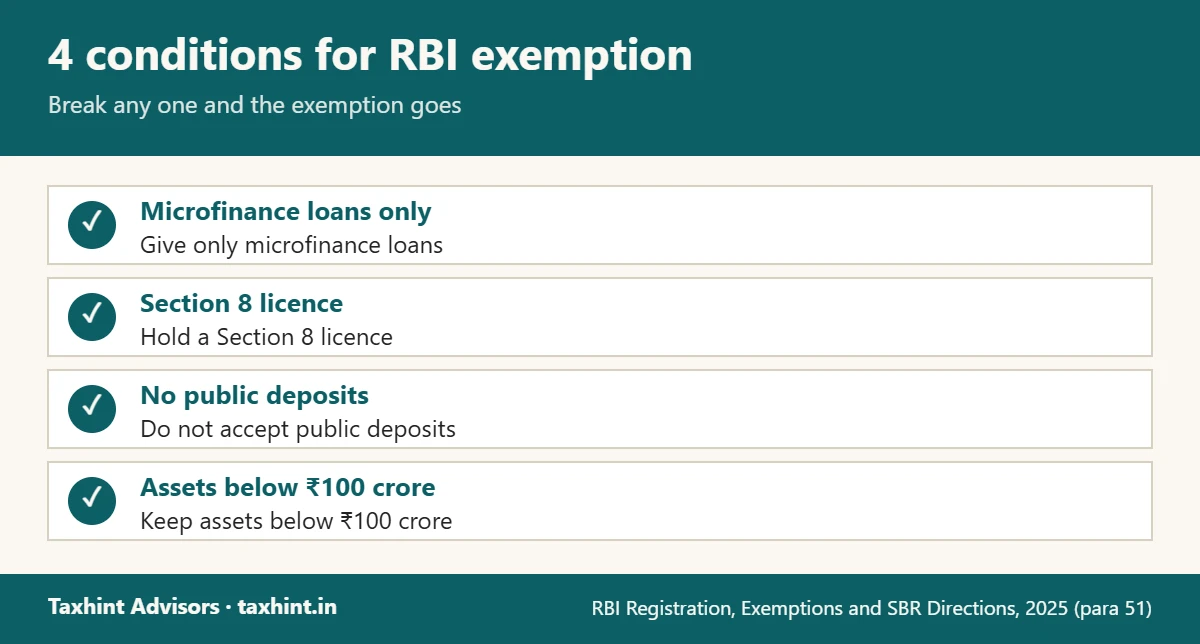
A Section 8 microfinance company is allowed to lend without registering with the RBI as an NBFC, but only on conditions. Under the RBI’s Registration, Exemptions and Scale Based Regulation Directions, 2025 (para 51), it must give only microfinance loans, hold a Section 8 licence, not accept public deposits, and keep its assets below ₹100 crore. Break any one and the exemption goes.
So the ban is not a quirk of company law. It is the price of staying outside RBI registration. If a Section 8 company starts taking deposits, it is carrying on something that needs RBI oversight, and the exemption no longer protects it. We cover the full registration route on our Section 8 microfinance company registration page.
One more point. A Section 8 company also cannot pay dividends, so there is no “return” you could promise a depositor out of profits anyway. Surplus stays in the company and goes back into the objects.
The NBFC-MFI position
The RBI’s Microfinance Institution Directions, 2025 define an NBFC-MFI as a non-deposit-taking NBFC with at least 60 per cent of its assets in microfinance loans. The name itself tells you the answer. An NBFC-MFI funds lending through equity, bank and institutional borrowings, and similar sources, not through savings collected from the public.
Some promoters assume that a bigger, RBI-registered entity must be allowed to take deposits. Not here. Deposit-taking NBFCs are a separate category with their own rating, ceiling and interest-rate rules in the RBI’s Acceptance of Public Deposits Directions, 2025, and an NBFC-MFI is not one of them. If you are weighing the two structures, read Section 8 vs NBFC-MFI first.
Contributions versus deposits
This is where good promoters go wrong without meaning to. Money coming into the company is not automatically a deposit, and not every rupee that looks like savings is safe to take.
- Grants and donations. Given for the objects and not meant to be returned. These are receipts of the company, not borrowings.
- Capital or membership contribution. What a member pays to join, as set out in the MoA and AoA. It is tied to membership, and the company does not promise to hand it back on demand with interest.
- Borrowings from banks, NBFCs and other institutions. A normal funding source for a lending company.
- Deposit. Money accepted from people, repayable, usually with interest or a benefit attached. This is what is barred.
The test we apply in practice is simple. Does the person expect their money back, on a date or on request, as a saver would? If yes, you are looking at a deposit in substance, whatever you call it in the receipt. “Member savings”, “security amount” and “group fund” are names we have seen used to describe exactly that.
Take an example. A trust in Palwal wants to run a livelihood programme and collects ₹500 a month from each woman in a group, to be returned with a small bonus at the end of the year. Call it what you like, it is a savings scheme. A Section 8 microfinance company cannot run it. Before you collect any money from the people you lend to, get your structure checked.
How a Section 8 microfinance company funds itself
With deposits closed, the usual sources are these:
- Promoters’ own funds and contributions as per the MoA and AoA.
- Grants and CSR-type support from donors, where the objects permit.
- Loans from banks and financial institutions.
- Surplus from lending operations, retained in the company.
This is why capital planning matters more than people expect. We have a separate piece on RBI microfinance rules that covers the lending side, including the household income limit of ₹3,00,000 and the cap of 50 per cent of monthly household income on repayment obligations.
Nidhi company: the lawful deposit route
If the real aim is to take savings from a closed group and lend back to the same group, the structure the law provides is the Nidhi company. Under the Nidhi Rules, 2014, a Nidhi’s object is to encourage thrift and savings among its members, and it takes deposits from and lends to members only. It cannot take deposits from, or lend to, anyone outside its membership.
The conditions are strict. Among them are a minimum of 200 members and net owned funds of ₹10 lakh (within one year of commencement), a cap on deposits linked to net owned funds, and a requirement to keep a share of deposits in unencumbered term deposits. We have compared the two models in Nidhi company vs microfinance company, and the setup route is on our Nidhi company registration page.
Our usual advice: if the money is savings, use a Nidhi or a credit cooperative society. If the money is credit to low-income households, use a Section 8 microfinance company or an NBFC-MFI. Do not try to run both inside one entity. For the cooperative option, see microfinance vs credit cooperative society.
What happens if you take deposits anyway
For a Section 8 company, taking public deposits breaks a condition of the RBI exemption. The RBI can then treat it as an NBFC without registration, and the company would also have to answer to the MCA, since a Section 8 licence can be revoked under section 8(6). Fines under section 8(11) run from ₹10 lakh to ₹1 crore for the company, and ₹25,000 to ₹25 lakh for each officer in default.
There is a wider risk too. The Banning of Unregulated Deposit Schemes Act, 2019 makes running an unregulated deposit scheme a criminal offence. A well-meaning promoter who collects “savings” with no regulator behind it is exactly the case the Act is aimed at.
Official texts, if you want to read them yourself: the RBI Registration, Exemptions and SBR Directions, 2025 and the NBFC-MFI Directions, 2025.
FAQs
Can a Section 8 microfinance company accept deposits from members?
It should not. The RBI exemption requires that it does not accept public deposits, and a refundable savings scheme run for members or villagers falls into that bucket in substance. Get your structure reviewed before collecting any money.
Can an NBFC-MFI accept public deposits?
No. The RBI defines an NBFC-MFI as a non-deposit-taking NBFC. It funds lending from equity and borrowings.
Is a grant or donation a deposit?
Not if it is given for the objects of the company and is not repayable. A refundable amount with interest or a promised bonus is a different matter.
Which company can take deposits from members and lend to them?
A Nidhi company, under the Nidhi Rules, 2014, can take deposits from and lend to its own members only. Credit cooperative societies do similar work under cooperative law.
Can a microfinance company borrow from banks instead?
Yes. Borrowings from banks and financial institutions are a normal funding route, and so are promoters’ contributions and grants, subject to the company’s objects.
Can I convert a Nidhi into a microfinance company later?
They are different structures with different rules, so a straight conversion is not how we would plan it. Tell us what you already hold and we will suggest a clean route.
Not sure whether your plan counts as a deposit? Talk to a CA before you collect a single rupee. Get Free Consultation or WhatsApp us on +91 93117 95484. Taxhint Advisors has handled company filings across 28 states since 2014, and every file is checked by a CA or CS.