November 23, 2026 · Guides
Microfinance Interest Rate Rules India: What the RBI 2025 Directions Say
There is no fixed ceiling on microfinance interest in the RBI’s 2025 Directions. What the RBI does require is a board-approved pricing policy, rates shown openly and stated per annum, and no hidden or surprise charges. If you are planning to lend, the microfinance interest rate rules India lenders must follow are about how you set and disclose the rate, not a number handed down from Mumbai.
We see promoters fall into two traps. Some assume a cap exists and price far below what the business needs. Others hear “no cap” and price as high as the group will bear. Both end badly. This post walks through what the Directions actually say, so your policy holds up when the RBI inspects.
In this guide
- Microfinance interest rate rules India: is there a cap?
- The board-approved pricing policy
- Disclosure and transparency
- Fees, penal charges and prepayment
- Flat or reducing balance?
- Setting a rate in practice
- FAQs
Microfinance interest rate rules India: is there a cap?
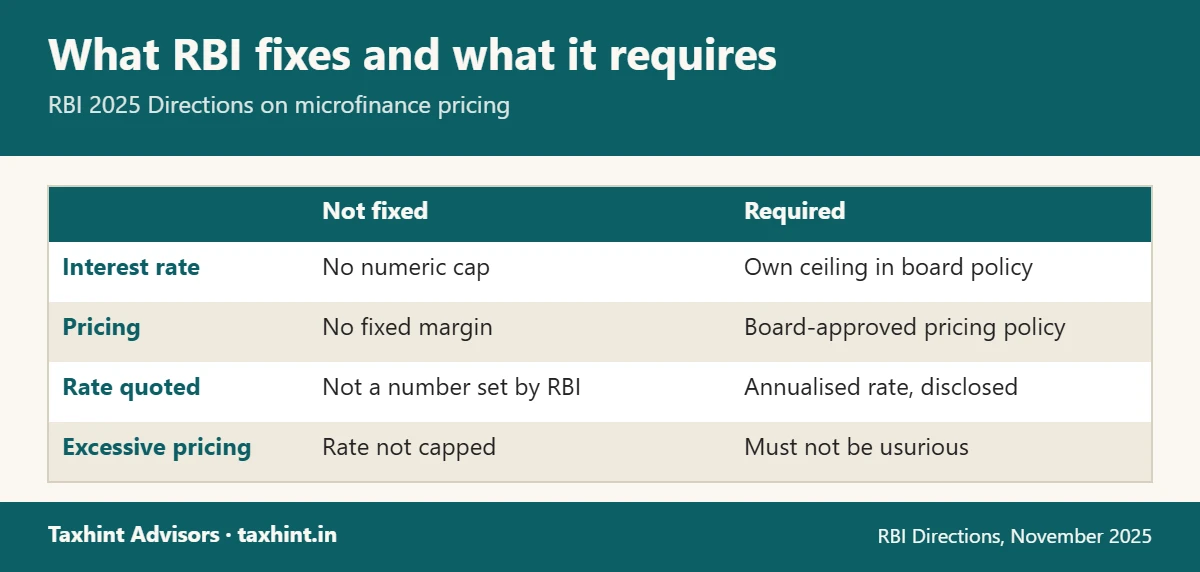
Older NBFC-MFI rules used to fix margins. The current framework does not. In the consolidated Directions of November 2025, the RBI says in so many words that it does not regulate interest rates, but notes that rates beyond a certain level may be seen as excessive. So the freedom is real, and so is the scrutiny.
The same Directions, in the Credit Facilities chapter on microfinance loans, add that interest rates and other charges must not be usurious, and that they are subject to supervisory scrutiny. In other words, no number is fixed, but a rate that looks exploitative is a problem when the inspector reads your policy. These rules apply across lenders, whether you are an NBFC-MFI or an exempt Section 8 microfinance company. For the full picture of who regulates what, start with our guide to RBI microfinance rules.
If you are still choosing a structure, our microfinance company registration page explains the NBFC-MFI route.
The board-approved pricing policy
The core obligation is a written pricing policy approved by your board. The Credit Facilities Directions, 2025 say it should cover:
- A documented interest rate model to arrive at an all-inclusive rate.
- The components of the rate, such as cost of funds, risk premium and margin, based on objective parameters.
- The range of spread allowed for each category of borrower.
- A ceiling on the interest rate and on all other charges.
Read the last point again. The RBI does not set a ceiling, but your own policy must contain one. That is the number an inspector will test your actual loans against. We advise promoters to set the ceiling with some headroom for a rise in cost of funds, then to review it each year at the board meeting.
The Responsible Business Conduct Directions add that the rate model must consider cost of funds, margin and risk premium, and that the reason for charging different rates to different categories must be disclosed in the application form and the sanction letter.
Disclosure and transparency
This is where most compliance gaps appear, because the field team and the head office do not always say the same thing. The Directions expect all of the following.
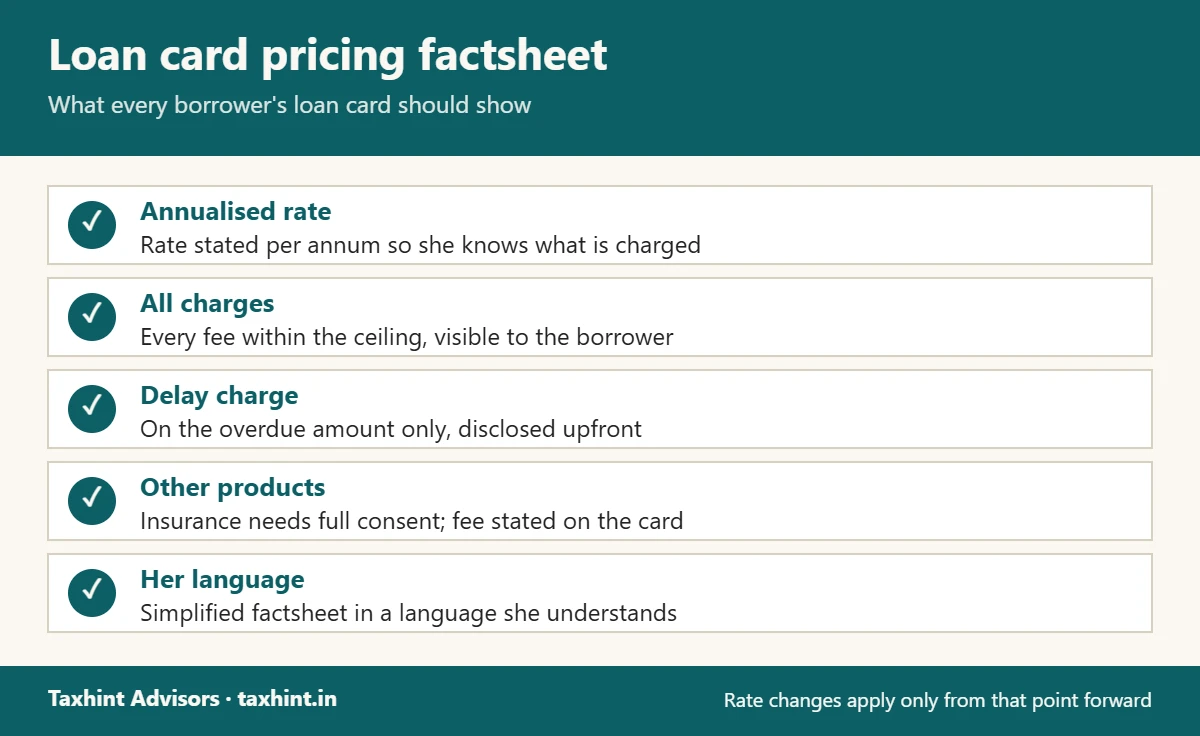
- The rate must be an annualised rate, so the borrower knows what is actually charged.
- Rates and the risk-grading approach must be published on your website or in newspapers, and updated when they change.
- The minimum, maximum and average interest rates must be displayed prominently in offices, in literature and on the website.
- Every borrower gets a loan card with a simplified pricing factsheet, in a language she understands.
- Any change in rate or charges must be told well in advance and applies only from that point forward.
The rule on future changes matters for loan software. If your system recalculates old schedules after a rate change, you are breaking it. Rates change for new loans, not for the sanctioned ones.
Fees, penal charges and prepayment
On fees, we looked for a percentage limit on processing charges in the 2025 Directions and did not find one. What exists is indirect: every fee falls under the ceiling on “all other charges” in your board policy, and it has to be visible to the borrower.
Three further points are clear:
- No prepayment charge. The Directions say no pre-payment charge shall be levied on microfinance loans.
- Delay charges only on the overdue amount. A charge for late payment goes on the overdue instalment, not on the entire loan. Under the general rule for credit facilities, penalties are levied as penal charges, not as extra interest, and they are not compounded. The amount and the reason must be disclosed upfront in the loan agreement.
- Other products need consent. If you sell anything beyond the loan, such as insurance, it needs the borrower’s full consent and the fee must be stated on the loan card.
Remember the other half of lending discipline. Collateral-free loans must go to households with annual income up to ₹3,00,000, and monthly repayment obligations are capped at 50 per cent of monthly household income, as the Credit Facilities Directions provide. Pricing high does not help if the household cannot service the loan. To see what an instalment looks like for a borrower, try our microfinance EMI calculator.
Flat or reducing balance?
The Directions require an annualised rate. A flat rate of, say, 20 per cent on the original principal looks cheaper than it is, because the borrower pays interest on money she has already repaid. The effective cost on a reducing balance is much higher. For the borrower’s sake and for your own inspection, quote the annualised effective rate. If you want the arithmetic and the software side, see flat vs reducing balance interest.
Setting a rate in practice
Take an example. A new NBFC-MFI works out its cost of funds from bank borrowing, adds operating cost per loan, a provision for defaults, and a margin. That total is its rate model. It then fixes the ceiling above that number and puts the whole thing before the board.
The steps we usually walk a client through:
- Work out cost of funds, operating cost and credit cost separately.
- Decide the spread for each borrower category.
- Set the ceiling on rate and all other charges.
- Get board approval and record it in the minutes.
- Print the rates in the loan card, on the website and in every branch.
- Test a sample of loans against the policy every quarter.
For the official text, read the RBI’s Responsible Business Conduct Directions, 2025.
FAQs
Is there a maximum interest rate for microfinance loans in India?
The RBI’s 2025 Directions do not set a numerical cap. Each lender’s board-approved policy must contain its own ceiling on the interest rate and other charges, and rates must not be usurious.
Can an NBFC-MFI charge a processing fee?
A fee can be charged, but it must sit within the ceiling on charges in the board policy and be disclosed on the loan card. We did not find a fixed percentage limit in the 2025 Directions.
Can a lender charge a prepayment penalty on microfinance loans?
No. The Directions state that no pre-payment charge shall be levied on microfinance loans.
How should late payment charges be applied?
On the overdue amount only, not on the whole loan, and the charge must be disclosed upfront.
Do these rules apply to a Section 8 microfinance company?
The microfinance pricing chapter in the Credit Facilities Directions applies to NBFCs. An exempt Section 8 company sits outside RBI registration, but should still follow the same discipline in how it prices and discloses, and our team can review your policy.
Should I quote flat or reducing balance rates?
Quote the annualised rate, as the Directions require. If you also show a flat rate, show the effective reducing-balance rate next to it.
Building a pricing policy for your microfinance company? Get Free Consultation or WhatsApp +91 93117 95484. If you need loan software that stores rates by product and never changes old schedules, book a free demo, microfinance software starting ₹15,000.