November 24, 2026 · Guides
KYC Checklist for Lenders: What Your Software Should Capture
KYC is the base of every loan file. Regulated lenders follow master directions on how to identify customers, verify them, assess risk and keep records. Those directions are detailed and are updated from time to time.
This is a working checklist for what your software should capture. Please verify the current requirements with your CA, CS or compliance officer before you fix your own policy.
In this guide
Identity and address
Capture each item in its own field, not in a note.
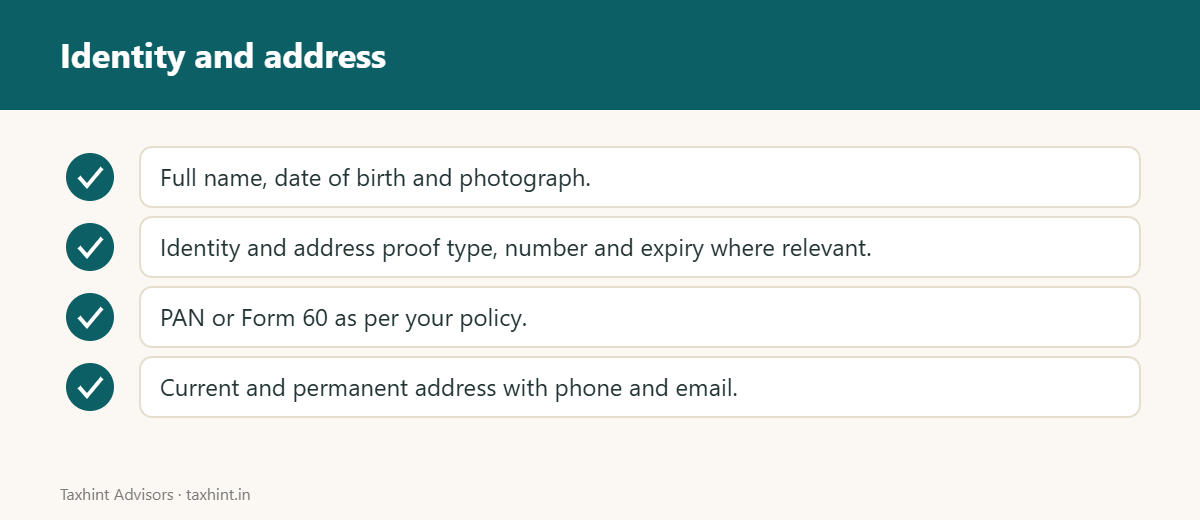
- Full name, date of birth and photograph.
- Identity and address proof type, number and expiry where relevant.
- PAN or Form 60 as per your policy.
- Current and permanent address with phone and email.
Rules in this area change, so please verify the current position with your CA, CS or compliance officer.
Verification
Record who verified and how.
- Original seen or digital verification done.
- Name and date of the verifier.
- Scan stored against the customer.
- Mismatches queried before sanction.
Risk category
Tag every customer.
- Low, medium or high as per your policy.
- Reason for the category.
- Review frequency linked to the category. See periodic updation.
Records and reports
Keep proof ready for audit.
- Retention period per your policy. See data retention.
- Report of customers with incomplete or expired KYC.
- Link with CKYC upload status. See CKYC upload.
See NBFC software and loan management software.
| Check | Evidence |
|---|---|
| Identity proof | Number and scan |
| Address proof | Number and scan |
| Verifier | Name and date |
| Risk category | Reason recorded |
How the checklist works at the counter
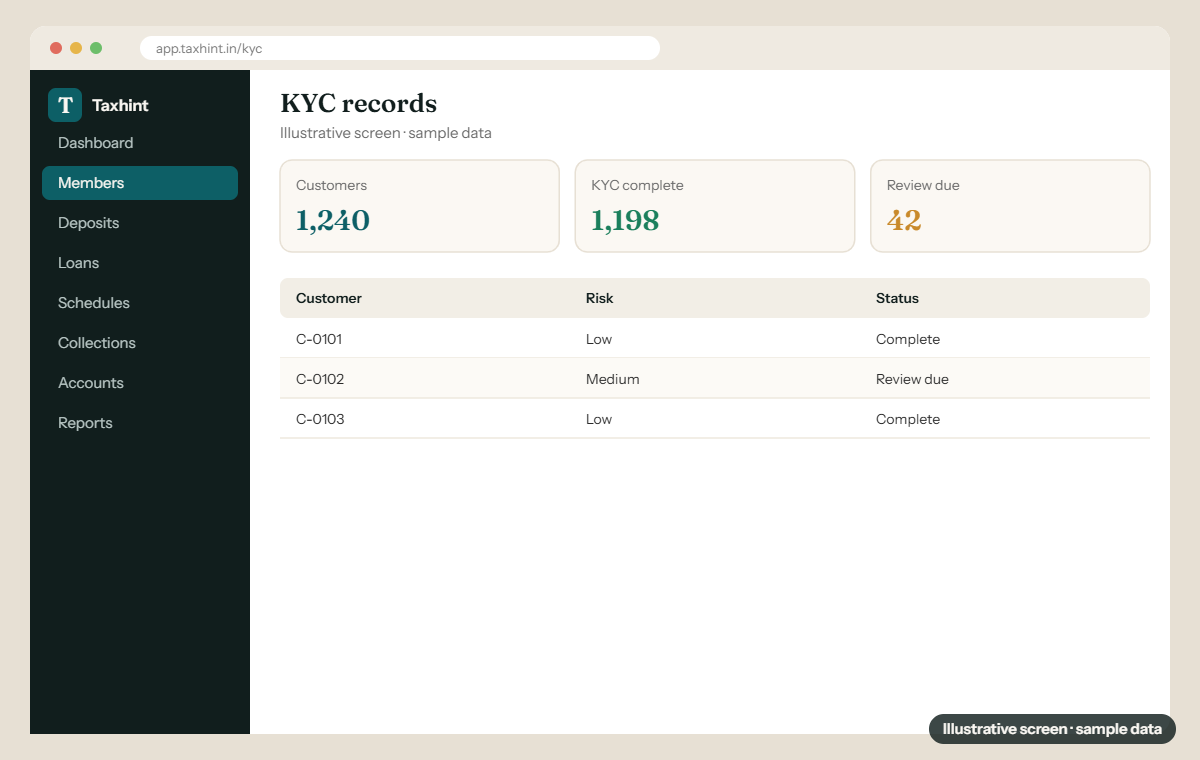
KYC is not only a form at onboarding. It is a set of checks at the start, a record you keep and a refresh over time. Your software should hold the documents, the verification status, the date of verification and the date the next review is due.
Illustrative example: a new customer is onboarded with identity and address documents. The officer marks each as verified, the system stores the images and sets a review date based on your policy. A weekly report lists customers whose review is coming due.
Mistakes to avoid
- Accepting documents without noting that the original was seen.
- Name spelt differently across documents.
- No reminder for periodic review.
- KYC records kept in a separate file from the loan.
Steps to set it up
- List documents accepted for each customer type.
- Add a verification status and a reviewer name in the system.
- Set review reminders from your policy.
- Run a monthly report of incomplete KYC.
- Train staff using sample cases.
Points to confirm
- Exact requirements from the current directions that apply to you.
- Who in your team is accountable.
- Please verify with your CA, CS or lawyer before you rely on it.
Making it routine
Choose one day each week to review incomplete KYC records and one day each month to review upcoming periodic updates. Share the numbers with the manager. Small, regular reviews are easier than a rush before an audit.
- Weekly incomplete KYC list.
- Monthly upcoming review list.
- Short note to management with counts.
FAQs
Is KYC the same for every borrower?
Requirements vary by customer type and risk. Please verify.
Can software enforce KYC?
It can block sanction until mandatory fields and documents are complete.
How long should KYC records be kept?
As per the rules and your policy. Please verify.
What about companies and firms?
They need entity documents and beneficial owner details. Please verify the list.
Want KYC completeness enforced before every sanction? Book a demo of Taxhint NBFC software. Talk to Taxhint on +91 93117 95484 or [email protected], or visit taxhint.in.