November 23, 2026 · Guides
Microfinance Business Plan: Sections to Include, With an Illustrative Example
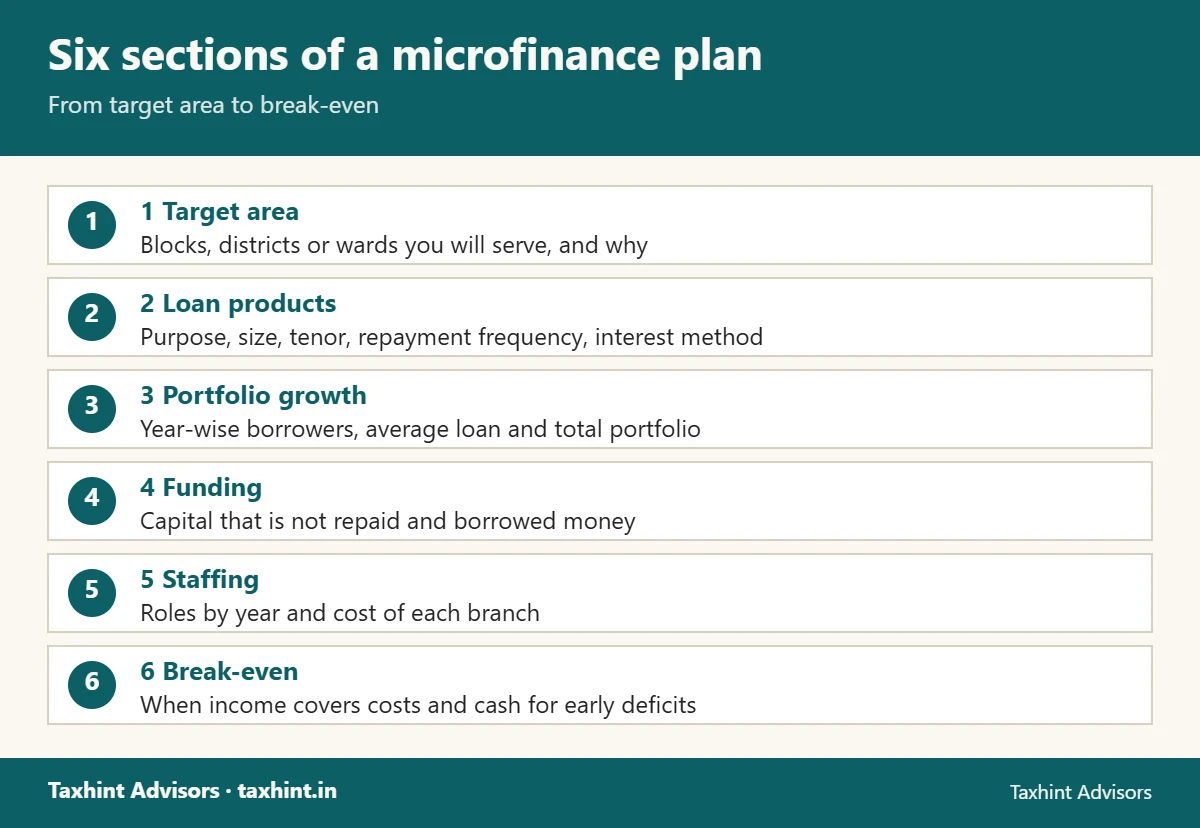
A microfinance business plan is the document that tells your board, your funders and, if you go that route, the RBI how your lending company will reach its borrowers, grow its portfolio and cover its costs. Six sections carry most of the weight: target area, loan products, portfolio growth, funding, staffing and break-even. This post walks through each one for a Section 8 microfinance company or an NBFC-MFI, with a clearly hypothetical worked example at the end.
The plan sits behind every registration. If you are choosing the route first, see Section 8 microfinance company registration before you fix your numbers, because the route decides how much capital you must show.
In this guide
- What the plan is for
- Target area and borrower profile
- Loan products
- Portfolio growth
- Funding plan
- Staffing and branches
- Break-even: an illustrative worked example
- FAQs
What the plan is for
Promoters often treat the microfinance business plan as a formality for a bank or a regulator. It is more useful than that. It forces you to say how many borrowers you can reach in a year, what each branch costs and when the company stops needing grants to survive.
The legal frame shapes the plan. A Section 8 microfinance company cannot pay dividends, so any surplus goes back into the programme. It stays outside RBI registration only while it lends microfinance loans alone, takes no public deposits and keeps assets below ₹100 crore. An NBFC-MFI needs ₹10 crore of net owned fund and at least 60% of its assets in microfinance loans. Our post on Section 8 vs NBFC-MFI sets the two side by side. Your plan should show that your growth path stays inside whichever frame you chose.
Target area and borrower profile
This is the first page a reader of your microfinance business plan turns to.
Name the blocks, districts or city wards you will serve, and say why. Funders look for a reason beyond “there is demand”. Maybe your promoters already run a livelihood programme there, or the area has few formal lenders.
Then describe the borrower. A microfinance loan is a collateral-free loan to a household with annual income up to ₹3,00,000, and repayments across all loans must stay within 50% of monthly household income. Write your eligibility test into the plan in those terms. A useful companion is our microfinance eligibility checker.
For example, a trust in Palwal might say: “We will start with 40 villages where our team already runs women’s training, and open a second cluster only after the first reaches target.” That is concrete, checkable and honest about sequence.
Loan products
In a good microfinance business plan, each product gets its own short entry: purpose, loan size range, tenor, repayment frequency and interest method. Keep the range small at first. Two or three products are easier to train staff on and easier to price than seven.
Some points to settle in this section:
- Is lending individual or through joint liability groups? Our post on JLG and SHG group lending covers how groups work.
- Will interest be flat or reducing balance? Say which and show the effect, as in flat vs reducing balance interest.
- What is the maximum loan to a single borrower? See Section 8 microfinance loan limits.
- What documents will each borrower sign? We list them in microfinance loan agreement documents, and our loan agreement drafting service prepares them for your product.
Portfolio growth
The growth table is the heart of any microfinance business plan. Give a year-wise forecast of active borrowers, average loan outstanding and total portfolio. Be conservative in year one. New branches take months to reach a steady collection rhythm, and early repayment problems are easier to fix when the portfolio is small.
Add your assumptions for portfolio at risk. Funders will ask what happens if collections slip, so say what you would do. The metric is explained in portfolio at risk (PAR) in microfinance. If your growth could push total assets near ₹100 crore, flag it, because a Section 8 company exemption has that ceiling.
Funding plan
Split the money into two buckets. One is the capital that does not have to be repaid: members’ contribution, grants and donations. The other is borrowed money that funds the loan book, from banks, NBFCs or similar lenders.
The Companies Act sets no minimum capital for a Section 8 company, but your plan sets the real minimum. Work it backwards from the portfolio you want and the gearing your lenders will accept. We discuss this in minimum capital for a microfinance company. Also budget for set-up costs, listed in microfinance company registration cost.
Staffing and branches
Staffing drives the cost side of the microfinance business plan. List the roles you need by year: a chief executive or manager, accounts and compliance, branch managers, field officers and an IT or MIS person. Show the cost of each branch from rent to salaries to travel. In practice most plans underestimate field travel and training.
Do not forget your technology spend. Collection tracking, receipts and borrower records are easier on a proper system; see our software for a Section 8 microfinance company post for what to look for.
Break-even: an illustrative worked example
The numbers below are made up to show the method. They are not benchmarks, forecasts or results from any real company, and your own interest rate, funding cost and expenses will differ.
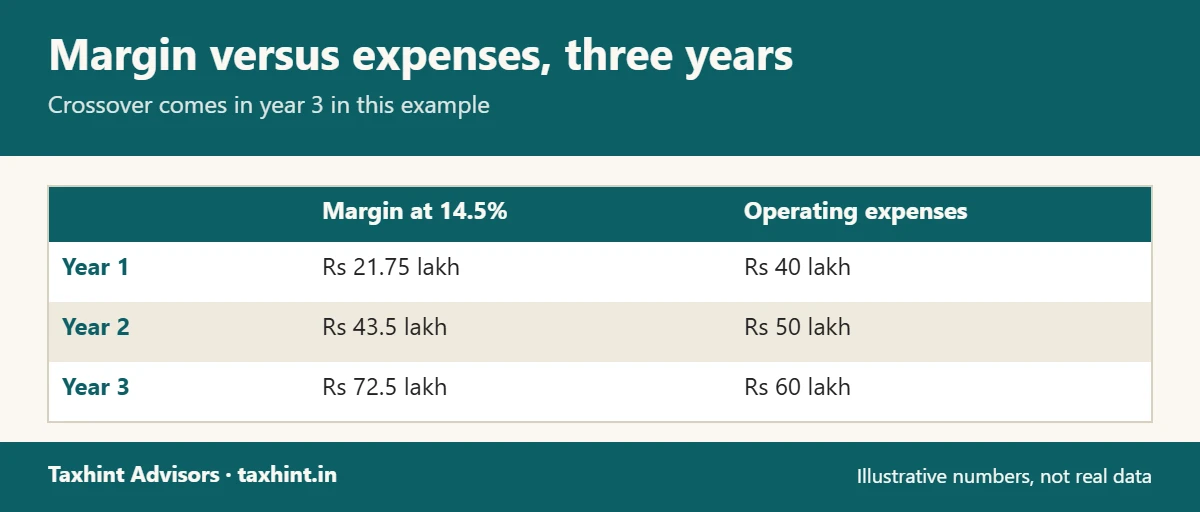
Assumptions: the company earns 22% a year on its average portfolio (interest and fees). 60% of the portfolio is funded by borrowing at 10%, and the rest by its own funds and grants at no interest cost. Credit losses are 1.5% of the portfolio. Operating expenses are given in the table.
Margin before operating expenses is 22% minus the cost of borrowing (60% of 10%, which is 6%) minus 1.5%, which leaves 14.5% of the average portfolio.
| Year | Average portfolio | Margin at 14.5% | Operating expenses | Surplus or deficit |
|---|---|---|---|---|
| 1 | ₹1.5 crore | ₹21.75 lakh | ₹40 lakh | Deficit ₹18.25 lakh |
| 2 | ₹3.0 crore | ₹43.5 lakh | ₹50 lakh | Deficit ₹6.5 lakh |
| 3 | ₹5.0 crore | ₹72.5 lakh | ₹60 lakh | Surplus ₹12.5 lakh |
At ₹60 lakh of expenses, the break-even portfolio is ₹60 lakh divided by 14.5%, about ₹4.14 crore. If each borrower owes an average of ₹20,000 at any time, that is roughly 2,070 active borrowers. The two deficit years add up to ₹24.75 lakh, so the plan must show where that money comes from, usually grants or members’ capital, as the company cannot pay dividends and has no profits to draw on early.
The lesson for your own microfinance business plan is the shape, not the figures: you need the portfolio to grow faster than the cost base, and you need cash to carry the early deficits. Our microfinance EMI calculator helps test the instalment side before you finalise the rate.
Before you submit the microfinance business plan to a funder or regulator, have a CA review the plan against your chosen route and your compliance calendar. The company-law side is on MCA.
FAQs
What is a microfinance business plan?
It is a written plan showing the area you will serve, your loan products, portfolio targets, funding, staffing and the point where income covers costs.
Do I need a business plan for a Section 8 microfinance company?
A Section 8 application typically carries a projected income and expenditure statement, and your board, lenders and funders will ask for a fuller plan. It also keeps your numbers honest.
What does an NBFC-MFI need to show?
The ₹10 crore net owned fund and at least 60% of assets in microfinance loans. Your plan should show how you reach and keep both.
How long does a microfinance company take to break even?
It depends on your rate, funding cost and expenses. In our hypothetical example it is the third year, but that is only a worked illustration.
Can a Section 8 company distribute its surplus?
No. A Section 8 company cannot pay dividends; surplus goes back into its objects.
Can Taxhint prepare our plan?
Yes. A CA/CS-led team can help structure the plan around your route. Use Get Free Consultation below.
Next step: Get Free Consultation, or WhatsApp us on +91 93117 95484, and we will help you shape the plan before you register.