November 24, 2026 · Guides
Microfinance Industry Trends in India, 2026: What the Data Shows

India’s microfinance sector went through a long contraction and then began to stabilise. These microfinance industry trends in 2026 matter to anyone planning a new lender or software, because funding and risk follow the data.
The figures below come from named sources. Different bureaus count differently, so numbers vary between reports.
In this guide
- Size of the market
- Why the numbers differ
- Main themes
- Asset quality
- What this means for lenders and new entrants
- Related reading
- Where this comes from
- What to watch next
- How to use this article
- FAQs
Size of the market
| Source and date | Portfolio | Borrowers and loans |
|---|---|---|
| SIDBI MFI Pulse, 31 March 2026 | ₹2,77,053 crore outstanding | About 5.5 crore unique live borrowers, 7.6 crore active loans |
| MFIN report, 31 March 2026 | ₹3,25,174 crore, up over 3 percent quarter on quarter after seven quarters of contraction | , |
| CRIF Credit Information Services, September 2026 | ₹3.28 lakh crore GLP, down 5 percent year on year and 1.4 percent quarter on quarter | 9.6 crore active loans, 6.4 crore live borrowers |
Why the numbers differ
Each source measures different sets of lenders and uses different definitions. SIDBI MFI Pulse and CRIF and MFIN reports are not directly comparable. Quote the source and date whenever you use a figure.
Main themes
- NBFC-MFIs lead. SIDBI reports NBFC-MFIs hold nearly half of active loans, portfolio and disbursement. CRIF puts their share at 44.7 percent of industry portfolio in September 2026.
- Larger tickets. CRIF reports average exposure per loan up 22.7 percent year on year, to about ₹34,200.
- Fewer lenders per borrower. Borrowers with fewer active lenders show lower delinquency, according to CRIF.
- Cautious funding. SIDBI’s own refinance to MFIs fell 31 percent in FY2025; see SIDBI and NABARD.
Asset quality
SIDBI’s MFI Pulse as of 30 June 2026 shows 90-plus delinquency of 1.05 percent for the overall industry. Quality has improved since the stress period, but it varies by lender type and state. Use bureau data for your own area.
What this means for lenders and new entrants
- Underwrite for fewer active lenders and the cap on repayments; see borrower selection.
- Build data systems to prove portfolio quality to funders.
- Plan funding from several sources; see funding sources.
- Use PAR and collection efficiency together.
Related reading
New to the sector? Read NBFC-MFI क्या है and our structure comparison.
Where this comes from
Sources: SIDBI Microfinance Pulse; Outlook Business on the MFIN report; Business Today on the CRIF report; SIDBI MFI Pulse 28th edition. Figures change every quarter.
What to watch next
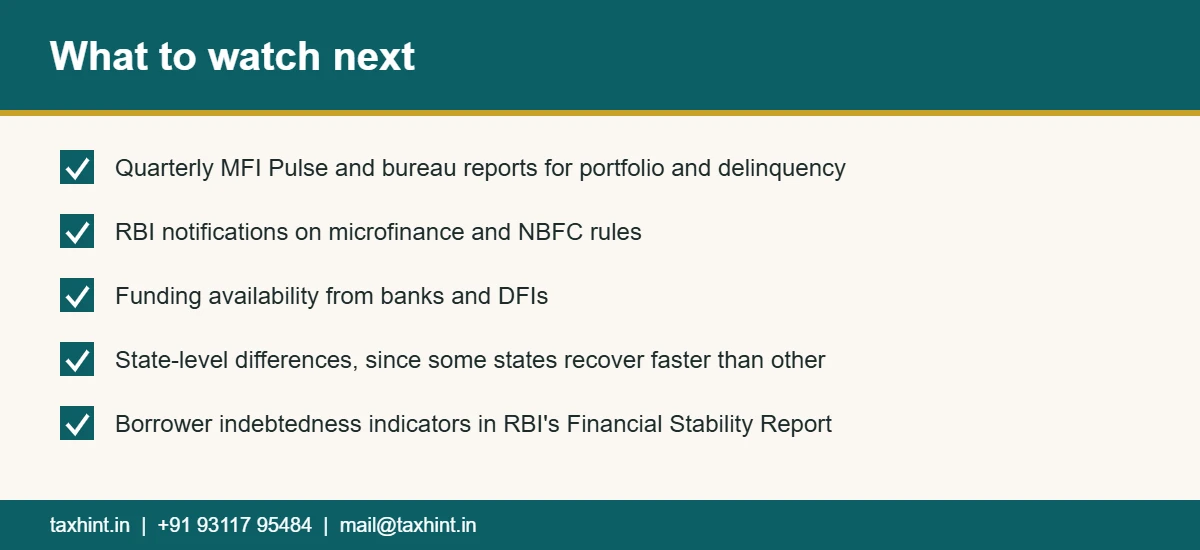
- Quarterly MFI Pulse and bureau reports for portfolio and delinquency.
- RBI notifications on microfinance and NBFC rules.
- Funding availability from banks and DFIs.
- State-level differences, since some states recover faster than others.
- Borrower indebtedness indicators in RBI’s Financial Stability Report.
How to use this article
Use these figures as context, not as targets. Your own PAR, collection efficiency and funding conversations matter more than industry averages. When you present numbers to a board or funder, cite the source and date, and state that definitions differ between reports.
FAQs
Is the sector growing again?
MFIN reported a quarter-on-quarter rise at 31 March 2026, but CRIF showed a year-on-year decline in September 2026. Watch the next quarters.
Which lender type is biggest?
SIDBI and CRIF both report NBFC-MFIs as the largest group.
Why are loan sizes rising?
Lenders have moved to fewer, larger loans per borrower, according to CRIF.
Where do I get fresh data?
SIDBI MFI Pulse, MFIN and credit bureau reports, which are published every quarter.
Will the sector keep growing?
Nobody can say. Watch the data each quarter and plan with a margin for error.
Planning a microfinance company or already running one? Our CAs and CSs handle registration, RBI work and yearly compliance. Get Free Consultation or WhatsApp +91 93117 95484.