November 23, 2026 · Guides
Microfinance Loan Agreement: The Documents Every Borrower File Needs
A microfinance loan agreement is the signed contract between your lending company and a borrower, but the agreement alone proves very little. When an auditor, a bank or an unhappy borrower asks questions, what counts is the whole file: application, KYC, sanction letter, key facts statement, agreement, repayment schedule and receipts. This post lists each document, what it should say and where RBI’s rules set the standard.
If you are still setting up the company that will lend, start with our page on Section 8 microfinance company registration. If you already lend, use this as a checklist against your current borrower files.
In this guide
- The seven documents at a glance
- Loan application and KYC
- Sanction letter and key facts statement
- What the microfinance loan agreement should contain
- Language: write it so the borrower can read it
- Repayment schedule and receipts
- Mistakes we see in borrower files
- FAQs
The seven documents at a glance
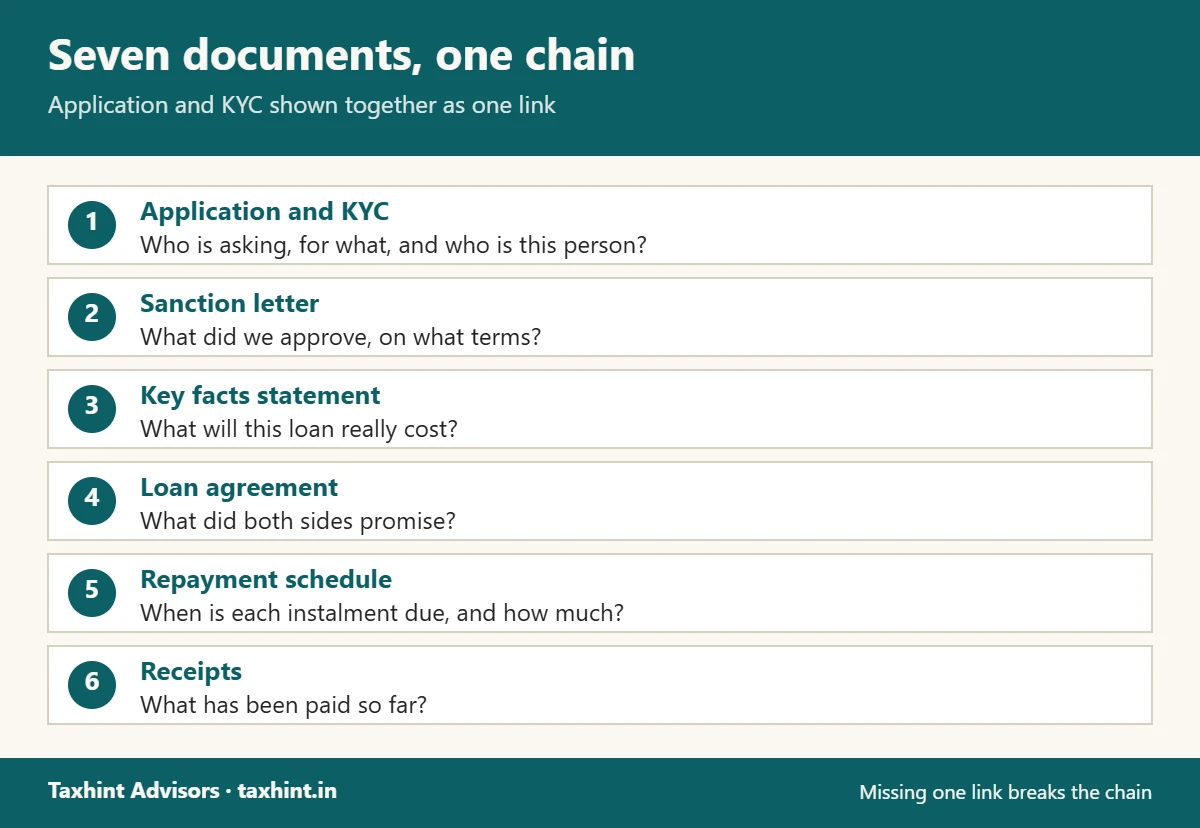
Think of the borrower file as a chain. Each document answers one question, and if one link is missing the chain breaks at the worst moment.
| Document | Question it answers | Who signs or holds it |
|---|---|---|
| Loan application | Who is asking, for what purpose and how much? | Borrower signs; you keep it |
| KYC set | Who is this person, really? | Borrower provides; you verify and keep |
| Sanction letter | What did we approve, on what terms? | You issue; borrower acknowledges |
| Key facts statement | What will this loan really cost? | You issue before the contract; borrower acknowledges |
| Loan agreement | What did both sides promise? | Both sign; both get a copy |
| Repayment schedule | When is each instalment due, and how much? | You issue; borrower holds a copy |
| Receipts | What has been paid so far? | You issue each time; borrower keeps |
Loan application and KYC
The application is where the loan starts, and where most of the later disputes can be prevented. Capture the borrower’s name, address, household details, purpose of the loan, amount asked and the household income figure you relied on. The income line matters because a microfinance loan is a collateral-free loan to a household with annual income up to ₹3,00,000, and your own file should show the borrower fits.
Also record the existing loans the household carries. Monthly repayment obligations on all loans together are capped at 50% of monthly household income, so the application is the natural place to note what you checked.
KYC is a separate set: identity and address proof, a photograph and a signature or thumb impression. The practical points are covered in our post on borrower KYC with Aadhaar, PAN, photo and signature. The credit bureau check also belongs here; see credit bureau membership for microfinance lenders for how that works.
Sanction letter and key facts statement
Once you approve, tell the borrower in writing what you approved. A sanction letter states the amount, the tenor, the interest rate, the fees, the instalment size and frequency, and the conditions before disbursement. RBI’s Responsible Business Conduct Directions for NBFCs expect sanction terms to be conveyed in writing in a language the borrower understands.
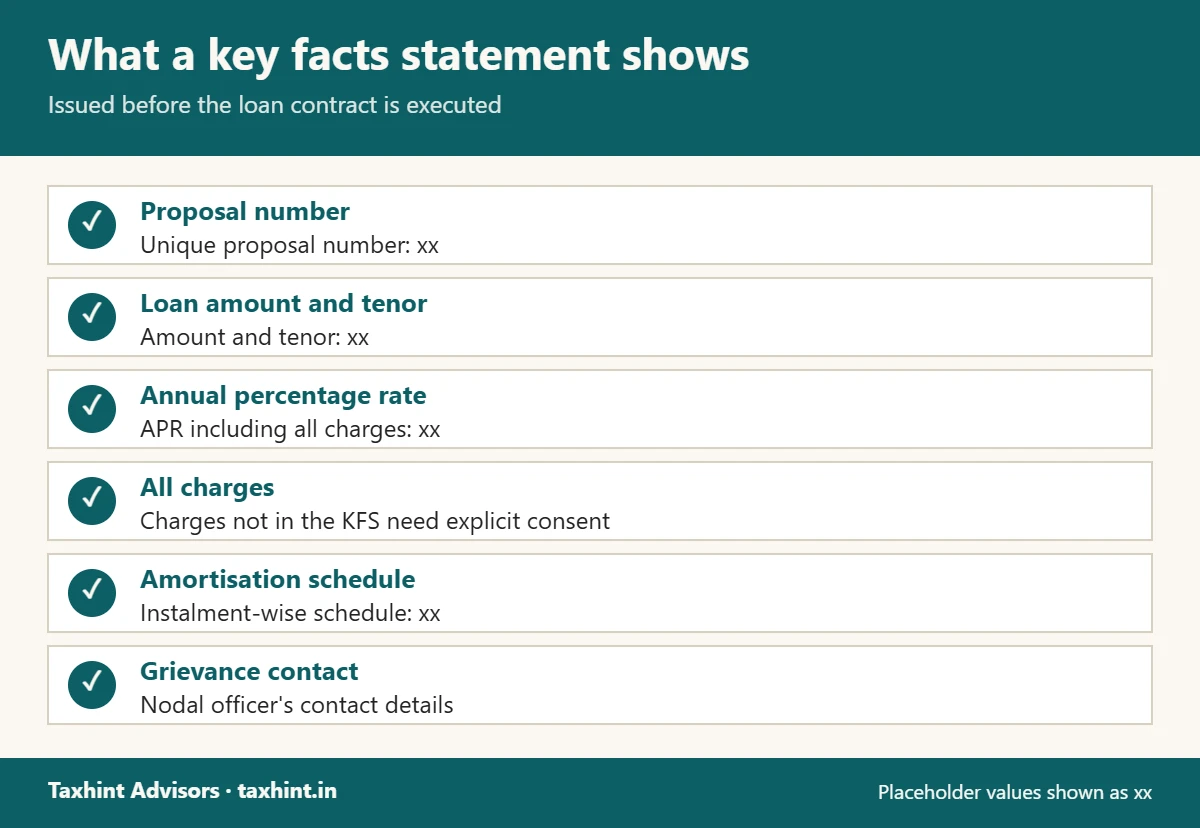
Alongside it sits the key facts statement, usually called the KFS. Under RBI’s directions, an NBFC gives a KFS for retail and MSME term loans before the loan contract is executed, in the format RBI prescribes. It carries a unique proposal number, an annual percentage rate that includes all charges, and an amortisation schedule. Charges that are not in the KFS cannot be levied without the borrower’s explicit consent. The rule applies to new loans sanctioned on or after 1 October 2024.
A fair question is whether this binds a Section 8 microfinance company. The RBI directions bind regulated NBFCs, and a Section 8 company under the exemption is not an RBI-registered NBFC. We still advise copying the standard. Banks that fund you, auditors who review you and borrowers who complain will all measure you against it, and it costs almost nothing to follow. For the rate side of this, read microfinance interest rate rules.
What the microfinance loan agreement should contain
We do not hand out a ready-made template here, because the right wording depends on your loan product and your lender covenants, and a template copied from another company is how contradictions creep in. Our loan agreement drafting service is built around your actual product. What we can give you is the list of clauses a sound agreement covers:
- Names, addresses and capacity of both parties, and the loan purpose.
- Amount, disbursement method and date.
- Interest rate, the method of calculation and every fee, matching the KFS exactly.
- Repayment frequency, number of instalments and a reference to the attached schedule.
- Late payment treatment. RBI’s directions for microfinance loans say delay charges apply only to the overdue amount, and that no pre-payment charge is levied.
- Insurance, if any, and who pays for it.
- Collateral-free declaration, and the group or guarantor arrangement if you lend through groups.
- Default, recovery and grievance redressal, with the nodal officer’s contact.
- Governing law, jurisdiction and stamp duty as your state requires.
On stamp duty: it varies by state and by how the agreement is executed, so confirm it for your registered office before you print a thousand copies. If your lending runs through groups, our post on JLG and SHG group lending explains how group liability is recorded.
Language: write it so the borrower can read it
This is the part promoters underestimate. RBI’s directions say microfinance loan agreements must be in a language the borrower understands, and the KFS must be written in such a language too. The directions also ask for a loan card showing the borrower’s identification, the pricing, repayment acknowledgements and grievance details, again in that language.
In practice, take a lender working with women’s groups around Palwal. An English agreement with a Hindi cover note is not enough. The borrower should be able to read the rate, the instalment and the due dates in Hindi, or have them read out and explained, and sign knowing what she signed. Keep the English version for your records and the local-language one for the borrower, and make sure the numbers are identical.
Repayment schedule and receipts
The schedule lists every due date, the principal and interest in each instalment and the balance after it. The RBI KFS format requires an amortisation schedule, and it should be the same schedule attached to the agreement. If your system uses flat interest in one place and reducing balance in another, borrowers will notice. Our post on flat vs reducing balance interest shows why that mismatch happens.
Receipts close the loop. Every collection should produce a receipt with date, amount, instalment number and balance outstanding, whether the money came in at a centre meeting or by transfer. The borrower keeps one copy, and the entry goes on the loan card as well. A microfinance collection app can print or send these on the spot, which removes the old problem of handwritten books that do not match the ledger.
Mistakes we see in borrower files
- Agreement without the schedule. The borrower is bound to pay, but cannot say how much or when.
- KFS issued after signing. The point of the statement is that it comes first.
- Charges in the ledger that appear nowhere in the paperwork. If it is not in the KFS and agreement, do not collect it.
- Borrower never got a copy. RBI’s directions treat not furnishing a copy of the agreement and its enclosures as an unfair practice.
- English-only documents for borrowers who read only Hindi or a regional language.
- Different numbers in different documents. Sanction letter says one rate, agreement another.
We usually advise scanning each file at disbursement and attaching it to the borrower’s record, so the whole chain can be produced in minutes. The RBI text is in the Responsible Business Conduct Directions on rbi.org.in; read the microfinance paragraphs and the KFS paragraph yourself, and have your adviser map them to your product. Our overview of RBI microfinance rules is a good first read.
FAQs
What is a microfinance loan agreement?
It is the written contract between the lending company and the borrower, setting out the amount, rate, charges, repayment schedule, default terms and grievance process.
Which documents make up a microfinance loan file?
Application, KYC, sanction letter, key facts statement, loan agreement, repayment schedule and receipts. Keep a loan card as well if you lend to groups.
Does the loan agreement have to be in a local language?
RBI’s directions say microfinance loan agreements must be in a language the borrower understands. Even where you are not directly bound, we advise following it.
Is a key facts statement mandatory?
For RBI-regulated NBFCs, yes, for retail and MSME term loans sanctioned on or after 1 October 2024, issued before the contract is executed. A Section 8 company under the exemption is not directly covered, but we advise using one.
Can we charge a pre-payment penalty?
RBI’s directions say no pre-payment charge is levied on microfinance loans, and delay charges apply only to the overdue amount.
Does the borrower get a copy of the agreement?
Yes. Hand over the agreement and every enclosure, including the schedule. RBI’s directions treat failing to do so as an unfair practice.
Can Taxhint draft our loan agreement?
Yes. A CA/CS-led team drafts it around your loan product, 100% online. Use the Get Free Consultation button below.
Next step: Get Free Consultation, or WhatsApp us on +91 93117 95484, and we will review your borrower file format or draft one for your product.