November 24, 2026 · Guides
From NGO to Microfinance Company: Your Options Explained

Many NGOs run small lending programmes under a trust or society. When the portfolio grows, regulators, banks and donors expect a company structure. The path from NGO to microfinance company is usually a new Section 8 company or a conversion where the law allows.
Here are the options and the order of work.
In this guide
- Why move
- Routes available
- Order of steps
- Assets and loans
- After the move
- A planning example
- Pre-conversion checklist
- Communicating with borrowers
- FAQs
Why move
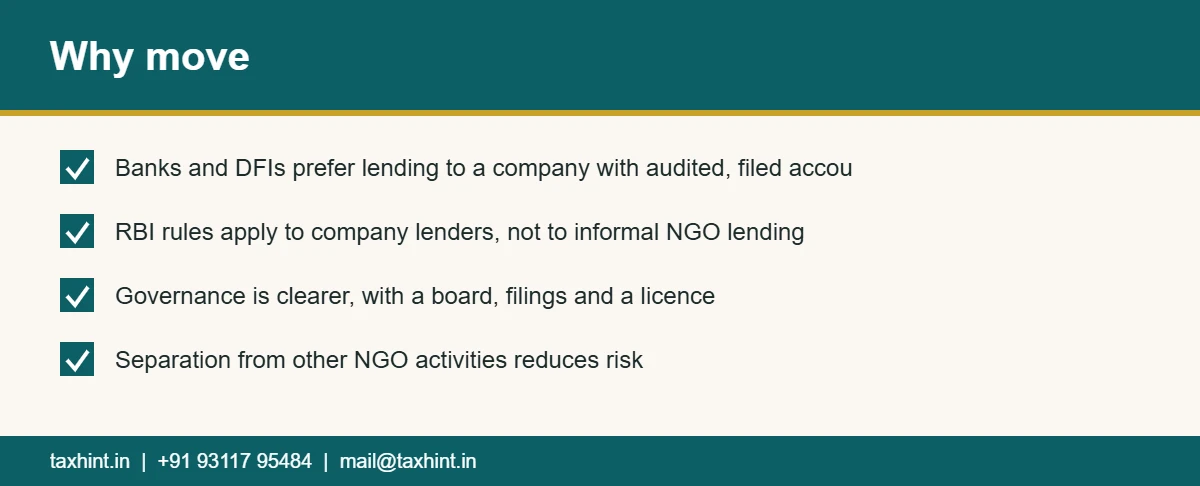
- Banks and DFIs prefer lending to a company with audited, filed accounts.
- RBI rules apply to company lenders, not to informal NGO lending.
- Governance is clearer, with a board, filings and a licence.
- Separation from other NGO activities reduces risk.
Routes available
| Route | What it means |
|---|---|
| New Section 8 company | Fresh incorporation; NGO transfers loan book later |
| Conversion where permitted | Direct conversion if the Act and your structure allow |
| Run both | NGO keeps grants work; company handles lending |
Which route is open depends on your registration type and documents. See Section 8 vs trust vs society.
Order of steps
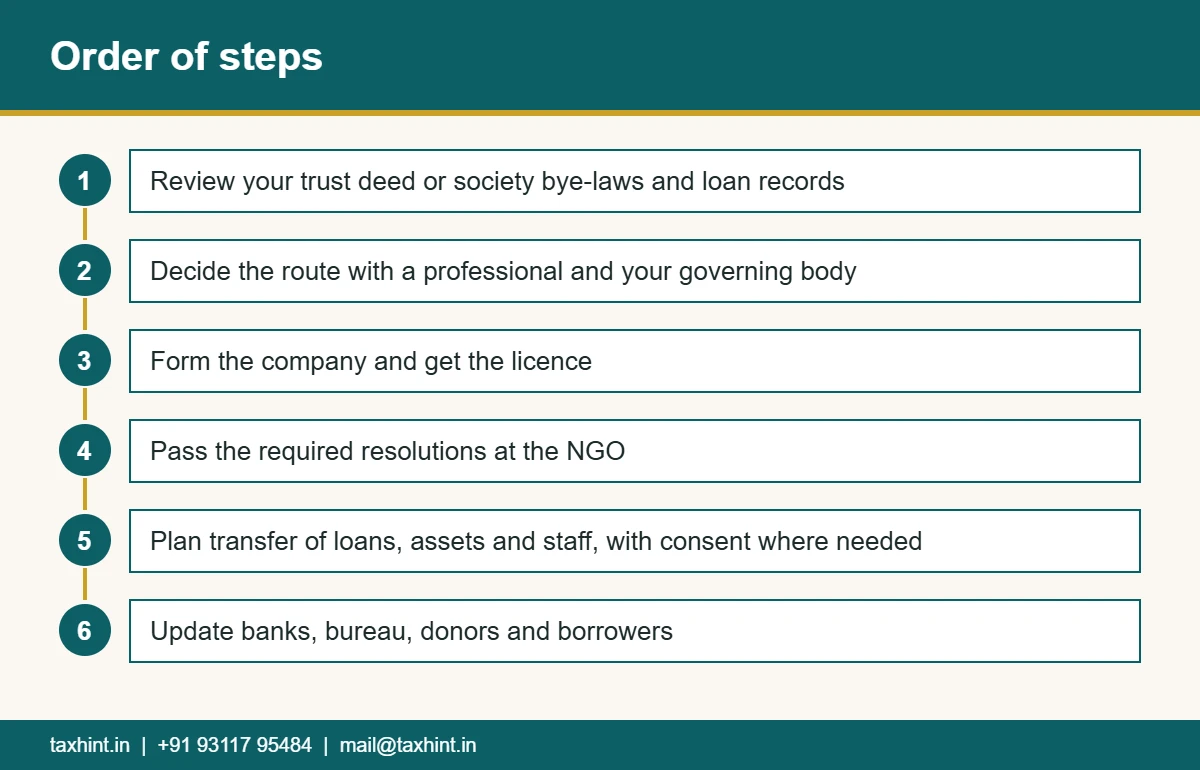
- Review your trust deed or society bye-laws and loan records.
- Decide the route with a professional and your governing body.
- Form the company and get the licence.
- Pass the required resolutions at the NGO.
- Plan transfer of loans, assets and staff, with consent where needed.
- Update banks, bureau, donors and borrowers.
Assets and loans
Moving loans needs borrower communication and proper documents, and any tax or regulatory implications should be checked first. Keep records clean; our Excel migration guide helps with data.
After the move
The new company must follow annual compliance and, depending on size, RBI rules. Start with the annual compliance guide and the registration timeline.
A planning example
This is illustrative, not a client case. An NGO runs a joint liability loan programme for a few hundred women under a registered society. Its board decides to form a Section 8 company, get the licence, hold a general body meeting to approve the transfer, notify borrowers, move the loan book on a cut-off date and open a new bank account. The society continues with training and grants. The company starts with clean books and its own filings.
Pre-conversion checklist
- Loan register reconciled to the bank and the books.
- Borrower list with addresses and loan terms.
- Donor and lender consents mapped.
- Staff and contract transfer plan.
- Tax and stamp-duty advice taken.
- Communication plan for borrowers.
Communicating with borrowers
Borrowers care about two things: will my loan terms change, and where do I pay. Tell them in simple language, in their own language, at the centre meeting and by letter. Give them a contact number and keep your grievance cell ready for questions.
FAQs
Can an NGO lend without becoming a company?
Small, regular lending can raise legal questions. Take advice on your structure and RBI rules.
Do we lose our 12A registration?
Check the tax position before any transfer; the treatment depends on your facts.
Will borrowers need to sign again?
Often yes, or at least be notified, depending on how the transfer is structured.
How long does conversion take?
It depends on the route, approvals and your records. Ask for a plan, not a promise.
Can the same people run both the NGO and the company?
Yes, but keep decisions, accounts and bank accounts separate and document conflicts of interest.
Do we need a valuation of the loan book?
Often yes, for a fair transfer and tax purposes. Ask your auditor.
Planning a microfinance company or already running one? Our CAs and CSs handle registration, RBI work and yearly compliance. Get Free Consultation or WhatsApp +91 93117 95484.