November 23, 2026 · Guides
Section 8 Microfinance Directors and Members: Rules and Practical Choices
A private Section 8 company needs at least two directors and at least two members. One director must be a resident of India, and every director needs a DIN and a digital signature certificate before the incorporation file goes in. That is the legal floor for Section 8 microfinance directors, and most small promoter groups clear it easily.
The harder questions on Section 8 microfinance directors come after: who should sit on the board, whether directors and members can be the same people, and what changes once the loan book grows. This post covers the rules and then the practical choices we see.
In this guide
- Minimum Section 8 microfinance directors and members
- The resident director rule
- DIN and DSC for Section 8 microfinance directors
- Who can and cannot be a director
- Independent directors: needed or not
- Choosing Section 8 microfinance directors in practice
- After incorporation: changes and RBI
- FAQs
Minimum Section 8 microfinance directors and members
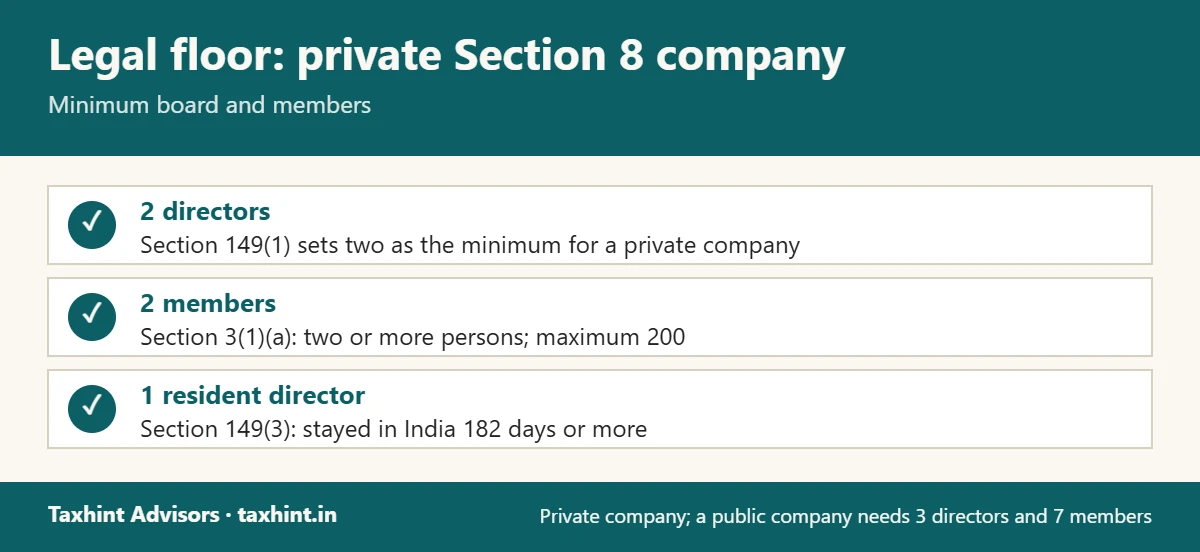
Section 149(1) of the Companies Act, 2013 sets two directors as the minimum for a private company. A public company needs three. A Section 8 company can be formed either way, but almost every microfinance start-up we see goes private, because it is simpler to run.
Members work the same way. Section 3(1)(a) allows a private company to be formed by two or more persons, and a public company needs seven. A private company cannot have more than 200 members.
Take a trust in Palwal that wants to start a livelihood lending arm. Two trustees can sign the memorandum as the first two members and also serve as the first two directors. That is perfectly valid. If you are planning the whole filing, our Section 8 microfinance company registration page shows how the board fits into the application.
| Item | Private Section 8 company | Public Section 8 company |
|---|---|---|
| Minimum directors | 2 | 3 |
| Minimum members | 2 | 7 |
| Maximum members | 200 | No cap |
| Resident director | At least 1 | At least 1 |
The resident director rule
Section 149(3) requires at least one director who has stayed in India for 182 days or more in the previous calendar year. It is a test of days spent in India, not of citizenship. A person holding a foreign passport who lives mostly in India can qualify.
We advise promoters to appoint at least one director who is plainly resident in India from day one. For a Section 8 microfinance company that is nearly always the case anyway.
DIN and DSC for Section 8 microfinance directors
Section 152 makes a Director Identification Number compulsory for anyone appointed as a director, and section 153 says the application is made electronically in Form DIR-3. Where a proposed director has no DIN, we arrange it as part of the incorporation filing so the board is ready when the file is submitted.
Forms on the MCA V3 portal are signed digitally, so each director also needs a DSC in their own name. Order it early, and keep the name on the DSC identical to the name on the PAN.
Keep the directors’ contact details current. DIN KYC is a recurring obligation, and the due dates were revised in 2026. We confirm the current date on the MCA site at each filing, so check it again before relying on any date you read online.
Who can and cannot be a director
The law does not keep Section 8 microfinance directors to a special list of people. The ordinary rules for company directors apply.
Section 164 lists the disqualifications. Among them are being of unsound mind, being an undischarged insolvent, and not holding a DIN. Certain criminal convictions and unpaid calls on shares are also grounds.
There is a limit on how many boards one person can sit on. Section 165 allows up to 20 directorships, but only 10 for public companies and for private companies that are holding or subsidiary companies of a public company. A promoter who already runs several companies should count before agreeing to one more.
Beyond the statute, choose Section 8 microfinance directors the community trusts. A Section 8 microfinance company lends to households with annual income up to ₹3,00,000, so credibility on the ground matters as much as paperwork.
Independent directors: needed or not
Rule 4 of the Companies (Appointment and Qualification of Directors) Rules, 2014 requires at least two independent directors in a public company that meets any one of three tests. These are paid-up capital of ₹10 crore or more, turnover of ₹100 crore or more, or outstanding loans, debentures and deposits above ₹50 crore. The rule speaks only of public companies.
So a private Section 8 company does not have to appoint independent directors under that rule. A public Section 8 company would have to check the thresholds each year against its audited accounts. Some promoters add an outside professional to the board anyway, for credibility with funders. That is a choice, not a requirement.
Choosing Section 8 microfinance directors in practice
We usually advise a board of three, even though two is enough. With two directors, a single disagreement leaves the company with no way to pass a resolution. A third director breaks the tie. Most Section 8 microfinance directors we work with are also the founding members, so this is rarely a hardship.
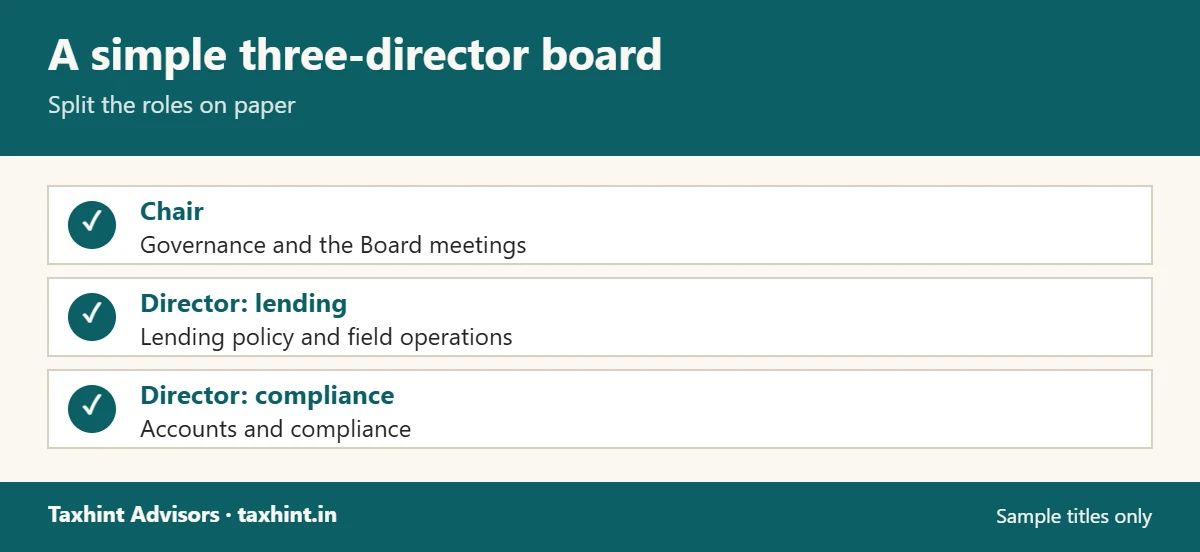
Split the roles on paper. One director looks after governance and the Board meetings. One watches lending policy and field operations. One handles accounts and compliance. Our Section 8 microfinance company documents checklist lists the KYC and consent papers each director signs.
Think about succession too. If the only two directors are also the only two members and one leaves, you are suddenly short of both. Bring in a third member early, so a single exit does not freeze the company.
Finally, keep the directors’ relationship with the lending business clean. A director who also borrows from the company, or who is related to a large borrower, creates a conflict. Record the interest at the Board meeting and keep that director out of the sanction decision.
After incorporation: changes and RBI
When a director is appointed or leaves, the company files Form DIR-12 within 30 days under Rule 18 of the same Rules. The yearly cycle of AGM, annual compliance and director declarations sits on top of this. A late DIR-12 is a small lapse, and an easy one to avoid with a calendar reminder.
A Section 8 company that gives only microfinance loans, takes no public deposits and stays below ₹100 crore in assets is exempt from RBI registration. Because it is not an RBI-registered NBFC, we do not describe RBI board-level criteria for it here. Once assets reach ₹100 crore, the exemption is withdrawn and the company must apply to RBI to register as an NBFC-MFI, as paragraphs 14 and 15 of the NBFC-MFI Directions, 2025 provide. That is the point to revisit your Section 8 microfinance directors and the board’s skills, and our comparison of Section 8 vs NBFC-MFI explains what changes.
The MCA portal and the text of the Companies Act on India Code are the sources to check any section against.
FAQs
How many Section 8 microfinance directors are needed?
A private Section 8 company needs at least two directors, and a public one needs at least three. We usually suggest three for a private company so there is a tie-breaker.
Can the same people be directors and members?
Yes. The subscribers who sign the memorandum can also be the first directors. Keep in mind that the minimum is two members, so plan a third member in case one exits.
Does a Section 8 microfinance company need a resident director?
Yes. Section 149(3) requires at least one director who has stayed in India for 182 days or more in the previous calendar year.
Is a DIN compulsory for directors?
Yes. Section 152 makes a DIN compulsory, and section 153 provides for the application in Form DIR-3. Without a DIN a person is disqualified from appointment under section 164.
Do directors need a digital signature certificate?
The incorporation forms are filed electronically and signed digitally, so each director should have a DSC in their own name. Keep the name identical to the PAN.
Do I need independent directors?
Rule 4 applies to public companies that cross specified thresholds on paid-up capital, turnover or borrowings. A private Section 8 company is not named in it, so it is not required.
How many companies can one person be a director of?
Section 165 allows up to 20 directorships, with a lower limit of 10 for public companies and for private companies that are subsidiaries or holding companies of a public company.
How soon must a change of director be reported?
Form DIR-12 is due within 30 days of the appointment or change under Rule 18.
Want your board and members lined up before the SPICe+ filing? Get Free Consultation from our CA and CS team, or WhatsApp +91 93117 95484.