November 23, 2026 · Guides
Section 8 Microfinance Board: Governance That Lenders Trust
A Section 8 microfinance board carries more weight than most promoters expect. It is the board, not the field team, that keeps the company inside the RBI exemption and convinces lenders and donors that the money is in safe hands.
This guide covers the basics we set up for every Section 8 lender we register.
Whether you are setting up a new company or tidying an existing one, a strong Section 8 microfinance board is the cheapest risk control you have.
In this guide
- Who sits on the board
- How often it meets
- The standing item: the RBI exemption
- Policies the board adopts
- What the board should see every time
- What good minutes look like
- Conflicts of interest
- Mistakes we see
- How we help
- FAQs
Who sits on the board
A private Section 8 company needs at least two directors, and a public one at least three. For a lender, aim for a mix: someone who knows the borrowers and field work, someone strong on finance or accounts, and at least one person independent of the promoter family. Our post on directors and members covers eligibility and DIN.
How often it meets
Under MCA’s 2015 exemption notification for Section 8 companies, the board must meet at least once in every six calendar months, provided the company is not in default on its filings. A lender should meet more often, ideally monthly or quarterly, because portfolio quality moves fast. Our Section 8 compliance calendar sets the minimum dates.
The standing item: the RBI exemption
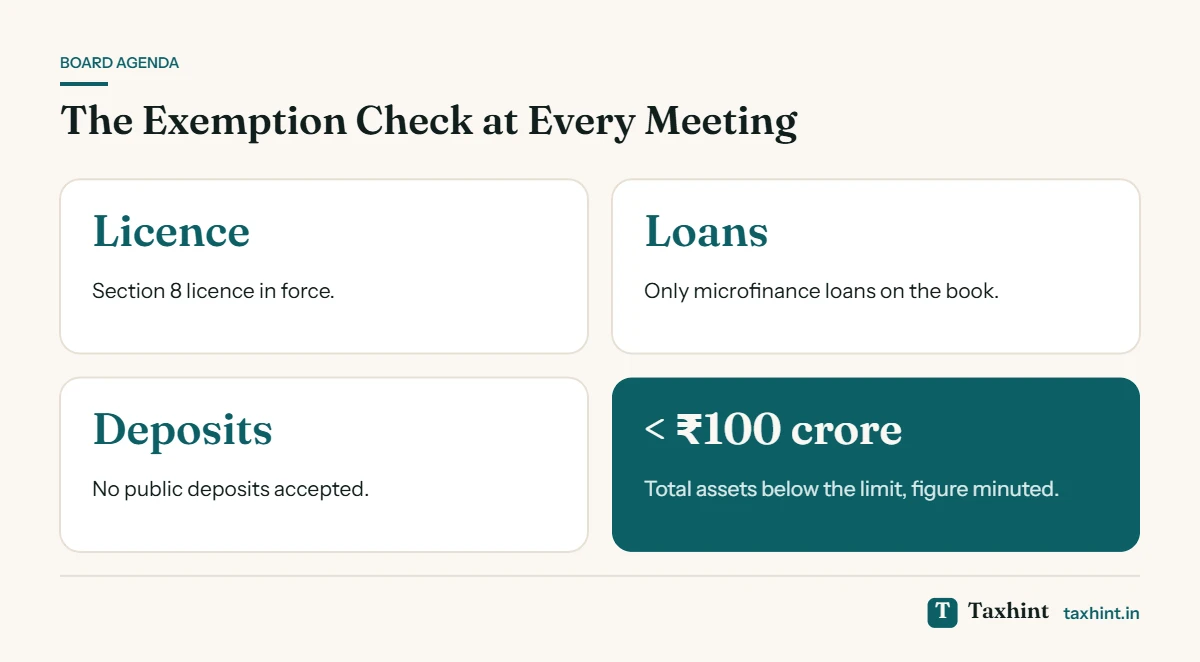
Every board meeting should note the four conditions that keep the company outside RBI registration: Section 8 licence in force, only microfinance loans, no public deposits and total assets below ₹100 crore. Put the asset figure in the minutes. If assets are approaching the limit, the board should be discussing options, including conversion to an NBFC-MFI.
Policies the board adopts
- Credit policy with eligibility, the 50% repayment cap and sanction powers (see our credit policy template)
- Pricing policy with the interest-rate range and ceiling
- Fair practices and recovery code
- Grievance redressal policy
- Related-party and conflict-of-interest rules
What the board should see every time
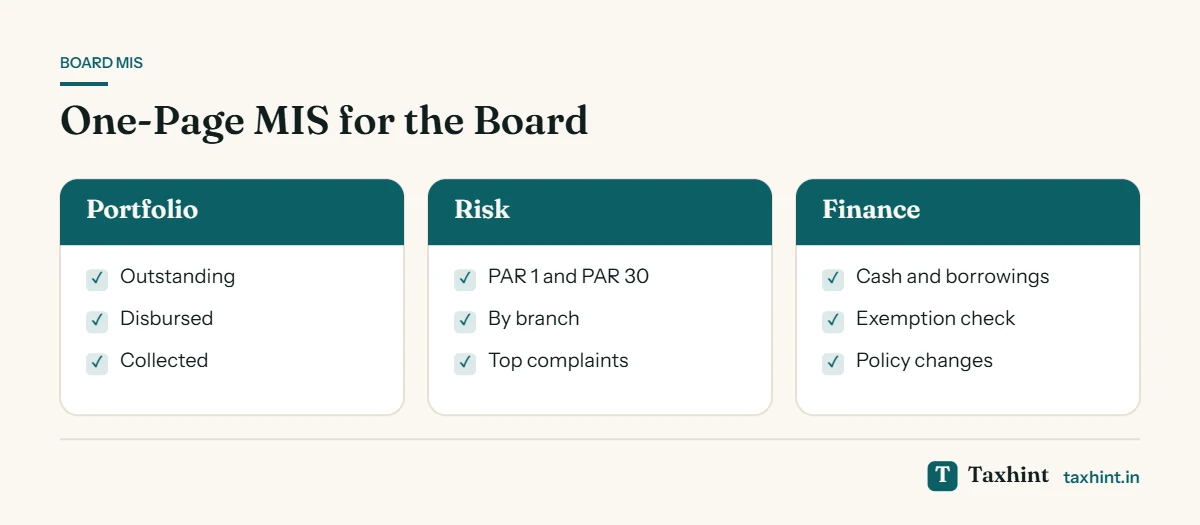
A one-page MIS: portfolio outstanding, disbursements, collections, PAR 1 and PAR 30 by branch, top complaints, cash and borrowings, and the exemption check. Our PAR calculator gives the core numbers if you are not yet on software.
What good minutes look like
Minutes should show that the board discussed, not just noted. For a Section 8 microfinance board, record the MIS figures, the exemption check with the asset number, decisions on policy changes, large or exceptional loans approved, and actions with owners and dates. Lenders and auditors read minutes to judge whether the board is in control.
Conflicts of interest
Related-party loans, office rent paid to a director’s relative, or vendors linked to promoters all need disclosure and approval under the Companies Act, and a Section 8 company must apply its income only to its objects. A written conflict-of-interest policy and an annual declaration from each director keep this clean.
Mistakes we see
- Board meetings held only on paper.
- No independent voice on the board.
- No mention of the RBI exemption in minutes.
- Policies adopted once and never reviewed.
- MIS that shows disbursements but not PAR.
How we help
We set up the Section 8 microfinance board pack, draft policies and minutes, and run the yearly compliance. See our Section 8 compliance service.
FAQs
How many directors does a Section 8 microfinance company need?
At least two for a private company and three for a public one. For a lender, a mix of field, finance and independent members works best.
How often must the board meet?
At least once in every six calendar months under the 2015 Section 8 exemption, if the company is not in default on filings. Lenders should meet more often.
What should board minutes record about the RBI exemption?
That the company holds its Section 8 licence, lends only microfinance loans, takes no public deposits and has total assets below ₹100 crore, with the asset figure.
Can the promoter’s family run the board?
It can, but lenders and donors trust boards with at least one independent member and clear conflict-of-interest rules.
Planning a microfinance company or already running one? Our CAs and CSs handle registration, RBI work and yearly compliance. Get Free Consultation or WhatsApp +91 93117 95484.