November 24, 2026 · Guides
Society to Section 8 Company: Microfinance Lender Guide

Many microfinance programmes began inside registered societies. As the portfolio and funding grow, a society to Section 8 company move often becomes the practical path to company-level governance.
These are the points to plan.
In this guide
- 1. Check the bye-laws and Act
- 2. Get the approvals
- 3. Form the new company
- 4. Transfer the loan book
- 5. After transfer
- Illustrative meeting plan
- Risks to plan for
- Typical sequence and timing
- Mistakes we see
- FAQs
1. Check the bye-laws and Act
Your society’s memorandum and rules decide whether it can transfer assets or merge, and how many members must approve. State societies laws differ, so confirm what applies to you.
2. Get the approvals
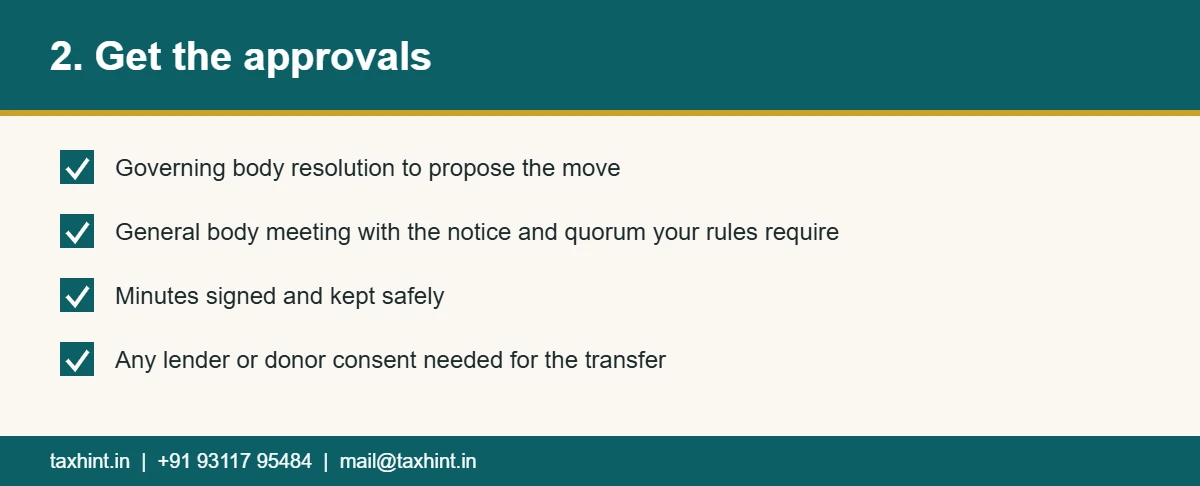
- Governing body resolution to propose the move.
- General body meeting with the notice and quorum your rules require.
- Minutes signed and kept safely.
- Any lender or donor consent needed for the transfer.
3. Form the new company
The new Section 8 company is incorporated with objects aligned to the lending work. Our objects clause guide and directors and members guide help you prepare.
4. Transfer the loan book
List loans, borrowers and assets. Tell borrowers, get consents where needed, and move bank accounts. Plan one clean cut-off date and keep both sets of books until the transfer is reconciled.
5. After transfer
The company needs its own PAN, bank account, auditor and filings. Read about annual compliance and compare options in Section 8 vs trust vs society.
Illustrative meeting plan
This is illustrative. The governing body proposes the transfer. A notice for a general body meeting goes to all members as the bye-laws require, with the resolution text. The meeting passes the resolution by the required majority and the minutes are signed. The company is formed, the loan book transfers on a cut-off date and the society files any intimation required under its own Act.
Risks to plan for
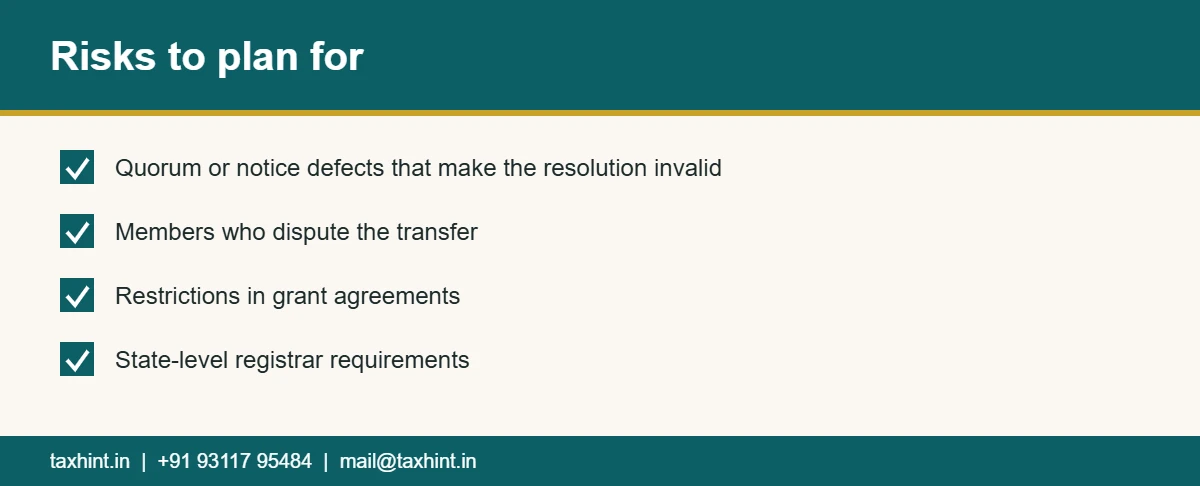
- Quorum or notice defects that make the resolution invalid.
- Members who dispute the transfer.
- Restrictions in grant agreements.
- State-level registrar requirements.
Typical sequence and timing
The order matters more than speed. First the governing body and general body decide. Second, the company is incorporated and licensed, which depends on MCA processing and your documents. Third, the transfer is executed on a cut-off date after both sides have audited figures. Fourth, the society completes any filings its state law requires. Do not move cash or loans before the company has its bank account and licence.
Mistakes we see
- Starting the transfer before the licence arrives.
- Using the society’s bank account for company lending after the cut-off date.
- Not telling grant funders in advance.
- Failing to update borrower records and bureau reporting.
FAQs
Can a society become a Section 8 company directly?
Usually through a new company and a transfer. Check your state law and bye-laws.
Who must approve?
The governing body and, normally, the general body as your rules require.
Do borrowers have to agree?
Notify them and take consent where the loan documents or law require it.
Is RBI approval needed?
It may be, depending on your lending size and activity.
Can a society simply become a company?
Often not directly. The route depends on your state law and the Companies Act.
Who files the intimation to the registrar of societies?
The society, as its Act requires, usually after the general body approves.
Planning a microfinance company or already running one? Our CAs and CSs handle registration, RBI work and yearly compliance. Get Free Consultation or WhatsApp +91 93117 95484.