Microfinance Company Registration in Madhya Pradesh
Microfinance company registration in Madhya Pradesh runs through RoC Gwalior, and most promoters use a Section 8 microfinance company. It needs no RBI certificate while it lends only microfinance loans, takes no public deposits and keeps assets under ₹100 crore. Stamp duty is the state-specific part, and we work it out at filing.
Microfinance company registration in Madhya Pradesh: the short version
For microfinance company registration in Madhya Pradesh, three decisions sit in front of every promoter. First, Section 8 company or NBFC-MFI. Second, where the registered office will be. Third, how much stamp duty the incorporation documents will attract in Madhya Pradesh. This page deals with all three.
On the first, the Section 8 route works if you lend only microfinance loans, take no public deposits and stay below ₹100 crore of assets. Paragraph 51 of RBI’s 2025 NBFC Directions then exempts you from Sections 45-IA, 45-IB and 45-IC of the RBI Act. If you want to pay dividends or carry the ₹10 crore net owned fund, the NBFC-MFI route is the one to study.
RoC Gwalior covers the whole state
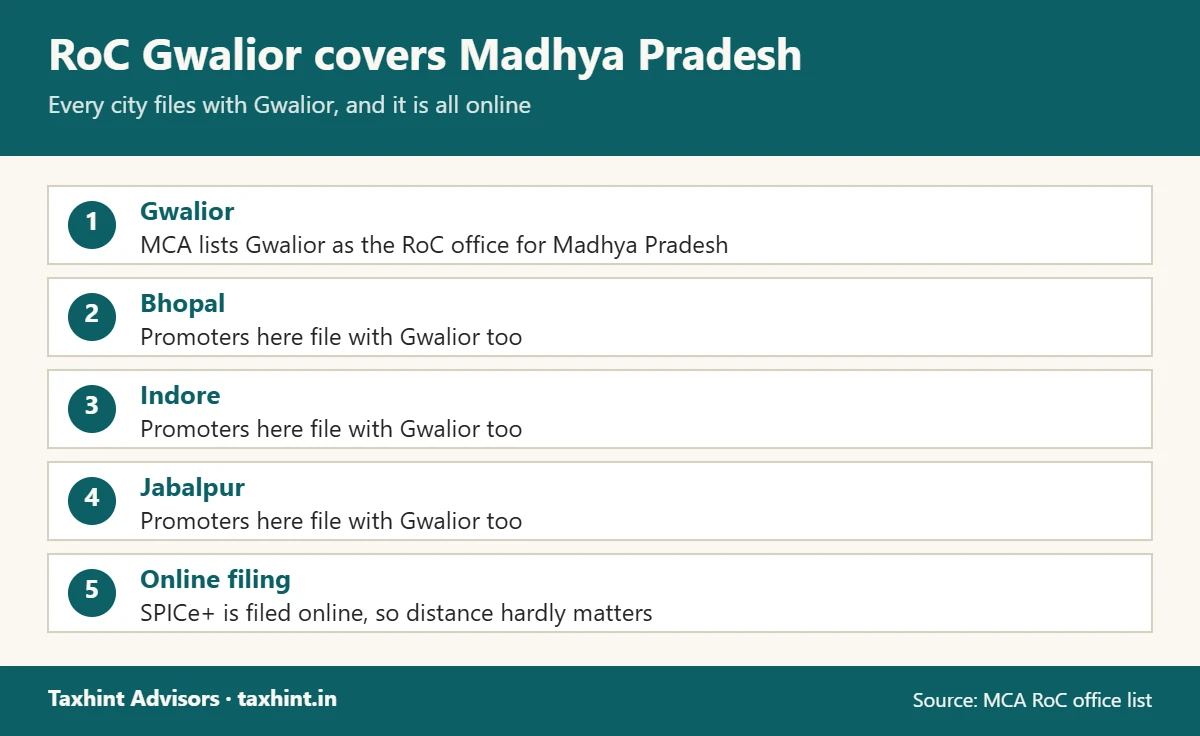
MCA lists Gwalior as the Registrar of Companies office for Madhya Pradesh. Promoters in Indore, Bhopal or Jabalpur file with Gwalior too. For incorporation the distance hardly matters, because SPICe+ is filed online.
The October 2025 notification, S.O. 4850(E), created ten registrar offices from 16 February 2026 and Madhya Pradesh has none among them, so we have no reason to expect a change for your file. Look at the MCA Registrar of Companies page if you want to see the list yourself.
Stamp duty in Madhya Pradesh: what we can and cannot say
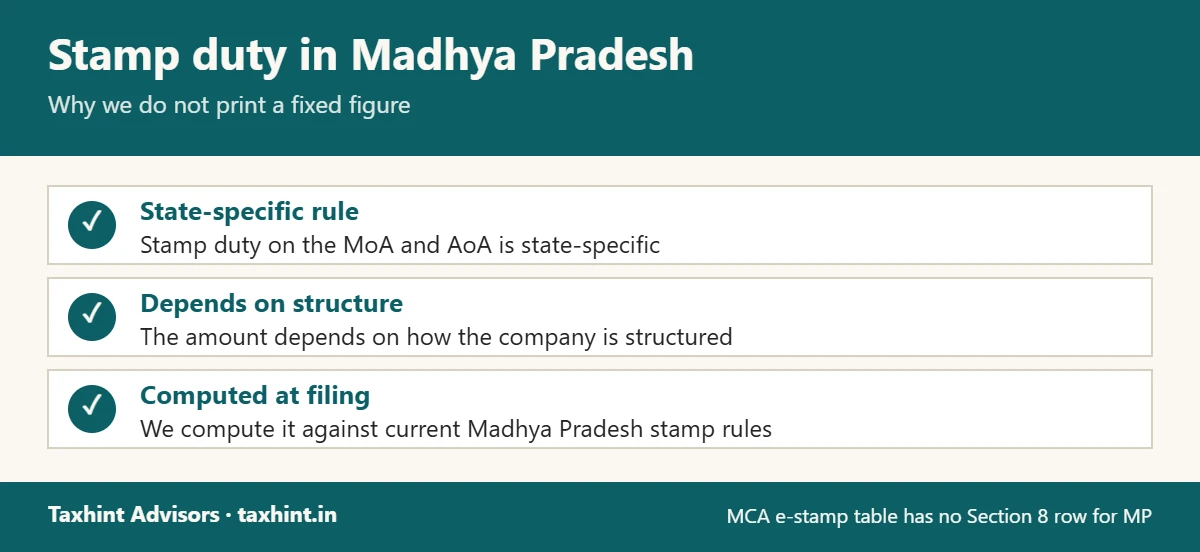
We are not going to print a rupee figure here, and the reason is worth knowing. MCA’s e-stamp rate table gives separate Section 8 rows for some states, including Uttar Pradesh and Bihar. For Madhya Pradesh it shows rows for ordinary companies only and no Section 8 row. We cannot read a Section 8 amount off it with confidence.
So the honest position is this. Stamp duty on the MoA and AoA is state-specific, it depends on how the company is structured, and we compute it at filing against the current Madhya Pradesh stamp rules. Ask us for the computed figure before you decide on authorised capital, because that is the number that can move it.
Other government charges are as elsewhere: ₹1,000 for name reservation, a SPICe+ fee linked to authorised capital, and a Class 3 DSC for each director.
Ajivika groups and what they mean for your loan checks
The Madhya Pradesh State Rural Livelihood Mission, often called the Ajivika Mission, forms self-help groups across the state. News reports describe members in vegetable and milk production, incense sticks, soap making, animal husbandry and small flour mills.
If your branch sits in a block with active Ajivika groups, expect some households to be borrowing from their SHG already. A member of such a group may also come to you. RBI’s 50% repayment cap counts every loan in the household, and a loan officer who skips the bureau check will not know. We advise a short signed sheet of the family’s existing loans on every file, plus a credit bureau pull before sanction.
Who files from Madhya Pradesh
A livelihood trust in Sheopur or Mandla
Imagine a trust that supports women’s enterprises and wants a licensed lending arm that can hold audited books. A Section 8 company gives it that, and the trustees can transfer the loan programme into it. An example, not a client.
A foundation in Indore with grant funds
A company foundation turns grant money into small working-capital loans. The surplus stays in the programme, which suits the funder. Check that no loan is secured and none goes to a household above the income limit.
An NGO already near a ₹100 crore ceiling
If the loan book is large and growing quickly, plan the NBFC-MFI step early. The exemption ends at ₹100 crore of assets, and RBI registration then needs the ₹10 crore net owned fund.
The four RBI conditions, plainly
Keep all four true at the same time: a Section 8 licence, only microfinance loans, no public deposits, assets below ₹100 crore. A microfinance loan has no collateral and goes to a household earning up to ₹3,00,000 a year, with total monthly repayments within 50% of monthly income.
Conduct rules follow. Borrowers receive a simple pricing fact sheet, no prepayment penalty applies, and calls on overdue accounts cannot be made before 9 am or after 6 pm. For the detail, see our note on RBI microfinance rules explained.
Filing sequence for a Madhya Pradesh company
For microfinance company registration in Madhya Pradesh, one SPICe+ (INC-32) application carries both the licence and the incorporation, with the MoA in INC-13, under Rule 19 of the Companies (Incorporation) Rules, 2014.
Pick the route and the capital plan
Section 8 or NBFC-MFI, then authorised capital, since that drives the SPICe+ fee and the stamp duty working.
Office, directors and DSCs
A registered office in Madhya Pradesh with a utility bill and the owner’s NOC, at least two directors, a DIR-2 consent and Class 3 DSC for each.
Name reservation
₹1,000, applied after the objects are drafted.
SPICe+ with INC-13
Objects, three-year income and expenditure estimate, declarations. We compute and pay stamp duty at this stage.
Policies and tax registrations
Credit policy, pricing fact sheet, KYC format, then 12A and 80G.
Compliance after the certificate
Expect MGT-7 (not MGT-7A) each year, AOC-4 within 30 days of the AGM, and ITR-7 if you claim the Section 11 exemption. Our Section 8 compliance work covers these, and 12A and 80G brings donor deductions. Under Section 8(11), default can mean fines of ₹10 lakh to ₹1 crore on the company, and ₹25,000 to ₹25 lakh on each officer in default. The licence itself can be revoked under Section 8(6).
Lending across the border into Rajasthan or Bihar
Madhya Pradesh borders both. If you plan field offices in Rajasthan, read our Rajasthan page first. Promoters looking east can compare the file on the Bihar page, where Section 8 stamp duty is easier to state. For the general sequence, our guide on how to start a microfinance company in India sits behind all of these pages.
Software for Madhya Pradesh branches
Field officers often work far from a town. Our microfinance software starts at ₹15,000 and covers group and JLG loans, centre meetings, KYC and a collection app that logs receipts for officers on the road.
Frequently asked questions
What is the stamp duty on a Section 8 company’s MoA and AoA in Madhya Pradesh?
It is state-specific and we compute it at filing. MCA’s e-stamp table has no separate Section 8 row for Madhya Pradesh, so we do not quote a figure without checking the current state rules.
Which RoC handles Madhya Pradesh?
MCA lists RoC Gwalior for Madhya Pradesh. The October 2025 notification that set up ten registrar offices from 16 February 2026 does not include a Madhya Pradesh office.
Do I have to travel to Gwalior for microfinance company registration in Madhya Pradesh?
No. SPICe+ is filed online, and our CA/CS team handles the filing from start to finish.
Can an Ajivika SHG member borrow from my company?
Yes, if the loan is collateral-free, the household earns up to ₹3,00,000 a year, and all its repayments, including SHG loans, stay within 50% of monthly income.
Is RBI registration compulsory for a Madhya Pradesh Section 8 microfinance company?
Not while it lends only microfinance loans, takes no public deposits and keeps assets below ₹100 crore, under paragraph 51 of RBI’s 2025 NBFC Directions.
When does the ₹10 crore net owned fund come in?
If you choose the NBFC-MFI route, or when a Section 8 company’s assets reach ₹100 crore and it needs RBI registration.
Can profits go to the promoters?
No. A Section 8 company pays no dividend to members and applies income to its objects.
Ready to begin?
Working on microfinance company registration in Madhya Pradesh? Send us your town, your lending plan and your preferred capital. We will give you the computed stamp duty and a straight answer on Section 8 versus NBFC-MFI before you pay for any filing. Call +91 93117 95484, email [email protected], or use the form.
Microfinance company registration in other states
Uttar Pradesh · Bihar · Rajasthan · Delhi · Maharashtra · Odisha · West Bengal · Jharkhand · Haryana · Gujarat · Karnataka · Tamil Nadu · Assam · Chhattisgarh · Andhra Pradesh · Telangana · Kerala · Punjab · Uttarakhand
Questions across states? See our microfinance FAQ.