Microfinance Company Registration in Karnataka
Microfinance company registration in Karnataka usually means a Section 8 company with RoC Bangalore as its registrar. Since 2025, a state law also requires microfinance lenders to register with the district authority before lending.
On this page
- What registration in Karnataka involves
- Your registrar: RoC Bangalore
- Stamp duty on MoA and AoA
- Lending in Karnataka: a large market, closely watched
- Karnataka’s 2025 microfinance law: what it asks of you
- Steps for a Karnataka registered office
- Documents to collect
- Software for field teams
- What it costs
- Neighbouring state pages
- Guides from our CAs
- FAQs
- Related services
What microfinance company registration in Karnataka involves
Karnataka has no separate company licence for microfinance; the company is incorporated under the Companies Act, 2013. But Karnataka now has its own microfinance law, passed in 2025, and it changes what you must do before the first loan. That is the main thing to understand about this state.
For a not-for-profit lender the usual structure is a Section 8 microfinance company. RBI does not require it to register as long as it holds the Section 8 licence, lends only microfinance loans, takes no public deposits and keeps total assets below ₹100 crore. Break any one of the four and it is treated as an ordinary lender that needs RBI registration.
If investors want dividends, or you plan to bring in the ₹10 crore net owned fund, the NBFC-MFI route with RBI is the other route, and an RBI-registered lender sits differently under the state law. For not-for-profit promoters, Section 8 remains the usual structure; just plan for the state registration as a second step.
Your registrar: RoC Bangalore
A company with its registered office in Karnataka comes under the Registrar of Companies, Bangalore, which the February 2026 MCA list gives the whole State of Karnataka. You can check MCA’s Registrar of Companies page.
Filing is online, so a promoter in Belagavi or Kalaburagi does not travel to Bengaluru. The registered office decides the registrar.
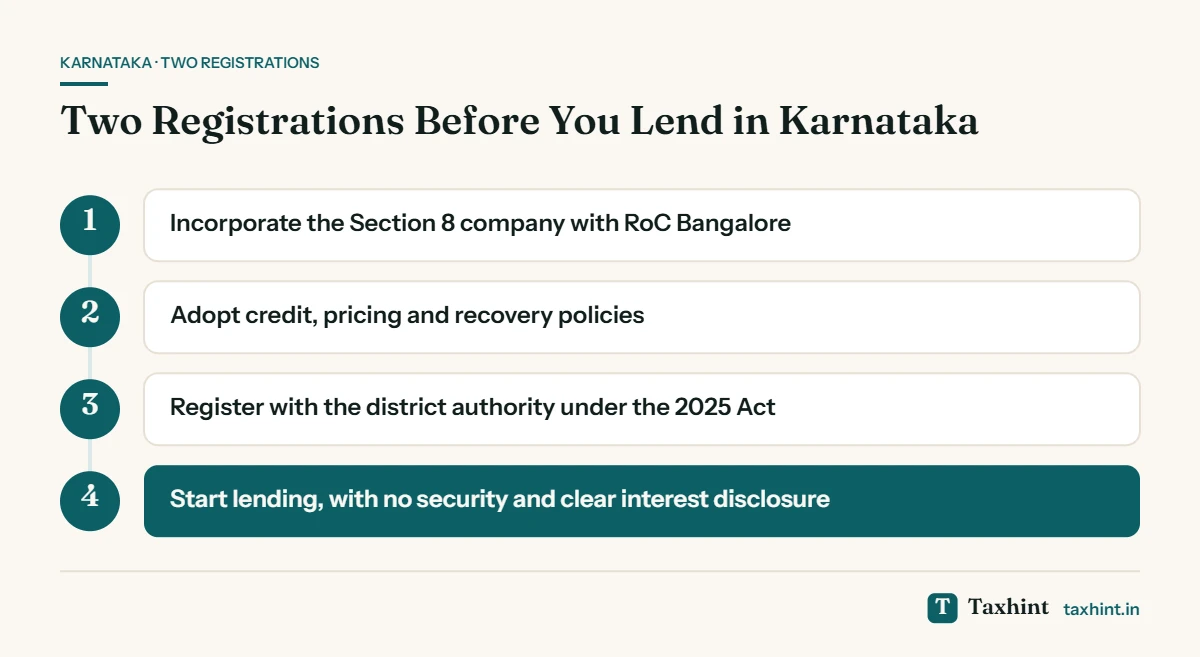
Company incorporation is only the first registration. The second, under the state law, is explained below.
Stamp duty on the MoA and AoA in Karnataka
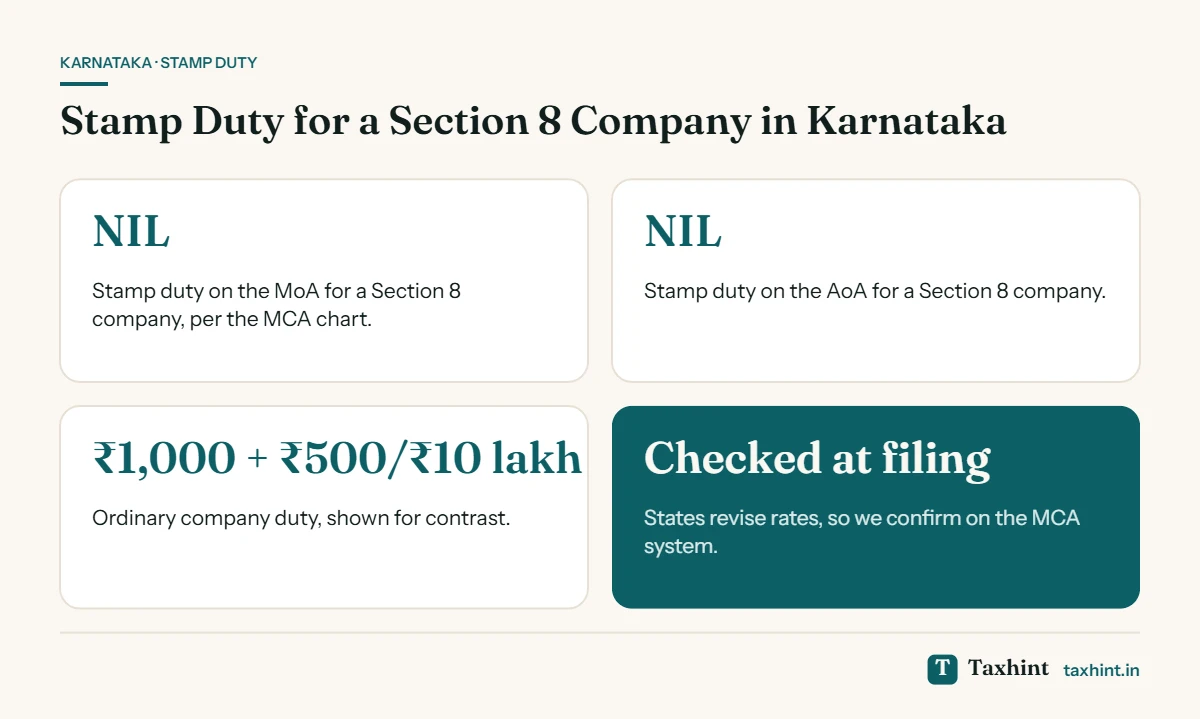
MCA’s e-stamp rate chart has a separate Section 8 row for Karnataka and shows NIL on both the MoA and the AoA. An ordinary company in the state pays ₹1,000 on the MoA and ₹500 for every ₹10 lakh of authorised capital on the AoA.
The chart carries no effective date and states revise rates, so we confirm the position on the MCA system at filing.
Stamp duty is only one government charge. Name reservation, the SPICe+ fee and DSCs are separate, and our note on the cost of microfinance company registration adds them up.
Lending in Karnataka: a large market, closely watched
Karnataka is one of the bigger microfinance markets in India. An RBI consultative document on microfinance listed it among the top five states, with 8.88% of the national microfinance portfolio as of September 2020.
In early 2025, complaints of harsh recovery led the state to act, first by ordinance in February and then by law. Borrowers and local officials now know their rights well. A new lender has to be visibly careful about pricing, disclosure and how its staff collect.
RBI’s household income ceiling and 50% repayment cap still apply, and with many lenders active, the bureau check before every loan is essential.
Karnataka’s 2025 microfinance law: what it asks of you
The Karnataka Micro Loan and Small Loan (Prevention of Coercive Actions) Act, 2025, deemed in force from 12 February 2025, requires microfinance institutions and money-lending agencies operating in the state to register with the district registering authority. It also bars taking security for these loans, requires transparency on interest, and punishes coercive recovery; reports put the maximum penalty at ten years’ imprisonment and a ₹5 lakh fine. The Act’s text is on PRS India.
A Section 8 microfinance company is not registered with RBI, so in practice you should expect to register under this Act before lending in Karnataka. We read the current Act, rules and district procedure against your model, prepare the registration, and build the Act’s requirements into your fair-practice and recovery policy.
Karnataka also amended its Money Lenders Act and its exorbitant-interest law in 2025, so we check those at the same time.
Steps for a Karnataka registered office
Fix the office and its district
The registered office must be in Karnataka if you want RoC Bangalore. A trust in Mysuru can register there and lend in Mandya. Remember that the state registration is done district-wise for the areas you operate in.
Test the lending plan
We check the plan against the four RBI conditions before anything is filed. A gold loan or any other secured product takes the company outside the exemption, so it comes out now, not after the licence.
Name, objects and projections
Directors get DSCs, names go into SPICe+ Part A, and we draft microfinance-focused objects with a three-year income and expenditure estimate. Our document checklist shows each paper.
File SPICe+ with RoC Bangalore
SPICe+ carries the Section 8 licence application and incorporation together. If the registrar raises a query on the objects or the projections, we reply and resubmit.
Policies and tax registrations
The board adopts a credit policy, a pricing policy and a grievance process before the first loan. Then we apply for 12A and 80G registration.
Documents to collect
Directors and subscribers
PAN, Aadhaar, photograph and address proof for each person, a DIR-2 consent from each director and a DSC. At least two directors.
Karnataka office proof
A recent electricity bill, rent agreement or ownership paper, and an NOC from the owner. Bills older than two months cause most queries.
Licence papers
Microfinance-focused objects, a three-year income and expenditure estimate, the declarations under the Rules and, as our own habit, a draft credit policy.
Bengaluru offices are often in apartments or shared spaces with bills in the owner’s name. The NOC must come from that owner. Keep these documents handy; the state registration may ask for office details too.
Software for Karnataka field teams
With the 2025 Act, every receipt, interest disclosure and collection visit needs a clean record. Our microfinance software starts at ₹15,000 and covers JLG and group loans, centre meetings, bureau reporting and a field collection app that keeps working on weak signal. Book a demo once you know how many centres you plan to run.
What it costs
Government charges usually cover name reservation, the SPICe+ fee linked to authorised capital, any stamp duty (NIL for a Section 8 company per the chart above), plus any fee for the state registration and DSCs for each director. Our professional fee depends on your plan and the state of your papers, so we quote after reading your file.
Budget too for the first-year audit and for board meetings held properly. A cheap incorporation followed by a missed AOC-4 ends up costing more.
Neighbouring state pages
Karnataka promoters often compare neighbouring states. To the south, read microfinance company registration in Tamil Nadu, which also has a 2025 law. To the north, compare Maharashtra. For a capital-region base, see our Delhi page. The registrar, the stamp duty and the lending law all change with the state.
Guides from our CAs
Starting from zero
Structure to first loan in how to start a microfinance company in India.
RBI rules, plainly
What the exemption and the loan rules mean day to day: RBI microfinance rules explained.
Interest rules
How pricing is set and disclosed: microfinance interest rate rules.
Frequently asked questions
Which RoC handles microfinance company registration in Karnataka?
RoC Bangalore, which MCA lists as the registrar for the whole State of Karnataka. Filing is online.
What is the stamp duty on MoA and AoA for a Section 8 company in Karnataka?
MCA’s e-stamp chart shows NIL on both for a Section 8 company in Karnataka. We confirm it at filing.
Do I need RBI registration for a Section 8 microfinance company in Karnataka?
Not under RBI’s rules, as long as it holds the Section 8 licence, lends only microfinance loans, takes no public deposits and keeps assets below ₹100 crore. State lending laws are a separate question.
Does a Section 8 microfinance company need to register under Karnataka’s 2025 law?
The Act requires microfinance institutions and money-lending agencies operating in Karnataka to register with the district registering authority. A Section 8 company is not RBI-registered, so expect to register before lending; we confirm under the current rules and prepare the application.
What does the Karnataka law prohibit?
It bars coercive recovery, prohibits taking security for these loans and requires transparency on interest, with heavy penalties. Your recovery policy and staff training should reflect it from day one.
How long does registration take?
There is no fixed number of days. It depends on DSCs, first-time name approval and registrar queries on the objects. Clean papers save the most time.
Ready to begin?
Planning microfinance company registration in Karnataka? Send us your lending plan and the district of your proposed office. A CA or CS will test it against the RBI conditions and tell you whether Section 8 fits before you spend on filings. Call +91 93117 95484, email [email protected], or use the form.
Microfinance company registration in other states
Uttar Pradesh · Bihar · Madhya Pradesh · Rajasthan · Delhi · Maharashtra · Odisha · West Bengal · Jharkhand · Haryana · Gujarat · Tamil Nadu · Assam · Chhattisgarh · Andhra Pradesh · Telangana · Kerala · Punjab · Uttarakhand
Questions across states? See our microfinance FAQ.