Microfinance Company Registration in Uttar Pradesh
Microfinance company registration in Uttar Pradesh, for most promoters, means a Section 8 microfinance company with its registered office in a UP district. Lend only microfinance loans, take no public deposits and keep assets under ₹100 crore, and RBI registration is not required.
What microfinance company registration in Uttar Pradesh means
There is no separate “Uttar Pradesh microfinance licence”. The company is incorporated under the Companies Act, 2013, like anywhere else in India, and the state matters in three places: which Registrar of Companies handles your file, how much stamp duty the MoA and AoA attract, and the ground you will lend on.
The exemption from RBI registration comes from paragraph 51 of RBI’s 2025 NBFC Registration, Exemptions and SBR Directions. It holds only while the company has a Section 8 licence, lends only microfinance loans, takes no public deposits and keeps total assets below ₹100 crore. Break one of the four and you are treated as an ordinary lender needing RBI registration.
If your investors want dividends, or you plan to put in the ₹10 crore net owned fund and lend beyond microfinance loans, the NBFC-MFI route with RBI is the other door. We usually ask promoters in Lucknow or Varanasi one plain question first: will anyone expect a return on capital? The answer settles the route.
Which Registrar of Companies handles a Uttar Pradesh file
Before 2026, RoC Kanpur was the registrar for the whole state. That changed with MCA notification S.O. 4850(E) dated 23 October 2025, effective 16 February 2026. The state is now split into two registrar jurisdictions, and the district of your registered office decides which one you deal with.
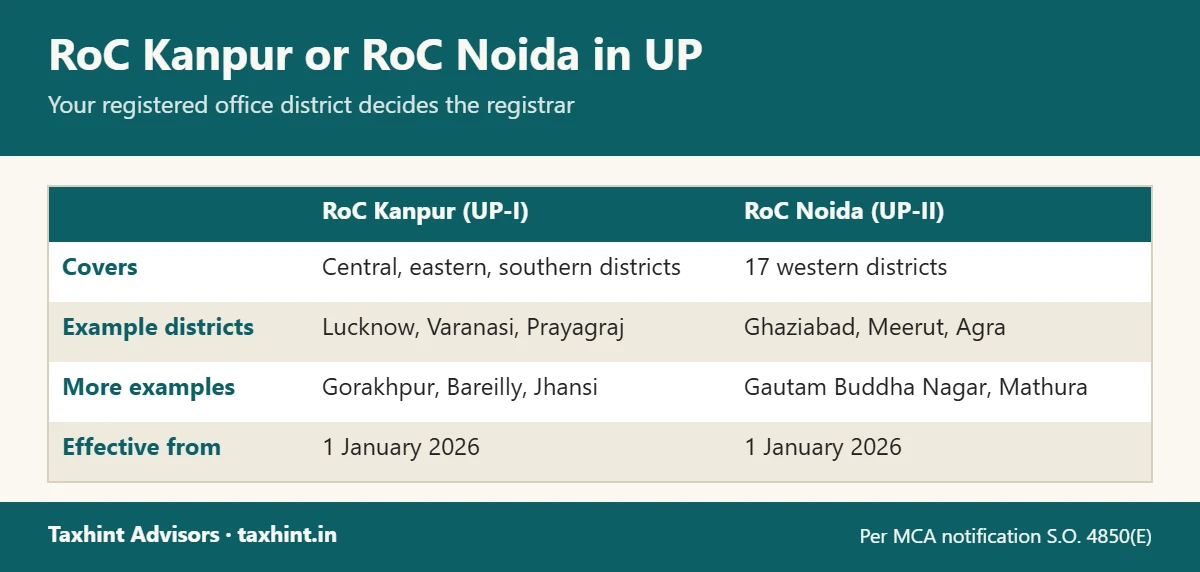
| Registrar | Districts, for example |
|---|---|
| RoC Kanpur (Uttar Pradesh-I) | Lucknow, Kanpur Nagar, Varanasi, Prayagraj, Gorakhpur, Ayodhya, Bareilly, Moradabad, Jhansi and the other districts not listed under Noida |
| RoC Noida (Uttar Pradesh-II) | Gautam Buddha Nagar, Ghaziabad, Meerut, Agra, Aligarh, Mathura, Saharanpur, Muzaffarnagar, Bulandshahr, Hapur, Hathras, Firozabad, Etah, Kasganj, Mainpuri, Baghpat and Shamli |
This split matters for a practical reason. Any query on your objects or projections comes from the registrar’s office that holds your file. If the registered office is in Meerut, the follow-up will come from Noida, not Kanpur. Check the current list on MCA’s Registrar of Companies page before you finalise the office address, and we confirm the district against the notification when we draft the file.
Stamp duty on the MoA and AoA in Uttar Pradesh
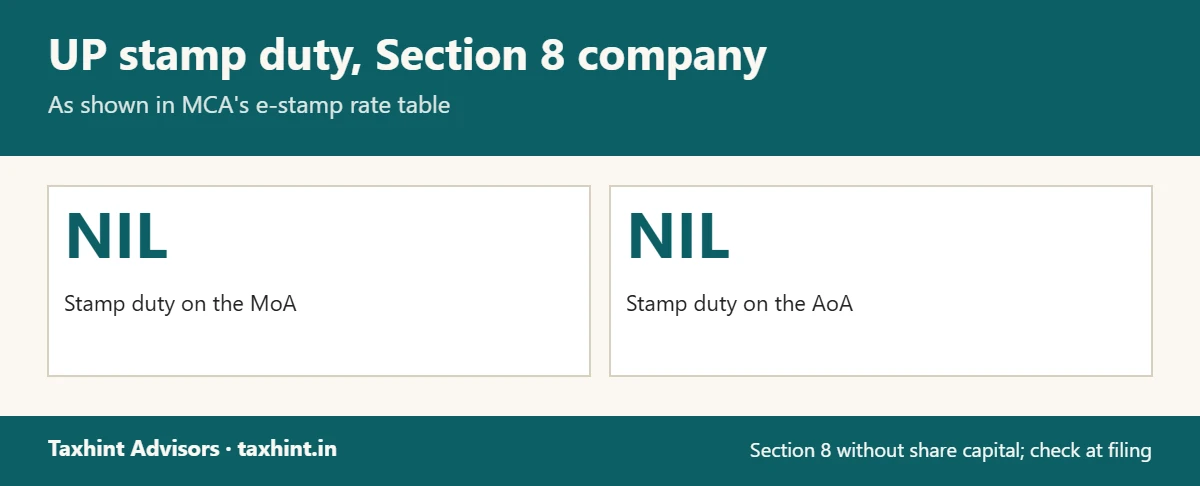
Stamp duty on incorporation documents is a state subject. MCA’s published e-stamp rate table has a separate Uttar Pradesh row for Section 8 companies, and it shows NIL for both the MoA and the AoA. The remark beside that row says it applies to Section 8 companies without share capital.
Most Section 8 microfinance companies are formed without share capital, limited by guarantee, so for them the NIL row is the one that applies. A Section 8 company that does have share capital falls under the ordinary company rules instead, per the same table. The table carries no date, so we check the rate again at the time of filing instead of quoting it from memory.
The other government charges are the usual ones: ₹1,000 for name reservation, the SPICe+ fee linked to authorised capital, and a Class 3 DSC for each director, bought separately.
Who registers a Section 8 microfinance company in Uttar Pradesh
A trust with a loan desk
Take a trust in Gorakhpur that has been lending small amounts to women’s groups for years, from a register and a cash box. Moving that book into a Section 8 company gives it audited accounts, a board and a lender-friendly identity. This is an example, not a client story.
Programmes near existing SHGs
The Uttar Pradesh State Rural Livelihood Mission (UPSRLM) promotes self-help groups and their village and cluster federations across the state. A household in such a village may already hold an SHG loan, and RBI’s 50% repayment cap counts every loan the household has, yours included.
CSR money in the NCR belt
Think of a foundation in Ghaziabad with CSR grants that it wants to turn into revolving loans for low-income households. A not-for-profit company keeps surplus inside the programme, and its file would go to RoC Noida under the new split. Again, an illustration.
Loan rules that apply in every Uttar Pradesh district
Microfinance company registration in Uttar Pradesh stands or falls on the loans, so we read the credit policy before the objects clause. A microfinance loan is collateral-free and goes to a household whose annual income is up to ₹3,00,000. The household’s total monthly repayments cannot cross 50% of its monthly income.
In a state with many scattered villages the hard part is the income and obligation check. Your loan officer in Sitapur or Unnao will not find a payslip. We suggest a simple household income sheet signed by the borrower, a credit bureau pull before sanction, and a rule that the officer records every other loan the family mentions. Our note on RBI microfinance rules explained covers pricing disclosure and recovery conduct too.
How a Uttar Pradesh Section 8 microfinance file moves
For microfinance company registration in Uttar Pradesh, the licence and incorporation are applied for together on the MCA portal through SPICe+ (INC-32), with the MoA in INC-13, under Rule 19 of the Companies (Incorporation) Rules, 2014.
Fix the registered office district first
The district decides RoC Kanpur or RoC Noida, and the owner of the premises signs an NOC with a recent utility bill. We settle this before the name is applied for.
DSCs and the name
Each director needs a Class 3 DSC and a DIR-2 consent. You need at least two directors. Name reservation costs ₹1,000.
Objects and three-year estimate
The objects are drafted around microfinance loans to low-income households, with an income and expenditure estimate that matches the loan plan you describe.
SPICe+ filing and stamp duty
We file SPICe+ with INC-13 and check the UP stamp duty position for your capital structure on the day of filing.
Policies before the first loan
A credit policy, a pricing fact sheet and a KYC format should be ready before the first disbursement. Then plan 12A and 80G.
After incorporation in Uttar Pradesh
Once microfinance company registration in Uttar Pradesh is done, the real work starts. A Section 8 company files MGT-7 (not MGT-7A) and AOC-4 within 30 days of its AGM, and files ITR-7 if it claims the Section 11 exemption. Our Section 8 compliance service handles the cycle, and 12A and 80G registration gives donors a deduction and the company a tax exemption.
A breach is expensive. The Central Government can revoke the licence under Section 8(6), and Section 8(11) provides fines of ₹10 lakh to ₹1 crore on the company and ₹25,000 to ₹25 lakh on each officer in default. For the base entity work, see Section 8 company registration.
Lending in more than one state
Promoters in Uttar Pradesh often have field staff across the border. Rajasthan and Delhi have their own RoC offices and rules, which we cover on the Rajasthan page and the Delhi page. If your branches lean towards the east, the Bihar page explains how that file differs.
One company can lend in several states, but the registered office fixes the RoC. For the wider picture, our guide on how to start a microfinance company in India sets out the full sequence.
Software for Uttar Pradesh field teams
Field teams cover long routes, often on patchy networks. Our microfinance software starts at ₹15,000, with group and JLG loans, centre meetings, member KYC and a collection app built for field officers.
Frequently asked questions
Can I do microfinance company registration in Uttar Pradesh without an RBI licence?
Yes, if the company is a Section 8 company that lends only microfinance loans, takes no public deposits and keeps total assets below ₹100 crore. Paragraph 51 of RBI’s 2025 NBFC Directions exempts it from Sections 45-IA, 45-IB and 45-IC of the RBI Act on those conditions.
Is Uttar Pradesh under RoC Kanpur?
Partly. From 16 February 2026, under notification S.O. 4850(E), RoC Kanpur handles most districts including Lucknow, Varanasi and Prayagraj, while RoC Noida handles 17 western districts such as Ghaziabad, Gautam Buddha Nagar, Meerut and Agra.
What is the stamp duty on the MoA and AoA of a Section 8 company in Uttar Pradesh?
MCA’s e-stamp rate table shows NIL for both for Section 8 companies without share capital in Uttar Pradesh. We verify the current position at the time of filing, since the rule is state-specific and the table carries no date.
Can an existing Uttar Pradesh trust or society convert into a Section 8 company?
Yes. A trust or society can register itself as a Section 8 company limited by guarantee under Section 366 of the Companies Act, or the trustees can promote a new Section 8 company and move the loan programme into it. We compare both against the existing loan book.
Can villagers who already borrow from an SHG take a loan from my company?
They can, but RBI’s 50% rule counts every loan the household holds. Check the credit bureau report and record other borrowing before sanction.
Can the company accept deposits from members in Uttar Pradesh?
No public deposits are allowed. Taking them ends the RBI exemption, and you also cannot ask a borrower for a deposit or margin money as a condition of the loan.
Do I need a physical office in Uttar Pradesh?
You need a registered office address in the state, supported by a recent utility bill and the owner’s NOC. A room in a trust’s existing office is fine if the owner signs.
Ready to begin?
Thinking about microfinance company registration in Uttar Pradesh? Tell us your district, your lending plan and whether a trust is involved. A CA or CS will check it against the four conditions and name the RoC that will hold your file, before you spend on filings. Call +91 93117 95484, email [email protected], or use the form.
Microfinance company registration in other states
Bihar · Madhya Pradesh · Rajasthan · Delhi · Maharashtra · Odisha · West Bengal · Jharkhand · Haryana · Gujarat · Karnataka · Tamil Nadu · Assam · Chhattisgarh · Andhra Pradesh · Telangana · Kerala · Punjab · Uttarakhand
Questions across states? See our microfinance FAQ.