Microfinance Company Registration in West Bengal
Microfinance company registration in West Bengal usually means a Section 8 company registered in the state, lending only microfinance loans to low-income households. With no public deposits and assets under ₹100 crore, it needs no RBI certificate.
On this page
- What registration in West Bengal involves
- Two registrars now: Kolkata-I or Kolkata-II
- Stamp duty on MoA and AoA
- Lending in West Bengal: a crowded field
- The Bengal Money-lenders Act: a check we make
- Steps for a West Bengal registered office
- Documents to collect
- Software for field teams
- What it costs
- Neighbouring state pages
- Guides from our CAs
- FAQs
- Related services
What microfinance company registration in West Bengal involves
West Bengal has no separate microfinance licence. The company is incorporated under the Companies Act, 2013, as in any other state. Bengal matters in four places: which of its two registrars reads your file, the stamp duty, the state’s 1940 money-lenders law, and a lending ground that is among the most crowded in the country.
For a not-for-profit lender the usual structure is a Section 8 microfinance company. RBI does not require it to register as long as it holds the Section 8 licence, lends only microfinance loans, takes no public deposits and keeps total assets below ₹100 crore. Break any one of the four and it is treated as an ordinary lender that needs RBI registration.
If investors expect a return, or you plan to bring in the ₹10 crore net owned fund, the NBFC-MFI route with RBI is the other option. Several Bengal promoters we meet run trusts that have lent to women’s groups for years on grant money; for them the question is simply whether to formalise without turning for-profit. That points to Section 8.
Two registrars now: Kolkata-I or Kolkata-II
Until early 2026 one registrar in Kolkata handled the whole state. MCA notification S.O. 4850(E) of 23 October 2025 split it in two, and the split took effect on 16 February 2026 after its first date of 1 January was deferred. Both offices sit in Kolkata, but your file goes to one or the other depending on the district of the registered office.
| Registrar | Jurisdiction |
|---|---|
| RoC Kolkata-I | Kolkata district (and the State of Sikkim) |
| RoC Kolkata-II | Every district of West Bengal except Kolkata |
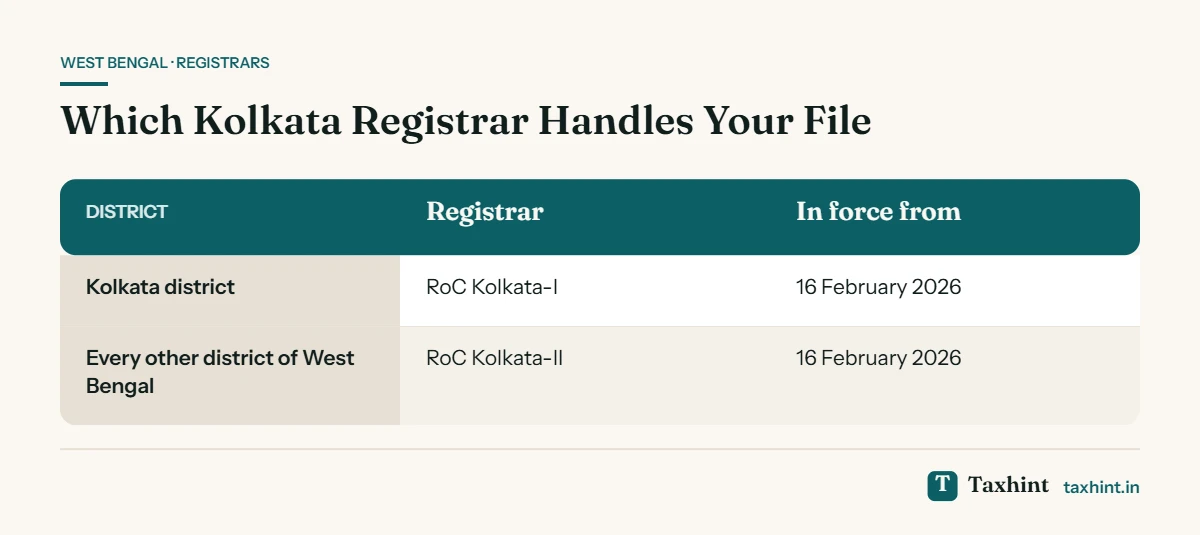
One practical effect: a registered office in Salt Lake or Howrah is a Kolkata-II file, not Kolkata-I, and moving the office between the two later is now a change of registrar. Check MCA’s Registrar of Companies page before signing a lease, and we match the district against the notification when we draft.
Stamp duty on the MoA and AoA in West Bengal
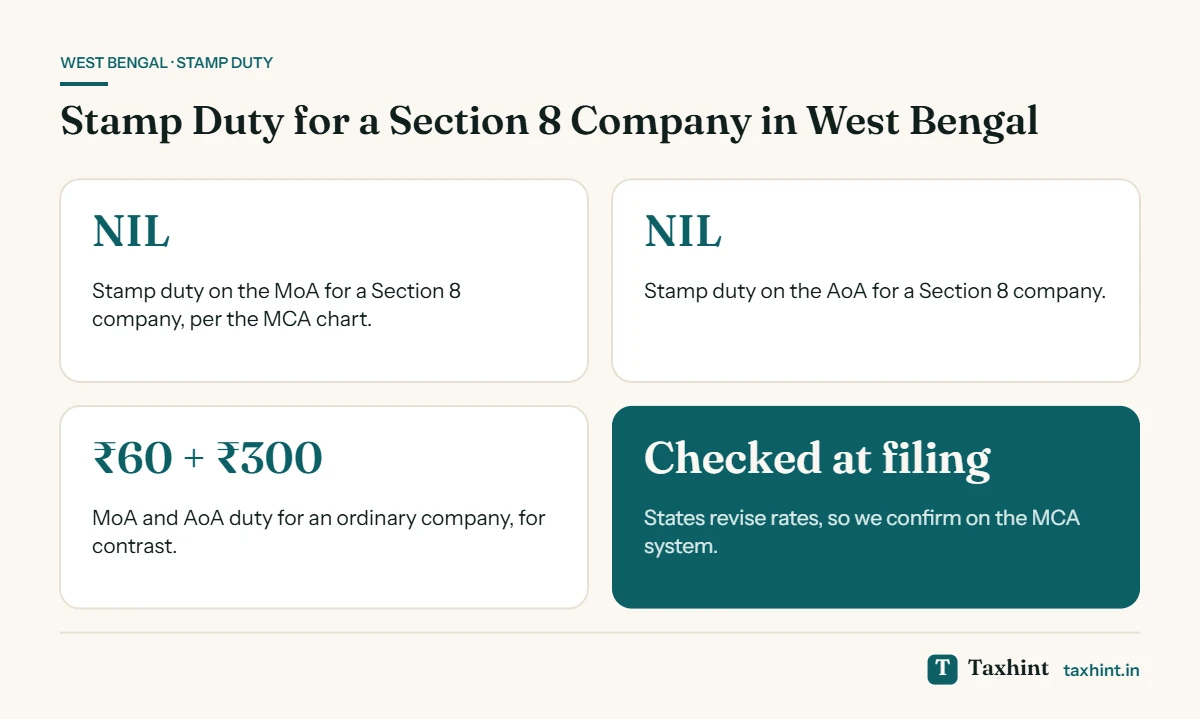
MCA’s e-stamp rate chart carries a separate row for Section 8 companies in West Bengal and shows NIL against both the MoA and the AoA. An ordinary company in the state pays ₹60 and ₹300.
The chart carries no effective date and states do revise rates, so we confirm the position on the MCA system at filing.
Stamp duty is only one government charge. Name reservation, the SPICe+ fee and DSCs are separate, and our note on the cost of microfinance company registration adds them up.
Lending in West Bengal: a crowded field
Bengal has a large state SHG programme, Anandadhara, run by the West Bengal State Rural Livelihoods Mission. In 2023 the Panchayats and Rural Development department said the state had 10.79 lakh SHGs, the highest of any state at the time, as reported by Millennium Post.
The state is also home to several of India’s largest microfinance lenders, so many households already hold more than one loan. RBI’s rule that total repayments stay within 50% of household income counts every one of them. A bureau check before each loan, and staff trained to ask about loans the borrower leaves out, are the minimum.
For a new Section 8 lender the better opening is usually depth, not reach: a few blocks where you know the households well, rather than chasing districts that other lenders already cover.
The Bengal Money-lenders Act: a check we make
West Bengal still applies the Bengal Money-lenders Act, 1940. It defines a money-lender as a person carrying on money-lending business in West Bengal and, under section 8, bars a money-lender from doing business without a licence. The text is on Indian Kanoon.
The Act has its own exclusions for banks and certain institutions. We do not assume where a Section 8 company lending under RBI’s microfinance rules falls. Before the first loan we read the Act and the current notifications against your lending model and give you a written view.
Steps for a West Bengal registered office
Fix the office and its district
The registered office must be in West Bengal, and its district now decides Kolkata-I or Kolkata-II. A trust in Siliguri can register there and lend in Jalpaiguri; the office decides the registrar and stamp duty, not where you lend.
Test the lending plan
We check the plan against the four RBI conditions before anything is filed. A gold loan or any other secured product takes the company outside the exemption, so it comes out now, not after the licence.
Name, objects and projections
Directors get DSCs, names go into SPICe+ Part A, and we draft microfinance-focused objects with a three-year income and expenditure estimate. Our document checklist shows each paper.
File SPICe+ with RoC Kolkata-I or Kolkata-II
SPICe+ carries the Section 8 licence application and incorporation together. If the registrar raises a query on the objects or the projections, we reply and resubmit.
Policies and tax registrations
The board adopts a credit policy, a pricing policy and a grievance process before the first loan. Then we apply for 12A and 80G registration.
Documents to collect
Directors and subscribers
PAN, Aadhaar, photograph and address proof for each person, a DIR-2 consent from each director and a DSC. At least two directors.
West Bengal office proof
A recent electricity bill, rent agreement or ownership paper, and an NOC from the owner. Bills older than two months cause most queries.
Licence papers
Microfinance-focused objects, a three-year income and expenditure estimate, the declarations under the Rules and, as our own habit, a draft credit policy.
Kolkata premises are often held by families or under old tenancies. Get the NOC from the person named on the electricity bill, and if the bill is in a deceased relative’s name, tell us early so we can plan the proof.
Software for West Bengal field teams
Whether your centres are in the Sundarbans or in north Bengal tea-garden villages, collections need a same-day record. Our microfinance software starts at ₹15,000 and covers JLG and group loans, centre meetings, bureau reporting and a field collection app that keeps working on weak signal. Book a demo once you know how many centres you plan to run.
What it costs
Government charges usually cover name reservation, the SPICe+ fee linked to authorised capital, any stamp duty (NIL for a Section 8 company per the chart above) and DSCs for each director. Our professional fee depends on your plan and the state of your papers, so we quote after reading your file.
Budget too for the first-year audit and for board meetings held properly. A cheap incorporation followed by a missed AOC-4 ends up costing more.
Neighbouring state pages
Bengal programmes often reach into neighbouring states. For work along the western border, read microfinance company registration in Jharkhand. Down the coast, compare Odisha. North of the Ganga, see our Bihar page. The registrar, the stamp duty and the lending law all change with the state.
Guides from our CAs
Starting from zero
Structure to first loan in how to start a microfinance company in India.
RBI rules, plainly
What the exemption and the loan rules mean day to day: RBI microfinance rules explained.
Credit bureau
Membership and reporting for small lenders: credit bureau membership for microfinance.
Frequently asked questions
Which RoC handles microfinance company registration in West Bengal?
From 16 February 2026, RoC Kolkata-I handles companies with a registered office in Kolkata district, and RoC Kolkata-II handles every other district of West Bengal. Both are in Kolkata and filing is online.
What is the stamp duty on MoA and AoA for a Section 8 company in West Bengal?
MCA’s e-stamp chart shows NIL on both for a Section 8 company in West Bengal. We confirm it at filing because rates can change.
Do I need RBI registration for a Section 8 microfinance company in West Bengal?
No, as long as it holds the Section 8 licence, lends only microfinance loans, takes no public deposits and keeps assets below ₹100 crore.
Does the Bengal Money-lenders Act apply to a Section 8 microfinance company?
The Act requires money-lenders in West Bengal to hold a licence and has its own exclusions. We check it and current notifications against your model before the first loan and tell you in writing.
Is Salt Lake under RoC Kolkata-I?
Kolkata-I covers Kolkata district only. Salt Lake (Bidhannagar) and Howrah are outside Kolkata district, so a registered office there goes to Kolkata-II. We confirm the district against the notification for each address.
How long does registration take?
There is no fixed number of days. It depends on DSCs, first-time name approval and registrar queries on the objects. Clean papers save the most time.
Ready to begin?
Planning microfinance company registration in West Bengal? Send us your lending plan and the district of your proposed office. A CA or CS will test it against the RBI conditions and tell you whether Section 8 fits before you spend on filings. Call +91 93117 95484, email [email protected], or use the form.
Microfinance company registration in other states
Uttar Pradesh · Bihar · Madhya Pradesh · Rajasthan · Delhi · Maharashtra · Odisha · Jharkhand · Haryana · Gujarat · Karnataka · Tamil Nadu · Assam · Chhattisgarh · Andhra Pradesh · Telangana · Kerala · Punjab · Uttarakhand
Questions across states? See our microfinance FAQ.